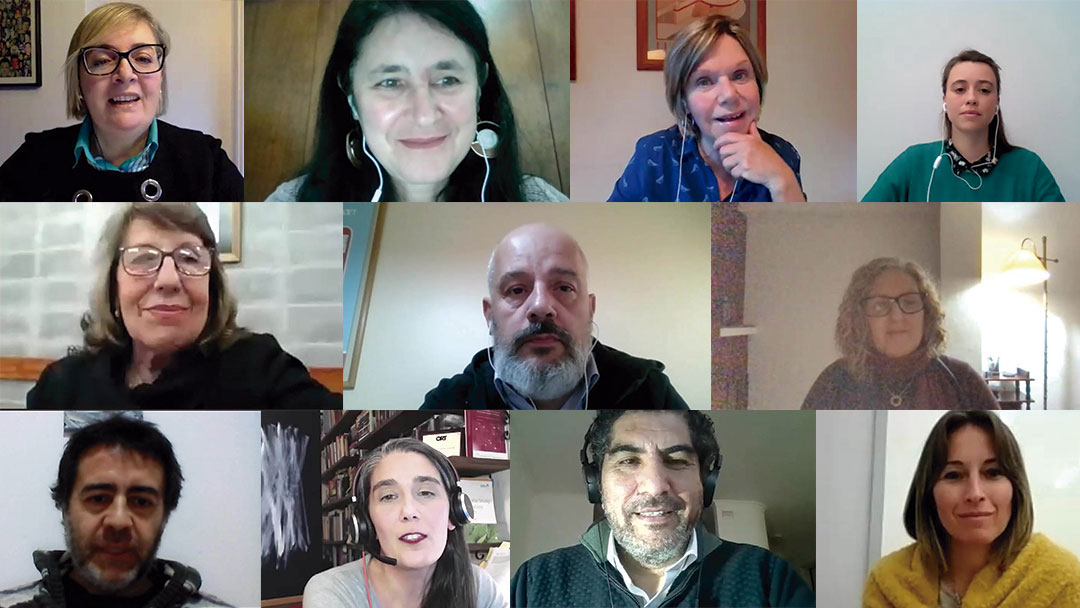
The event served to highlight the key features of the " Networks and Digital Inclusion" project: a research initiative that sought to explore how teacher training centers in Chile and Uruguay utilized digital inclusion to build communities and foster deep learning.
In addition, the event organized by the Institute of Education at Universidad ORT Uruguay sought to strengthen ties among the teacher-training institutions participating in the project.
Digital inclusion: a necessity for education
“Digital inclusion is not just an experience or a wish; today, it is a necessity for all our training centers,” said Dr. Denise Vaillant, who delivered the opening remarks at the event.
The dean of the Institute of Education emphasized the importance of the “Networks and Digital Inclusion” project in light of the current pandemic and its impact on teacher training: “It has brought to the forefront issues that, now more than ever, are on the educational agenda of our countries—issues related to digital inclusion that we have been grappling with for a long time, but which are now more relevant than ever.”
He also pointed out that the topic offers an added benefit: the opportunity to compare two educational models—the Chilean university model, on the one hand, and the Uruguayan higher education model, on the other.
“This research will undoubtedly contribute greatly to future scenarios, upcoming studies, and, above all, to decision-makers,” said Vaillant. He added, “Hopefully, it will also encourage the formation of collaborative networks among the institutions that have been involved in the project.”
What did the project entail?
The project’s principal investigator, Dr. Andrea Tejera, gave a brief presentation on the project’s key features and the phases it has gone through. The project is funded by the National Agency for Research and Innovation (ANII) and the Ceibal Foundation under the Education Sector Fund’s “Digital Inclusion” program.
The study—conducted by the Institute of Education at Universidad ORT Uruguay, in collaboration with ARS Chile—aimed to identify and characterize teacher-training institutions that use digital inclusion as a means to build communities, foster innovation, and promote deep learning.
The project—which began in 2019 and is expected to be completed in October 2021—was carried out in three main phases:
- Development of a typology: in which the centers were categorized based on how digital inclusion was used to build communities, foster innovation, and promote deep learning.
- An in-depth study of three cases from Chile and Uruguay, which differed in their use of digital technologies.
- Project validation by a panel of experts, exchange of experiences, dissemination, and promotion of the research.
At the same time, Dr. José Ignacio Porras, a consultant and co-coordinator of the project for the Chilean universities, presented some preliminary findings from the research.
The greatest differences between Chilean and Uruguayan schools were found in terms of access to technology. In contrast, the greatest similarities were found in the structure and functioning of learning communities.
However, what factors contributed to the adoption of digital technologies? Institutional support and guidance, the accumulation of skills and knowledge, as well as the pandemic context, were some of the aspects that emerged repeatedly during the research.
What about the obstacles? According to Porras, two main obstacles were identified: internet connectivity issues and internal resistance from certain groups of teachers who were skeptical of technology.
https://youtu.be/JMeGMHynXVo
A sharing of innovative experiences
During the webinar, representatives from the institutions participating in the project were also given the opportunity to present the characteristics of their institutions and share an innovative initiative. Dr. Claudia Cabrera Borges, a researcher on the project, moderated the session.
On behalf of the “Clelia Vitale D’Amico de Mendoza” Teacher Training Institute in Florida, Ms. Rosaura Alanís and Ms. Eloísa Leguísamo presented an ongoing initiative aimed at identifying and analyzing valuable digital resources for use in educational practices, particularly in science education.
The initiative, aimed atthird-year students in the Early Childhood Education program, is empowering them to take the lead in their own learning processes. Additionally, as they explained, it is fostering critical thinking and encouraging the use of a variety of digital tools and resources to work in a “collaborative and connected” manner.
“We aim to strengthen the bond between students and teachers so that they can become true partners in learning,” Leguísamo stated.
María Gloria Olano, M.A., represented the “Mtro. Julio Macedo” Teacher Training Institute in Treinta y Tres. For years, the institution has been committed to human rights education and to strengthening teacher training through the use of new technologies.
During the webinar, Olano outlined various initiatives they are currently implementing, related to interagency collaboration, teaching practices, and the use of digital platforms and tools. In his words, these are “extremely valuable” opportunities, as students can later apply these experiences and lessons to real-world situations.
“Making teaching practices more student-centered and better aligned with students’ interests helps future teachers in Uruguay develop skills in different ways of working, creating, and communicating,” he concluded.
“It really is a cause for celebration that we’re able to come together,” said Dr. Claudia Cabrera.
Speaking on behalf of the “Clemente Estable” Southern Regional Teachers’ Center was Dr. (cand.) Karina Nossar. In response to the issue they identified regarding student turnover across different educational levels—including elementary, secondary, UTU, and higher education—the center launched a project involving various institutions that focuses on environmental education.
The initiative will be implemented starting in 2022, but according to Nossar, the main anticipated outcome is its impact on inter-institutional collaboration: “It’s a rather ambitious idea, but we believe it’s very important for all the subsystems to be able to work together.”
Dr. Roberto Canales, for his part, introduced the Education, Technology, and Society Working Group at the University of Los Lagos (Chile), of which he is a member. In addition to highlighting key aspects of the university where he works, he described the working group’s main features and mentioned the major projects in which they have been involved in recent years.
As Canales pointed out, they are currently working hard on the concept of professional teaching competence, always with a focus on “teaching, pedagogy, and different learning environments.”
Finally, Dr. Marcelo Astorga—a faculty member at the Virtual Training Center of the Metropolitan University of Educational Sciences (Chile) and a member of ARS Chile—gave a presentation on the university. In particular, he provided a brief overview of its history, its academic programs, and its key distinguishing features.
He also highlighted the work of the Virtual Training Center: an organization specializing in digital technologies and initial teacher training that conducts interdisciplinary research and seeks to develop a teacher training model based on the use of interactive methodologies.
The Importance of Reflecting on Experience
“The presentations shared by our colleagues highlight the role of technology and address an aspect that sets these processes apart: reflection on practice,” said Dr. Mariela Questa Torterolo, a researcher on the project, who summarized the contributions made by representatives from teacher-training institutions in Uruguay and Chile.
Torterolo structured the presentations around the core concepts explored in the research and highlighted the “creativity on display,” particularly given the context of the pandemic. In his view, the creativity involved in this practice requires “a high degree of commitment to educational projects” and is the “foundational element of innovation processes.”
He also identified examples of deep learning—whether already achieved or still in progress—that have proven to be an “invaluable contribution to the initial training of Chilean and Uruguayan teachers.”
The researcher also found that there were mechanisms for collaboration among teachers, among students, and between teachers and students: “We hope that this meeting will also foster collaboration among the participating schools.”
“The cases presented provide us with invaluable insights for considering how to build networks between institutions and countries that benefit all participants and enhance research and learning,” concluded Questa Torterolo.
Finally, a discussion session was held among all event attendees to identify collaborative actions and future plans related to the project. In particular, the session focused on planning a collaborative effort for the project’s open webinar, which will take place on Wednesday, October 6, 2021.