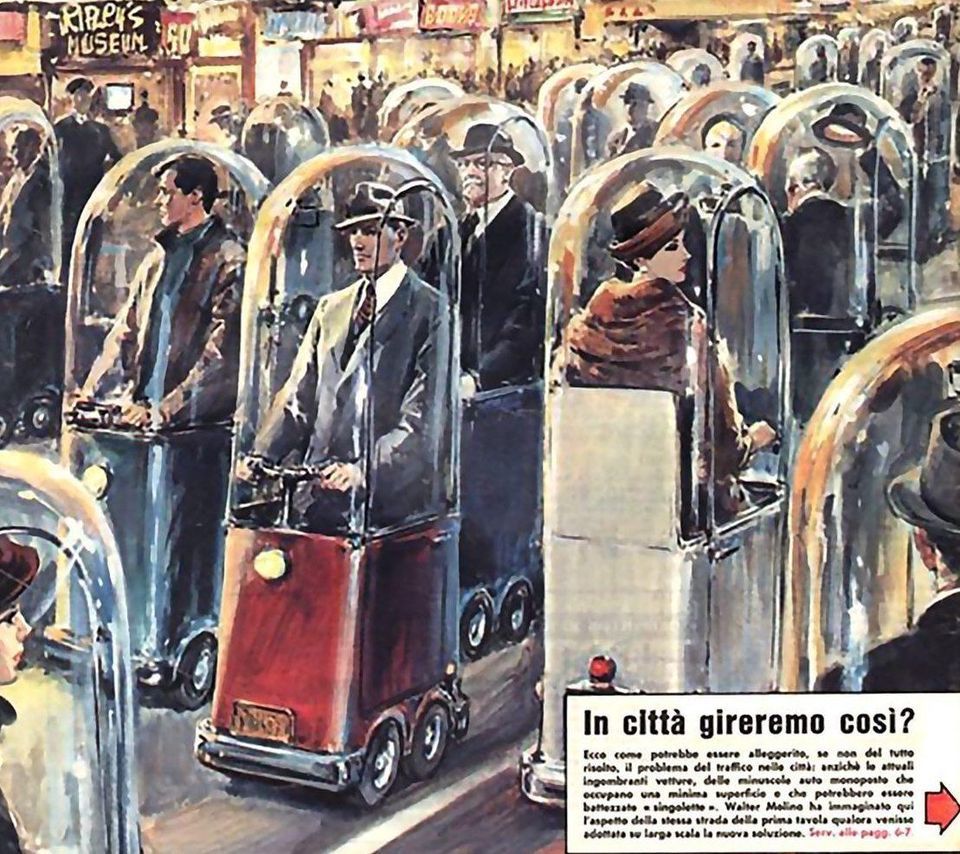
At the beginning of his talk, he mentioned something he found while cleaning his house during this quarantine: a copy of *Doménica del Corriere*, whose cover asked what life would be like in the year 2022. “There were people on the street inside a glass dome. As I laughed, it struck me as incredibly strange because in 2020 we’re doing what people in 1954 already thought we’d be doing. So we’re not as creative as we imagined. That’s why it’s so important to listen to design by leading creators.”
He said that, in the past, “research was a very simple, straightforward process”: someone would use something we found interesting—we called them a “tastemaker”—then another person—an “early adopter”—would adopt it, after which it would appear in magazines and on blogs—at that point we referred to them as “trendsetters”—and eventually, everyone on the street was using it; in other words, it became mainstream.
Things have changed; now everything is random: everyone is an influencer.
This idea led her to comment on some fashion magazine covers during the pandemic. “Everyone was talking about *Vogue Italia*, which produced an incredible cover,” she said, while also highlighting the work of the Mexican magazine *Marie Claire*.
“There’s another message here: women can no longer stay at home taking care of their children; instead, they have to go out into the streets to take care of everyone. And who’s going to take care of them? What kind of clothing should we design for people who are facing a war against an invisible enemy?” she reflected.
What drives change in fashion design, then?
- Repetitions
- Learn about
- Universe
- Differences
- Apply
- Multiverse
We used to hear the same old thing over and over again about what the trend was, but not anymore—now we’re focusing on the differences.
Observe, decode, and translate
Fashion companies are beginning to think about this new consumer, “the new normal.” For example, he mentioned that a Japanese student launched a clothing design on Kickstarter that, from the computer screen, looks like a very formal shirt, but underneath the sleeves is made of very comfortable fabrics, designed for wearing at home. In short, clothing made for remote work. The young man’s genius, he said, isn’t in the product itself (which Garcia clarified already existed) but in how to present that product to the public.
So, the important thing is to pay attention to:
- Colors
- Shapes
- Textures
- Spaces
- Links
- Times
- Art
- Technology
- Science
- Urban Planning
- Nature
So, he asked himself: What are brands and designers doing for their customers? What are they doing to help during this difficult time?
Just as an Italian magazine in 1950 imagined what 2022 would be like, he noted that for the past five years, since he began working with ORT’s Fashion team, they have been thinking about the country brand as it applies to design and have been searching for Uruguayan roots.
Carol García holds a Ph.D. in Communication and Semiotics; she is a trend scout and freelance fashion journalist. She is also a university professor and the scientific director of the consulting firm Modus Marketing and Semiotics.