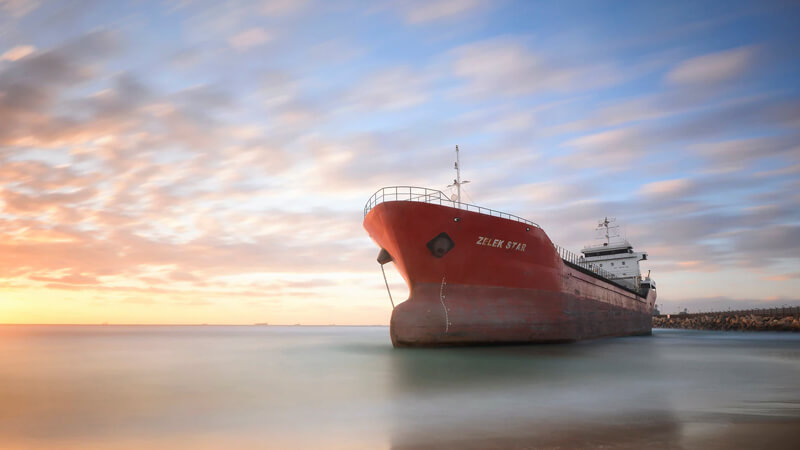
Despite the efforts being made to free the 220,000-tonne giant ship that ran aground in the middle of the Suez Canal due to adverse weather conditions, it does not appear that the situation will be resolved anytime soon.
As a result, the main maritime trade route between Europe and Asia is completely blocked. At the moment, nearly 100 ships are waiting in the area to continue on their respective routes.
Javier Maseiro, academic coordinator of Foreign Trade Analyst at Universidad ORT Uruguay professor in the Bachelor’s Degree in International Studies explains in this interview what the trade consequences might be of this ship running aground in the middle of the Suez Canal.
-
Why is the Suez Canal important for international trade? How significant is it?
It is extremely important for international trade because it is one of the main shipping routes. It is the route that carries the vast majority of trade between Asia and Europe. Currently, 12% of global maritime trade passes through the Suez Canal. These are primarily consumer goods, raw materials, and parts for production lines that are manufactured in Asia and destined for Europe. There are also hydrocarbons, which leave the Persian Gulf and head toward Europe or the United States.
To get an idea of the volume of trade that passes through there, it’s estimated that about 20,000 ships pass through each year—that is, just over 50 ships per day. In addition, it’s estimated that approximately $10 billion worth of cargo passes through each day.
-
Have there been similar cases of traffic jams on this scale in the past?
Not on this scale. Since the Suez Canal was built—more than a century ago—the only times traffic has been interrupted for several days or indefinitely were during military conflicts in the region following World War II, such as the Suez Crisis or the armed conflicts between Israel and Egypt.
Although trade through the Suez Canal was significantly disrupted for an indefinite period at that time, the volume of global trade back then was not what it is today. Countries now trade with one another much more extensively.
Not only has global trade expanded, but supply chains are also much more interconnected. Supply chains in Europe, for example, rely on components manufactured in Asia, while other supply chains depend on those products, which are then finished in Europe and shipped to other parts of the world.
I believe that, given both the current volume of international trade and the interconnectedness of global supply chains, the consequences of this blockade are far more severe than anything that might have happened in the past.
-
Is there an estimate of how much this blockade is costing?
 At this point, it is very difficult to estimate how much the blockade might end up costing, because it depends on whether it lasts a couple of days or weeks, which is the most likely scenario.
The costs will be broken down into different categories. On the one hand, there will be all the costs associated with claims and liabilities resulting from delays. On the other hand, there will be costs related purely to logistics: for example, ships that must take alternative routes or perishable cargo that has to be unloaded at a nearby port and shipped by air.
Then there will be all the costs associated with the delays that will occur on the production lines in Europe. But it is very difficult, at this point, to quantify all of that.
Some consulting firms estimate that a one-day delay in trade translates to a loss of between half a percentage point and two or three percentage points of the cargo currently in transit. If approximately $10 billion passes through the Suez Canal each day, we can easily estimate that the cost will run into the hundreds of millions of dollars per day. But these are estimates.
The reality is that the consequences of this won't be known right away, because we're going to see a domino effect throughout the global logistics chain and across several global supply chains. For example, we don't know how this might affect the automotive industry or how it might affect industries that rely on semiconductors.
There is already a global shortage of semiconductors. Asia is the leading producer of semiconductors, and we don’t know whether this situation could affect the production of electronic and technological goods in Europe. We don’t yet know what the consequences will be.
On the other hand, this isn’t a new phenomenon… In 2020, international logistics suffered a major disruption due to COVID-19 and the abrupt shifts in global demand for goods caused by the pandemic. As a result, the cost of chartering a container from Asia to the West is now extremely high. Any importer in Uruguay right now is fully aware of this and is already feeling the consequences: a container that cost $1,000 or $2,000 in December can now cost $7,000 or $8,000.
These delivery delays, caused by the blockade, will put even more pressure on and further strain a global logistics chain that was already facing challenges. This will have repercussions around the world, for example, through a potential increase in international freight rates.
Another cost that is causing concern is the rise in oil prices. Initially, when the news broke, oil prices rose sharply, but they later corrected, because the Suez Canal is also a key transit point for oil shipped from the Middle East to Europe and North America. For now, if the situation is resolved relatively quickly, energy consulting firms say that hydrocarbon stocks should not be significantly affected. However, as the situation drags on and ships are forced to take alternative routes—which would delay oil supplies—this could have cost implications for all economies.
-
While they are trying to refloat the ship, is there an alternative way to get the cargo delivered, or is one being considered?
Yes, the natural alternative is the one that was historically taken until the canal was built: sailing around Africa.
At this point, shipping companies are considering what to do with their ships: whether to wait to cross the canal, or to accept that they won’t be able to do so and deal with the two weeks it will take to sail around Africa and the additional cost of that route.
On the other hand, there are ships that haven't reached the channel yet and have suddenly decided to avoid the area.
For more sensitive goods, air freight is the alternative. If I have a shipment headed to Europe and that shipment is going to be delayed, I can arrange for the container to be unloaded at one of the previous ports of call and have it shipped by air, or send it by air before it is loaded onto the ship.
There is another factor that compounds this problem: security. The Horn of Africa, which serves as the gateway to mar , faces serious security challenges due to widespread piracy, particularly in Somalia. When an area is plagued by piracy, it adds another cause for concern and also incurs additional costs. There are already reports that some shipping companies are asking certain naval powers to increase their presence in the area to deter any kind of piracy.
-
Does this blockade have any impact on Uruguay?
 The vast majority of cargo arriving in Uruguay does not necessarily pass through the Suez Canal.
All container shipments arriving from China and Southeast Asia come directly via the Indian Ocean, pass through southern Africa, and then make stops at Brazilian ports before heading down the Río de la Plata. From that route, the large volume of traffic coming from Asia to Uruguay would not be affected.
Shipments coming from India or the Middle East could be affected, particularly those that involve a transshipment at a port in mar .
How might Uruguay be affected most immediately? First, through an increase in freight costs. Uruguay and the entire Western Hemisphere are experiencing an extremely significant rise in freight costs from Asia, due to a shortage of empty containers on that continent for shipments to the West. If an additional stress factor is added—which is what is happening in this case—and container logistics are further disrupted, it is very likely that we will suffer the consequences of higher rates. Perhaps not an increase, but the slight decline we have been seeing from January to date could also come to a halt.
On the other hand, a potential rise in oil prices could also directly affect us.
Next, we need to consider the impact all of this will have on global supply chains. It’s possible that in a couple of months, our market will face a shortage of certain products, and the root cause of that will be linked to this issue. Many electronic components are already facing production issues because the world was already experiencing a semiconductor shortage. We don’t know if this situation will exacerbate that shortage. So, there are some consequences that are still unclear to us.
I think the most immediate risk could be a potential increase in freight costs—or that they don’t go down—as well as some impact on oil prices; in a few weeks, we’ll have to see if there might be a shortage of a specific product.