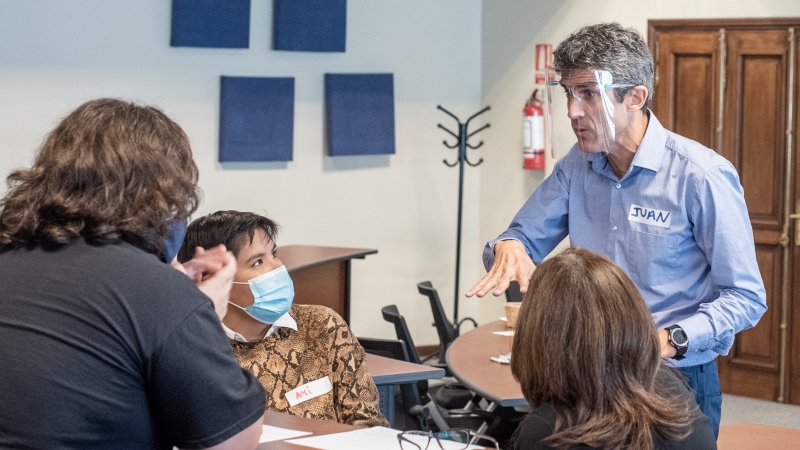
A workshop offering tools to build a leadership style that is both approachable and capable of generating tangible results within the organization. This was the focus of the event “The Power of Positive Leadership,” which took place on Thursday, March 24, 2022, at the School of Business and Social Sciences at Universidad ORT Uruguay.
The workshop—organized by the Graduate School of Business—was led by Juan Carro, M.A., a visiting professor at ORT who facilitates training programs on creativity, personal development, teamwork, leadership, decision-making, and nonviolent conflict resolution.
During the in-person event, participants discussed how to build effective organizations.
Emotions at the center
The expert noted that positive leadership involves focusing on emotions and keeping in mind that “we are highly emotional beings.”
Without a doubt, this type of leadership has extremely positive effects on the company, making it more organized and fostering better dynamics among its members. “Why is positive leadership so difficult if it brings so many benefits?” Carro wondered.
Listening to others and listening to oneself
A positive leader is someone who can bring ideas to life while taking the entire team into account. They are also someone who is mindful of their own emotional well-being and, in addition to listening to others, listens to themselves.
“It’s very difficult for me to understand other people’s emotions if I can’t understand how I feel.”
To reflect on these topics, the expert asked the workshop participants to consider the following questions: “What does positive leadership mean to me? Who is the person in a leadership role who has influenced me the most? What qualities of that person had an impact on me?”
We all want to know the “secret recipe” for successful leadership, but everyone has their own special twist on how to prepare it.
Positive leadership, while it involves taking emotions into account and placing them at the center, is not just about that. It involves translating this understanding into helping people become highly efficient and effective.
Working in small groups, the workshop participants had time to share examples of best practices they have observed both at their current workplace and at other organizations.
Among the situations and characteristics they observed, they mentioned connection, the ability to be seen while working, leaders who cared about how employees were doing emotionally, who built trust, broke down hierarchical barriers, knew how to listen, learned from mistakes, and did not punish them.
Carro emphasized that leaders’ self-care is essential. “In the mornings, be your own gardeners. Nurture yourselves as you would a plant. Take care of yourselves.” It is through this that you will have the energy to foster a positive work environment, with strong relationships among colleagues and open, meaningful communication.
A positive leader focuses on the following questions: “To what extent do our day-to-day activities within the organization fulfill us and align us with our life’s purpose? As a team, why are we here?”
It focuses on the glass being half full, not just half empty. It highlights what uplifts individuals and organizations, as well as what challenges them; what works well, as well as what goes wrong; what is life-affirming, as well as what is problematic.
Image gallery:
