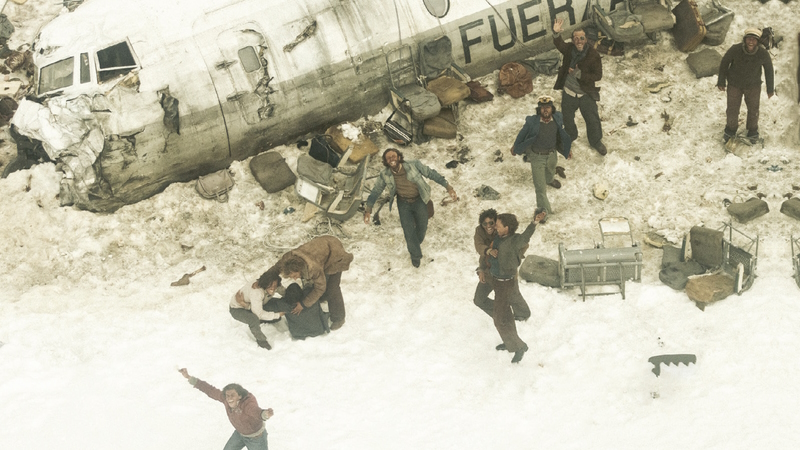
In this interview, Florencia talks about her professional experience on this film and other projects, as well as the skills she gained from her degree at ORT’s School of Communication and Design.
When and how did your career in the film industry begin?
I started out in 2008 working exclusively in advertising, until, in 2015, a colleague invited me to work as a third assistant director on an Italian film. Since then, I’ve been working in both advertising and fiction, though I’ve been focusing more on fiction.
Was it something you'd always dreamed of? What was it like to start working in that field?
When I was a little girl, I used to daydream about making movies by filming with my parents' camera, using my dolls as actors, without ever imagining that I might actually get to work in this field. It’s rewarding to be able to make a living doing what I love most and what I studied.
What previous experiences in film led you to *The Snow Society*?
Luckily, I’ve appeared in several movies and TV shows, many of them for international audiences, and thanks to that, I’ve met people from all over the world with different ways of working, which has taught me a great deal.
How did you come to join the team at La sociedad de la nieve?
In August 2021, they called me because they needed an assistant director for the final stage of the film’s casting process. The Spanish assistant director came, but since he was mostly busy organizing location scouting for the film, I was the one on set coordinating the callback sessions.
The following year, the production company contacted me to ask if I was interested in joining the directing team, and I accepted.
What was your role, and what did it involve?
My role was second assistant office manager, which is my usual position. On large projects, there is usually one assistant on set and another in the office organizing and coordinating what will happen over the next few days.
On the set of *La sociedad de la nieve* in Uruguay, there were at one point as many as four assistant directors: two on set and two in the office.
During pre-production, I had to organize the pre-shoot schedule. There were many costume and makeup fittings, actor rehearsals, as well as meetings between actors and specialists—doctors, helicopter pilots, and airplane pilots—to make the performances as believable as possible. We also organized soccer and rugby practices for the sports scenes, and we had to coordinate the cast’s appointments with nutritionists, since they were following a strict diet.
During filming, I oversaw the cast’s preparation, put together the shooting schedule for the next day (checking with the other departments to make sure all the necessary elements were in place), and sometimes lent a hand on set when there were a lot of extras or a large cast.
What was a typical workday like on the set of *The Snow Society*?
Every day was different, but we usually started very early to get the cast and extras ready. Depending on the location, there were large tents where the wardrobe, makeup, and hair departments set up their stations. We would greet the actors and direct them to the various preparation stations, making sure no time was wasted and that all the necessary steps were followed before they reached the set.
In my case, as I was the second assistant office manager, after that I would set up wherever we were setting up the office (anywhere there was a desk, a chair, and an outlet to plug in the computers) to start preparing the plan for the next day. The plan would change several times throughout the day, so I had to keep checking in with others so that, by the end of the day, it would be approved and sent out.
At the same time, I helped out with whatever was going on on set: escorting actors who were on standby, greeting actors who arrived to get ready later or to change costumes. Sometimes, survivors would visit the set or make cameo appearances, and we had to accompany them to the production office so they could be filmed.
What did it mean to you to be part of this film and to tell this story, which is so significant to Uruguayans—and now to the world?
On the one hand, I feel that it has once again been demonstrated that our industry has the technical team capable of handling a production of this scale. It was one of the largest projects I’ve ever been a part of, and that allowed us to work with many resources we don’t normally have access to.
At the same time, the film tells this story that all Uruguayans know, one that has reached us in one way or another. It was interesting to gradually discover some details I wasn’t aware of, which make the story more human. The connection with the survivors helped us bring down to earth what we had previously viewed as mythical.
How do you remember deciding to pursue a Bachelor's degree in Audiovisual Communication at ORT?
When I was a senior in high school, I went to an information session with a friend and became very interested in pursuing a bachelor’s degree in Communication, though I wasn’t sure which specialization to choose and was leaning more toward Advertising. Later, once I had started the program, I realized that what I really liked and was drawn to was the audiovisual aspect, so I ended up choosing that specialization.
Which skills you learned in college do you use today in your film work?
My degree gave me the technical tools that I later developed in the audiovisual industry. My critical eye, understanding of processes, and technical knowledge were on par with industry standards, where it’s crucial for the team to be well-trained. Then, of course, I learned a great deal through hands-on experience, and much of what I learned evolved over time, as this is an industry that advances with new technologies.
What advice would you give to an undergraduate student in Audiovisual Communication who wants to work in film?
Try to get involved in film shoots as soon as possible—whether they’re short films with friends or working as an intern on a larger project—so you can start getting a feel for the practical side of things.
A good way to get started is to send your resume to production companies or reach out to people already working in the field to gain hands-on experience—which is the hardest thing to teach in an academic setting—and that’s what helps you build the connections you need to launch a career in the audiovisual industry.