“We’ve shown a great deal of goodwill, but we can’t keep relying on stopgap solutions,” said Dr. Denise Vaillant, academic secretary of the Institute of Education.
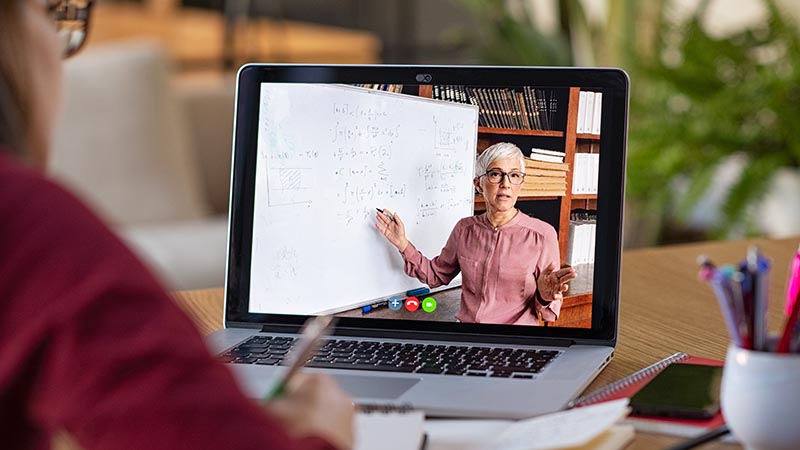
The COVID-19 pandemic posed a major challenge for teachers, from elementary school through college. Within a matter of days, they had to switch from in-person to online instruction, which sometimes made it difficult to provide a quality education.
A lack of prior preparation, insufficient teacher training, and a shortage of resources, connectivity, and accessibility were among the factors cited by Vaillant that led to “many unsatisfactory experiences.”
“Today, as we look ahead to 2021, many countries are considering and planning the reopening of schools. But distance learning will most likely continue to be part of our daily lives, at least to some extent,” he added.
In that regard, what are the challenges for next year?
“We need to go far beyond simply equipping schools with facilities and infrastructure. We have to redefine the curriculum, the roles of students and teachers, as well as the very organization of space and time,” emphasized Dr. Denise Vaillant.
If schools are unable to hold classes tomorrow, according to the academic secretary of the Institute of Education, it is essential to have a Plan B in place. Implementing a hybrid model—one that combines in-person and remote learning through various means—could be a possibility.
But that shift “isn’t as simple as it seems”: “These are systems that put students at the center of learning and involve much more than simply moving to a screen.” It requires detailed design and planning, developing learning resources, and assessing learning in a different way.
At the same time, the hybrid model does not in and of itself guarantee the development of knowledge, reflective processes, critical thinking, or active engagement on the part of students.
“Let’s stop talking about technology and school: every school is technology. The only question is which information and communication technologies we use and how to achieve the best possible education. As we free ourselves from outdated technology, teachers must transition from being mere transmitters of information to designers of learning environments, spaces, experiences, activities, and pathways,” said Dr. Mariano Fernández Enguita.
“It is the teacher’s guidance—their understanding of the contexts and realities of their students—that will enable us to create educational projects that address current needs,” Vaillant emphasized during the roundtable discussion titled “Teaching in Hybrid Contexts,” held as part of the Summer School: an initiative of Plan Ceibal, which offers training and networking opportunities to reflect on different proposals that contribute to teachers’ professional development as well as educational practices.
The event, which took place on Tuesday, February 9, 2021, online, also featured the participation of Dr. Carina Lion—professor of Education and Technology at the Faculty of Philosophy and Letters of the University of Buenos Aires and visiting professor at the Institute of Education of Universidad ORT Uruguayand Dr. Mariano Fernández Enguita—professor of Sociology at the Complutense University of Madrid. It was moderated by Dr. Martín Rebour, Training Manager at Plan Ceibal and a graduate of the Doctor of Education program at Universidad ORT Uruguay.
https://www.youtube.com/watch?v=lNGWRbFY8ww
According to Vaillant, 2020 marked a turning point: “The world that lies ahead is one of complementary strengths; a world of collaboration and exchange.”
One of the most important lessons learned was the realization that teachers alone could not tackle the enormous problems that arose.
“We need policies, training, resources, and support. But above all, we need to understand that education isn’t just the responsibility of teachers and school administrators—it’s everyone’s responsibility,” he concluded.
“If we want an inclusive, supportive, and fair education system, we need to focus on the sophistication of learning pathways, not on platforms or tools. And we must build on all the pedagogical knowledge we generated in 2020 to document our progress and continue thinking about the next steps,” said Dr. Carina Lion.