 Between bacteria that reduce intestinal inflammation and studies on environmental factors that are toxic to the body, we arrive at the intersection of biotechnology and cell biology.
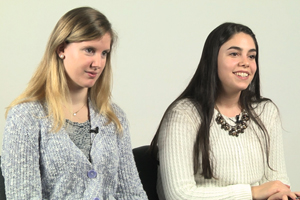
Although this corner is little known, Belén Harreguy and Giuliana Mastropietro spent eight months working on it, developing two studies that explore the collaboration between the two disciplines.
“My thesis focuses on the medical field,” explains Mastropietro, who holds a bachelor’s degree in biotechnology and developed a cellular model capable of detecting bacteria that reduce intestinal inflammation, thereby helping to manage conditions such as Crohn’s disease and chronic ulcerative colitis.
Using colon cancer cells obtained from a cell bank, Mastropietro created a cell line—that is, a group of cells that were modified to serve a specific purpose.
This particular approach makes it possible to measure the effects of various probiotic microorganisms in order to assess their capabilities and analyze how they can modulate different inflammatory diseases.
The topic came up in the Cell Biology unit at the Institut Pasteur, where Mastropietro was doing a fellowship. “I liked it because I’m really interested in medicine and the treatment of diseases,” he says. “In our country’s dairy industry, identifying these microorganisms could help incorporate them into milk, cheese, and other dairy products. That’s what happens with some yogurts, for example those labeled L. casei defensis—that’s a probiotic.”
Belén Harreguy, who also holds a degree in biotechnology, based her thesis on another cell line, the T47D-KBluc line, which is used to analyze certain compounds in water or the environment and determine whether they may be harmful to human health.
For the study, a cell line specifically designed to detect these compounds—known as endocrine disruptors because they affect the body’s hormonal system—was obtained from a cell bank in the United States.
“I used a reporter cell line that, when it detects one of these compounds in its growth environment, produces a protein that can then be measured because it emits light,” he explains. “When we see that light, we can determine how harmful it might be to humans.”
The work involved fine-tuning the technique so that the line could be used effectively; that is, determining how it grows, how it is measured, and how many compounds react to it, among other things. The work took eight months.
“This was new here, and besides, every lab needs to adapt its protocols, because the culture medium I use might not be the same as what other labs use, and that makes a huge difference,” explains Harreguy.
The compounds analyzed using this method were bisphenol, which is found in plastics and is released when plastic is heated in the microwave or in the sun; ethinyl estradiol, which is found in birth control pills; and a compound found in sunscreen, methylbenzylindan-camphor.
“We observed that the cell line did not respond to methylbenzylindane-camphor, but it did respond in the other two cases. These compounds bind to the body’s hormone receptors, which, at certain doses, can be harmful,” he summarizes. “There are 70,000 compounds believed to affect the body’s hormonal system. They haven’t all been screened yet because this is a relatively new field.”