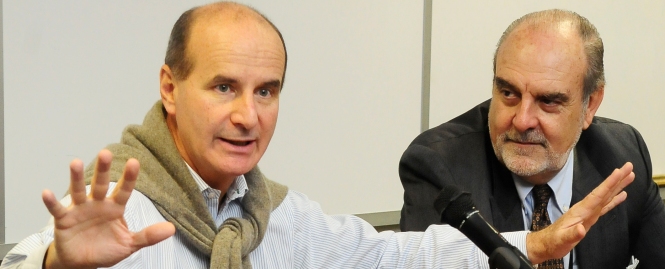
On December 7, 2012, the Faculty of Administration and Social Sciences hosted a lecture titled “A Latin American Statesman Facing the Challenges of Today and Tomorrow,” delivered by José María Figueres, former President of Costa Rica (1994–1998).
Figueres spoke to students, faculty, Universidad ORT Uruguay officials from Universidad ORT Uruguay all the guests in attendance about the challenges the world is facing and the importance of addressing climate change.
The conference, organized by the Department of International Studies, emphasized the need for special policies to prevent further natural disasters, and Figueres, who has extensive experience in this area, shared his thoughts on the matter.
Figueres was the youngest head of state in Central America’s modern history. Previously, he served as Minister of Foreign Trade and Agriculture. On the international stage, he has been a pioneer in linking sustainable development and technology. He helped establish the United Nations Working Group on Information and Communication Technologies (ICT) and founded the Costa Rica Foundation for Sustainable Development. He currently continues to work in the fields of technology and development.
As noted at the outset, there are three major challenges facing all countries: increasing productivity and the capacity for solidarity, fostering growth, and living in harmony with nature. These were the topics addressed by Figueres.
“For the 15 years leading up to 2007, we were part of a period of rapid economic growth worldwide. The United States and Europe grew, but so did Latin America,” he said, adding that this enabled many people to escape poverty. However, he predicted that it would take at least ten more years for the hardest-hit countries to emerge from the economic crisis that began in 2008.
“Decapitalization isn’t just an economic phenomenon; it’s also a social one. And it affects the most highly educated people,” he said, adding, “We’re leaving behind high levels of unemployment. In some parts of the world, we’re seeing a lost generation.”
According to the former president, the war against poverty and inequality is one that must be won. The other is the fight against climate change.
“The world has sufficient economic and technological resources to combat inequality and poverty. And while we have been successful in macroeconomic policies, we have been far less successful in microeconomic policies—in achieving a fairer and more equitable distribution of resources. As for climate change, it is probably the most significant challenge we have ever faced as a humanity,” said Figueres.
The expert offered a very clear solution to this dilemma. In his view, there is a single solution to both of these problems. He stated that poverty and environmental issues can be addressed using the same set of policies. “Moving from a development model like the one we have today to a low-carbon economy”
Before the Industrial Revolution, he said, there were approximately 280 parts per million of carbon in the atmosphere. Over the course of 200 years, he added, that figure has risen to 400 parts per million. According to him, scientists say we cannot exceed 450 parts per million if we do not want to risk temperature increases of more than two degrees Celsius.
Figueres stated that reducing these figures requires a two-pronged approach. On the one hand, a global agreement is needed—the one currently being negotiated by the United Nations. And on the other hand, “we can reduce them by turning this into a good business opportunity. By making it a good business.” “Why aren’t we doing this? Because of a lack of information and because humanity has never faced anything like this before. But also because there are many market barriers that are slowing our progress in this discussion,” he said.
He also cited the Ciudadela Building in Old Town as an example. In his view, installing central heating and double-paned windows would save a lot of money, and it is a renovation that “pays for itself.” He advocated for joint ventures involving engineering firms, banks, and insurance companies.
The former leader also advocated moving away from fossil fuels and toward renewable energy, without ruling out the use of less polluting nuclear energy during this transition. In this regard, he noted that it would be difficult for Japan to stick to its decision to shut down all its nuclear power plants.
Finally, he stated: “Small countries can be more proactive and demand more. It is much easier for us to adopt environmental policies than it is for a large country.”