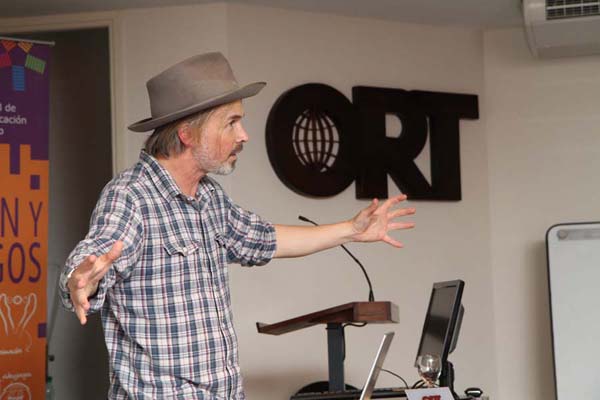
 Klubien is Danish. After earning a degree in art in Denmark, he received a Disney Scholarship. He has worked at Disney, Pixar, and DreamWorks. He contributed to the story development for films such as Pocahontas, The Lion King, Oliver & Co., The Little Mermaid, Cars, Monsters, Inc., Toy Story 2, A Bug's Life, Shrek 4and Frankenweenie, among others.
He was nominated for an Oscar for Best Screenplay: the story of *Cars* was his idea.
When did you first become interested in animation?
One Christmas, I received *The Art of Disney Animation*.
What caught your attention?
The wonderful illustrations in that book.
When you were a child, what was your favorite cartoon?
A Disney game, *Mother Goose Goes Hollywood*, featuring the iconic characters of various Hollywood stars.
What did it mean to you to be part of the team that created the Cars franchise?
I feel proud to have played a significant role in a major Disney hit. I also feel that I’ve contributed something to American pop culture, which has inspired me for so long.
What was the job you enjoyed the most?
The development of *A Bug's Life* and *Cars*, as well as creating key drawings for *Toy Story 2*, *Monsters, Inc.*, and *Frankenweenie*.
But the funniest thing that ever happened to me was when I was making my own film for Laika. For two and a half years, I had a full staff of incredibly talented people helping me bring my vision to life, until one day—a very unfortunate day—Laika decided not to finish the film. So, of course, I was heartbroken, but it was fun while it lasted.
What do you enjoy most about working on the artistic development of a film?
That I could be both a writer and an illustrator.
Which animated film do you think changed the animation industry?
Well, Steamboat Willie, Snow White, and Toy Story are the first of their kind. So is The Nightmare Before Christmas, since it was the first feature-length film made using stop-motion animation.
How did you experience the transition from 2D to 3D?
Since I'm a storyteller, the specific technique used to carry out the project isn't that important.
Can good animation save a movie that doesn't have a good story?
Only a very short film can get by without a story. A film that is purely artistic, no matter how interesting or innovative it may be, can hold the audience’s attention for only about three to five minutes.
Is working for Pixar, DreamWorks, or Disney the same thing?
Yes and no. A lot of things are the same, but every location has its own culture, and every studio head has a different approach to filmmaking.
What was it like working with John Lasseter, Tim Burton, or Andrew Stanton?
Well, since we’ve been friends since art school (CalArts), there’s a certain level of understanding and respect between us. That’s a nice thing, although I never lose sight of the film I’m working on.
Could you mention a scene in which some of your ideas are evident?
Well, in a lot of places, I suppose. Here are a few scenes I came up with that were included in the storyboard: “The Circle of Life” from *The Lion King*; “Eating the Peach,” the song from *James and the Giant Peach*; and “What’s This?” from *The Nightmare Before Christmas*. And in Cars, where Lightning McQueen gets lost and drives to Radiator Springs, as well as the scene where he helps The King Across reach the finish line. Also, Flick in A Bug’s Life, as an inventor in the courtroom scene, where he’s sentenced to leave Ant Island in search of warriors. However, in all the movies I’ve worked on, several of my ideas have been included.
Besides teaching at CalArts and now at ORT, what other projects are you working on?
I am working on my own project, funded by the Danish Film Institute.
What impression did the students here at ORT make on you?
My ORT students are a great group; they are smart and talented young people.
How do you view the international animation market?
What I see is an industry that seems to be growing steadily, becoming more international, and with more and more animated films being made around the world.
Do you think Uruguay has the potential to break into the global market?
Of course. All some of the ORT students need to do is get together, find the money somehow, and make a movie.