https://youtu.be/F12j3o8NIyQ?si=agzVlnIjFBj7o6cp
WEDO is a non-governmental organization founded in 2013 that empowers women to become active participants in the economy by fostering international networks of leaders, innovators, and entrepreneurs working toward economic development and social transformation.
Women's Leadership and Transformative Technology
For this edition, the School of Communication welcomed prominent figures from the academic, business, technology, and social sectors to discuss the impact of artificial intelligence on entrepreneurship, society, and new models of women’s leadership.

The event was opened and welcomed by Marcela Mailhos, MBA, Director of Admissions and Institutional Communications at ORT, who welcomed the audience, all the panelists, and participants to another WEDO conference, before handing the floor to Eduardo Hipogrosso, Vice Rector for Institutional Management and Development at Universidad ORT Uruguay.
It was emphasized that:
"Entrepreneurship isn't about starting a business; it's about daring to imagine what doesn't yet exist."
During the welcome remarks, it was emphasized that supporting women's entrepreneurship is a daily priority at Universidad ORT Uruguay, which supports both those who wish to lead and those who seek to create.
Voices with a Purpose: Communicating and Innovating
To kick off the day, Sabrina Bianchi, M.A., academic secretary of the School of Graduate and Continuing Education in Communication and Design, served as moderator and welcomed the panelists, who discussed the role of communication in the digital age and the media’s responsibility to represent diverse voices.
 The Federica Hananía, M.A., producer and journalist at Channel 4, he pointed out that “It is important that women’s voices be represented in the media” and that technological communication should foster talent and opportunities in Uruguay.
In turn, Andrea Melle, Managing Partner at Pindata, emphasized the need to understand the rapid advancement of AI.
For those who create digital content, understanding technology is essential to designing accessible and inclusive experiences.
He also pointed out the internal barriers that still exist regarding the use of new tools and technologies, and how training can help overcome them.
In addition, Rosario Velasco, commissioner of the Caritas Food Bank of the State of Mexico and ambassador for WEDO Mexico, explained how her personal experience with training in these new technologies enabled her to learn how to use them and go beyond that, allowing her to feel a sense of fulfillment with the results she has seen.
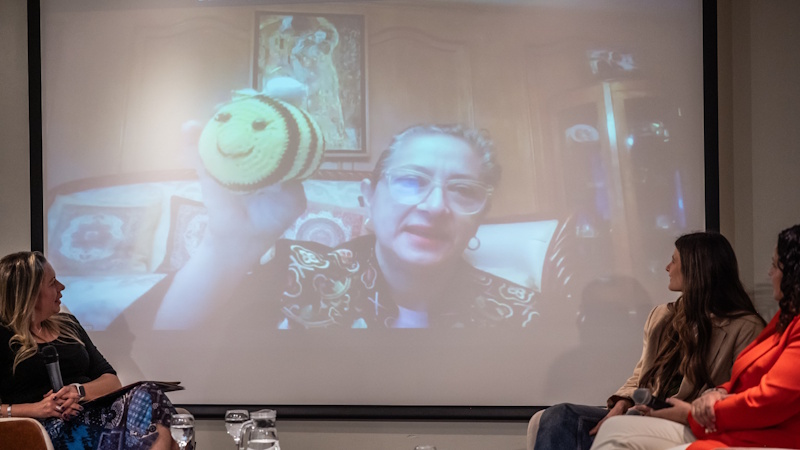
Another panelist, Renata Flangini, co-founder of Ciphia and a student pursuing a bachelor’s degree in Information Systems at ORT, shared how her personal experience led her to become an entrepreneur in the tech industry.
He stated that "the most vulnerable element of organizations is people."
That is why he created an AI-based cybersecurity platform designed to protect organizations; since more than 60% of cyberattacks stem from human error, Ciphia takes an innovative approach, helping to prevent incidents before they cause damage.
The panel concluded with a message of optimism:
The future for women in technology looks promising. We can’t just go to sleep dreaming about it—we have to make it a reality.
The speakers agreed on the importance of research, curiosity, staying up to date, and assertive communication as key skills for women entrepreneurs.
“Learning how to learn must be our guiding principle,” they said.
Leading Change: From Idea to Impact
The second panel, also moderated by Sabrina Bianchi, M.A., featured Dr. Teresa Cometto, dean of the School of Business and Social Sciences, who highlighted the challenges of today’s job market.
He argued that"40% of skills will need to be reinvented."
 Cometto pointed out that the leadership contemporary demands to inspire, motivate, guide and understand that success is collaborative, based on the teamwork.
For her part, Mariana Píriz, President and CEO of WPP Media and President of BURSON, discussed the role of AI in the industry, noting that this technology has been present and actively used by companies for over a decade.
He introduced the concept of industrial creativity, noting that, although creativity stems from human experience and arises from insights and needs that only the human mind can understand, AI allows us to amplify those ideas and expand their reach.
Thus, human creativity is enhanced by AI's ability to organize concepts and reach new audiences.
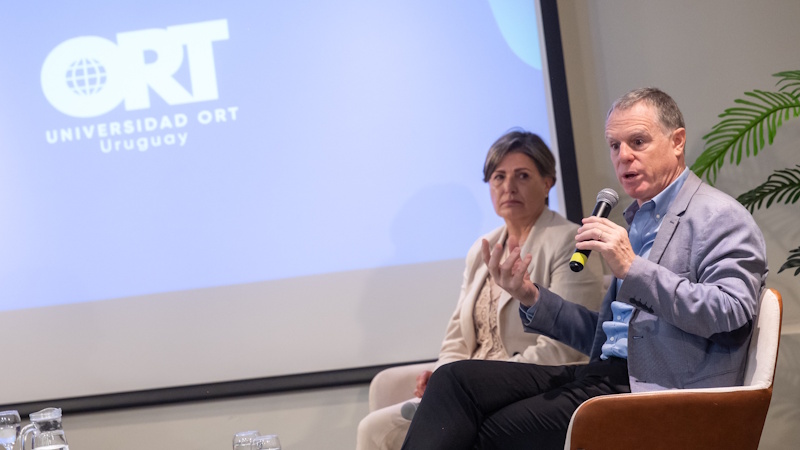
Also in attendance was Enrique Topolansky, MBA, director of the Center for Innovation and Entrepreneurship (CIE), who discussed how AI is transforming workflows and processes.
He pointed out that today an idea or a startup can be developed much faster than before. What used to take a year now takes two months.
He reiterated that creativity and innovation will continue to be the key differentiators for entrepreneurs, inviting us to reflect on how we use the time that technology frees up for us.
With the speed and automation of AI, where are we going to spend our time?
It also presented Arena Emprendedora, a CIE women’s entrepreneurship project that brings together more than 30 women from different regions of the country to receive training and develop community-based initiatives.
"You can feel the energy and optimism in this environment of women's entrepreneurship."
This program helps women entrepreneurs gain the confidence to navigate uncertain situations, make decisions, work as a team, and explore their creative limits.
At the same time, it aims to integrate them into Arena’s entrepreneurial community, where the women entrepreneurs themselves take the lead and collaborate with one another to bring their projects to fruition.
In this role, the CIE provides digital tools and innovative solutions that you can apply directly to your business.
A closing ceremony focused on equal opportunity
Panelist Mariana Piriz closed the panel on leadership by reflecting on the progress made and the challenges remaining in the area of equality.
The event concluded with a call to move beyond gender categories in the professional sphere.
Let's stop talking about gender; we're all workers and deserve the same opportunities.
She noted that the wage gap remains a critical issue for women in the workplace and emphasized that “wages aren’t what we deserve; they’re what we negotiate.”
End of the day
The event concluded with remarks of gratitude from Dr. Cristina Bertolotto, WEDO’s ambassador in Uruguay.
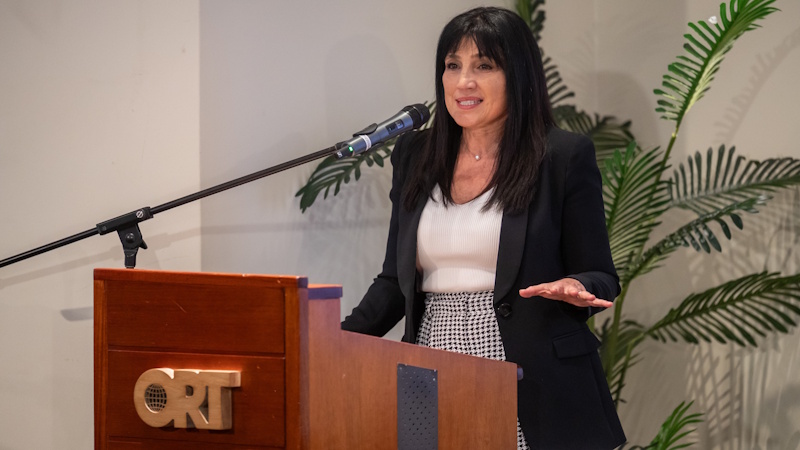
Her moving and powerful message paid special tribute to Wendy Diamond, executive director and founder of Women’s Entrepreneurship Day (WEDO), as well as to Universidad ORT Uruguay once again opening its doors to this organization, which empowers women to become entrepreneurs and innovators in an increasingly technological world.
The challenge moving forward is to build an ecosystem in which technology and equal opportunity go hand in hand, so that more women can become key players in the future they envision.
The 2025 edition of WEDO Uruguay once again demonstrated that when knowledge, innovation, and diversity come together, the impact is multiplied.
Universidad ORT Uruguay its commitment to continuing to create opportunities where women can lead, innovate, and transform their realities.