On March 17, 1992, the Israeli Embassy in Argentina was the target of a terrorist attack. On July 18, 1994, the bombing of the Argentine Israelite Mutual Association (AMIA) took place. On January 27, 2013, the Argentina-Iran Memorandum of Understanding was signed, which, according to Argentine Congressman Waldo Wolff, constituted the third attack in Argentina, since “a pact was signed allowing the perpetrator of the attack to investigate itself.” The fourth, according to Wolff, took place on Saturday, January 17, 2015, with the death of prosecutor Alberto Nisman.
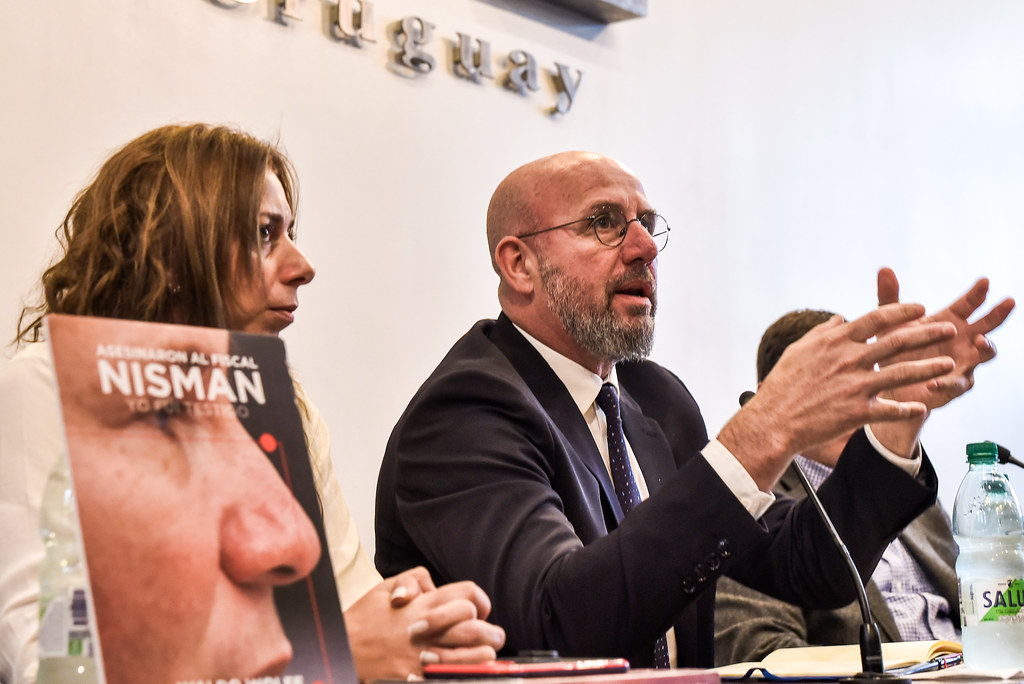
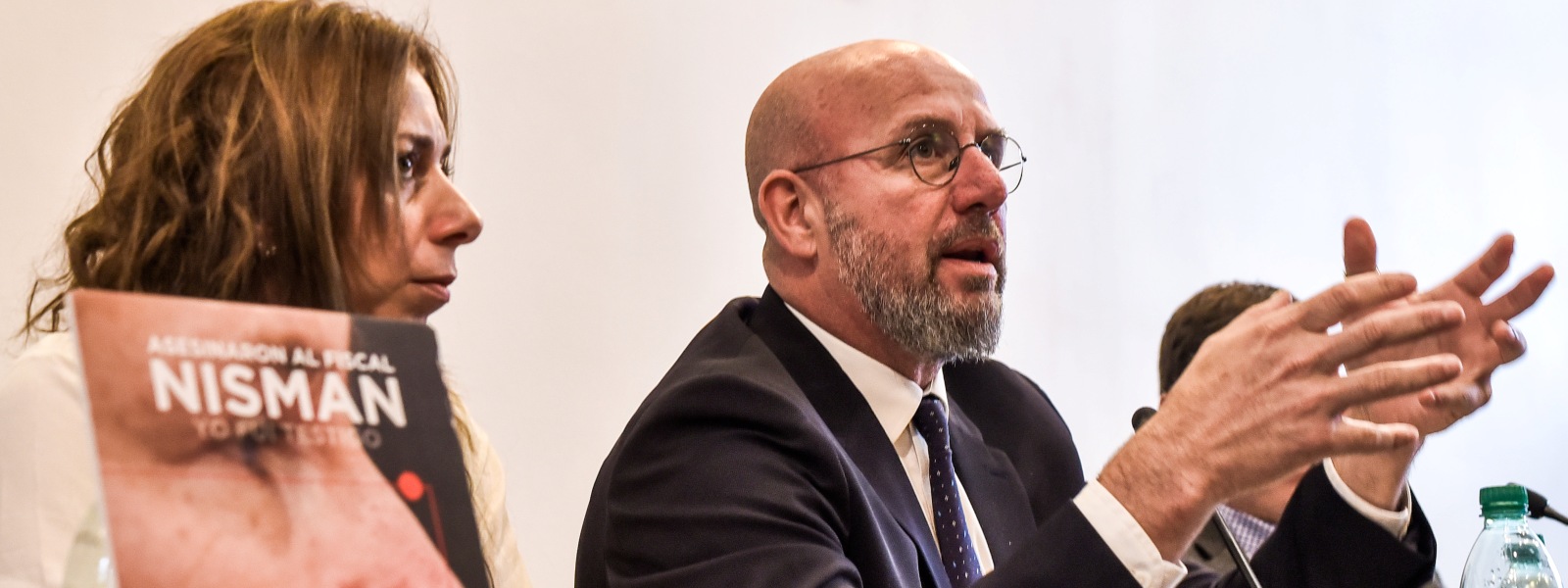
The book launch for *They Murdered Prosecutor Nisman: I Was a Witness* took place at the Pocitos Campus of Universidad ORT Uruguay. The event was held on Tuesday, April 23, 2019, and was organized by the Department of International Studies.
Wolff—who is a co-author of the book and has served as vice president of the Sociedad Hebraica Argentina, president of the Argentine Federation of Maccabi Community Centers, vice president of the Latin American Maccabi Confederation, and vice president of the Delegation of Argentine Jewish Associations—spoke alongside Delia Sisro —co-author of the research, holder of a Bachelor’s degree in Social Communication Sciences, and professor at the Faculty of Social Sciences at the University of Buenos Aires (UBA)— and Martín Natalevich —ORT professor and editor of the political section of the newspaper El Observador—.
A period portrait
Natalevich described the book as“an indictment, a factual account, a portrait of the times, and an act of remembrance and resilience.” Through facts and evidence, the book reveals “the suicide that never was and the homicide that actually occurred” and “explains how the prosecutor went against the government’s interests.”
“They Murdered Prosecutor Nisman: I Was a Witness has the unique quality of being several books in one. It is a precise criminal investigation and, at the same time, a summary of one of the darkest chapters in recent Argentine history. It is an investigation with journalistic elements and a personal account,” said Natalevich.
The government's responsibility
“Why aren’t the attacks in Argentina solved quickly?” Wolff asked, noting that while attacks are common around the world today, in most countries the perpetrators are usually identified within a short period of time.
The congressman emphasized that, particularly in Nisman’s case, he was “the person who should have been under the closest protection in Argentina.” In his view, this failure to act is directly linked to the government’s responsibility.
“Prosecutor Nisman filed a complaint in accordance with the law. It is normal for a prosecutor to file a complaint in any democratic country in the world. In any country in the world, one can even file a complaint against the president,” he said.
“Back then, we witnessed how the political powers of the time began to target Prosecutor Nisman—the very institution of the prosecutor’s office. They spread lies, published images of his private life in the media, and meddled in his family life,” Wolff said.
Wolff and Sisro’s book traces historical events such as the start of the investigation into the AMIA bombing in 1994; Nisman’s appointment as prosecutor in the AMIA case in 1997; the death of former President Néstor Kirchner in 2010 and the subsequent shift in stance toward Iran; and, finally, January 28, 2018, when the prosecutor was found dead in his apartment.
On that day, Wolff said, Nisman’s ex-partner was in Europe. She asked them to wait until she returned to Argentina before performing the autopsy. However, the autopsy was conducted without any experts representing her, and no family members were allowed to be present.
“The official voice in a republic is the voice of justice. And the Argentine justice system—based on a prosecutor’s indictment, a judge’s ruling, and a panel’s confirmation of that ruling—concludes that Prosecutor Nisman was murdered. This book, rather than taking a stance, clarifies institutional positions, ”Wolff said.
The Calling to Tell Stories
Sisro served as literary consultant for *They Murdered Prosecutor Nisman. I Was a Witness*. Regarding the choice of title, he noted that “a murder has no preamble or metaphors.”
The book came about because of“a calling to tell the story.” Contrary to what was said, the complaint filed by the prosecutor “was consistent.” Following Nisman’s death, there was a clear divide between “those who were accomplices and those who were not.”
“Words can heal the wounds we carry as a society,” Sisro said, adding, “When we write, we put our lives on the line, we get our hands dirty, but we’ve done something real.”
Full lecture:
https://youtu.be/RTV2Ri1ZsHU?si=eSPtRmF_kfiCBOMw
Image gallery: