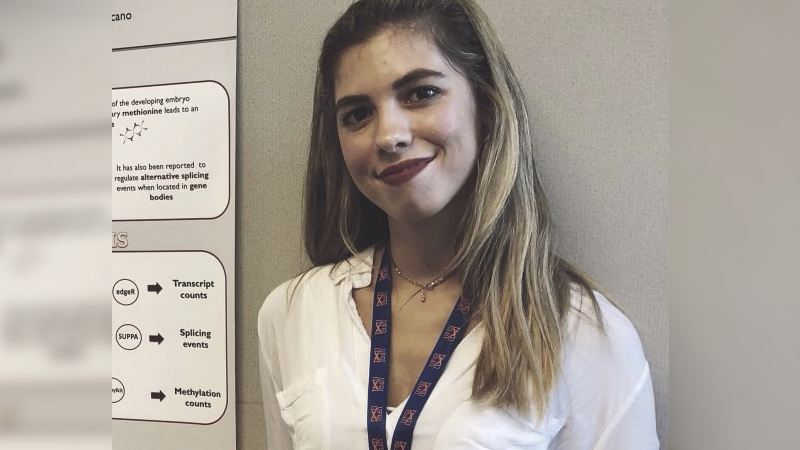
Rocío Amorín de Hegedüs was part of the second cohort of the Bachelor’s Degree in Biotechnology at Universidad ORT Uruguay in Universidad ORT Uruguay. When she began her studies, there were no graduates yet and everything was new.
In 2016, shortly after graduating, she joined the Bioinformatics Unit at the Pasteur Institute in Montevideo for an internship. It was then that her supervisor told her about a professor who was looking for students to pursue a master’s degree at the University of Florida (United States): “At that time, I was looking for opportunities to study abroad, so I met with the professor and everything fell into place,” recalls Amorín.
It wasn't long before the recent graduate set off for the United States to continue her education and pursue her career.
Today, four years later, Amorín is still a member of the University of Florida. There, he continues his research and is pursuing a Ph.D. in Genetics and Genomics.
“I’d like to help ensure that women—or anyone from any minority group—can find their place in science.”
-
Finding a home away from home
Moving to a new country is always a culture shock. For Amorín, however, the process was gradual and smooth: “It didn’t happen all at once; rather, as I adapted to a new place and educational system, my experiences and perspectives broadened, which made the process very manageable,” she explains.
Still, he does acknowledge that the biggest challenges were on a personal level: being far from his family and friends, and building a new life for himself. It’s true that these were the hardest challenges he faced, but they were nonetheless enriching experiences that allowed him to grow a great deal.
What happened on the professional front? Amorín felt confident, and she often talks about this with friends and acquaintances who are eager to venture out into the world. “In Uruguay, we receive a very good education that allows us to explore the world with confidence,” she says.
According to the biotechnology graduate, Uruguayans receive a well-rounded education that isn’t overly specialized, and while this can sometimes be a drawback, it can also be an advantage. Furthermore, she believes that having worked while pursuing their degrees is a plus that many Uruguayans have, but which is uncommon among Americans or Europeans.
-
A contribution that stands the test of time
When Amorín began her bachelor’s degree in biotechnology at ORT, there were no graduates from the program yet. As part of the program’s second graduating class, she says that she and her classmates and professors were instrumental in shaping many aspects of the curriculum and practical training. “I have very fond memories of my time at ORT,” she says.
During his time as a college student, Amorín was introduced to bioinformatics, a field he later pursued professionally and with which he remains involved today. “If I hadn’t studied at ORT, I don’t know if I would have discovered it,” he says.
In her day-to-day work as a scientist, she draws on much of the knowledge she gained during her bachelor’s degree in biotechnology at ORT. Of these skills, programming is the one she uses most often. On this point, she reflects: “We learned to program in Python. If I didn’t have that foundation, many things would be extremely difficult for me today.”
-
The Role of Women in Science
The role of women in science is a matter of great importance to Amorín, and she has a clear and forceful stance on the issue: “Women have always played a significant role in science. The problem is that they haven’t always been given the credit they deserve, and that is something that is slowly beginning to change,” she says.
Although the path for women in science remains challenging, the biotechnology graduate believes that improvements are gradually becoming apparent. “I feel that we are at a turning point, and while full equality has not yet been achieved in the world of science, we are gradually moving toward it, ”she says.
On the other hand, the ORT graduate also believes that while women have always wanted to pursue science, it is only now that this field is beginning to open its doors to them: “When we were girls, we were encouraged to be afraid of subjects like math or physics. I feel that doesn’t happen anymore and that there is less and less discouragement,” she explains.
Geographical location, the scientific field, and even the institution to which one belongs are also key factors for women who choose to pursue a career in science, according to Amorín. On this point, she comments:“In Uruguay, there are many women working in science. In fact, in my class—during my degree program at ORT—most of us were women, and there were also many women at the Institut Pasteur in Montevideo. I think we’re more advanced than in other countries around the world.”
-
A future with more opportunities for everyone
Planning isn’t really her thing. Amorín prefers to stay open to opportunities: “Four years ago, I was enjoying an internship at the Institut Pasteur in Montevideo, and today I’m doing the job I’ve always dreamed of and conducting research in the field I love most. I never would have imagined it,” she says.
However, she is clear about one thing regarding her future: the mark she would like to leave through her work has nothing to do with a major scientific achievement, but rather with helping to make science a more equitable field. “I would like to contribute so that women—or any member of any minority group—can have their place in science,” she says.
He also dreams of a more decentralized scientific community. In this regard, he explains that he would like the voices being heard to come not only from those working in the United States or Europe, but for everyone—regardless of their background—to have the opportunity to share what they do and be heard on an equal footing.