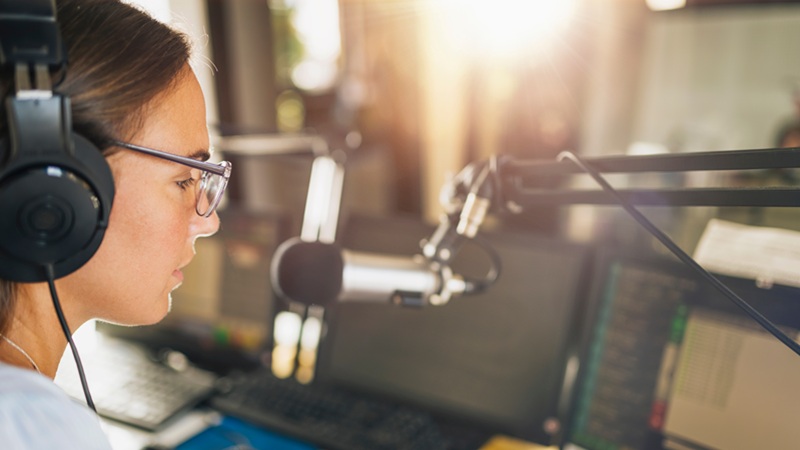
Every February 13, this date is commemorated, inviting us to recognize the historical and contemporary impact of radio on the development of the public sphere.
This is a medium whose uniqueness lies in its auditory nature: it dispenses with images and relies exclusively on words, music, and sound effects to convey meaning.
In that world, the voice takes center stage.
Over time, radio has undergone technological transformations and shifts in listening habits, incorporating new digital platforms and formats.
Nevertheless, it retains its ability to inform, engage, and establish a direct connection with audiences.
What does it mean to be a radio announcer?
A voice-over artist is a professional trained to use their voice as a communication tool in audio media.
Their task goes beyond simply reading texts: it involves understanding the content, interpreting it, and adapting it to the context and the target audience.
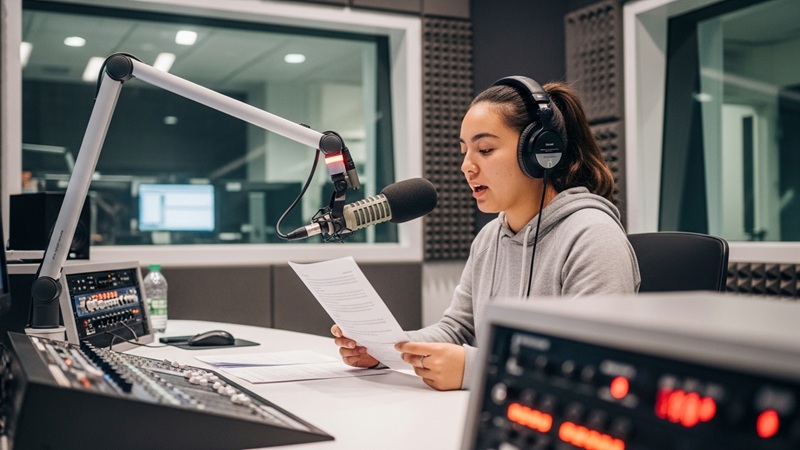
In the field of radio, you can work as a programmes host, present news segments, read the news, or produce advertising spots.
In addition, its scope of work extends to institutional productions, audiovisual content, and digital formats.
The professional practice of broadcasting requires technical expertise, sound judgment in communication, and a sense of responsibility for the message being conveyed.
The voice as a working tool
Using your voice as a professional tool requires understanding its capabilities and limitations.
Factors such as breathing, diction, intonation, and pacing directly affect the clarity and effectiveness of speech.
The proper use of pauses, intonation, and volume helps prioritize information and hold the audience’s attention. In this sense, naturalness does not come from improvisation, but rather from systematic and deliberate practice.
View this post on Instagram
Core Skills in Voice-Over
Education and Continuing Education
Professionalism sets you apart. Studying voice-over or communication provides you with the theoretical and practical tools to improve your performance in front of the microphone. Regular vocal training helps build endurance and prevent burnout.
Interpretive ability
Every text has a communicative purpose. Reading for information requires a different style than that of a persuasive or narrative message. The speaker must identify that purpose and convey it in a coherent and credible manner.
Active listening and communication skills
Carefully listening to various radio and audio formats is a valuable learning tool. Analyzing styles, structures, and discursive strategies helps broaden one’s professional repertoire and strengthen one’s communication skills.
Adaptability to the digital environment
Media convergence has expanded the scope of the profession. Today, voice-over work is featured in podcasts, online broadcasts, and digital content. Understanding these dynamics is now part of a professional’s skill set.
Beyond the voice
While vocal tone may be a distinctive trait, professional practice is not limited to that quality alone. Credibility, accuracy, and a sense of responsibility in communication are built through training and experience.
The announcer acts as a mediator between the message and the audience. Their role influences how the information is interpreted and received.
A constantly evolving profession
In observance of World Radio Day, it is worth highlighting the enduring relevance of broadcasting as a discipline. Although the mediums may change, the need to communicate clearly and effectively remains.
Radio continues to reinvent itself, and with it, the role of the broadcaster. Training, technical skills, and the ability to adapt are becoming the cornerstones of professional practice in a dynamic and ever-changing media landscape.
Learn about the Bachelor's Degree in Journalism and Content Creation