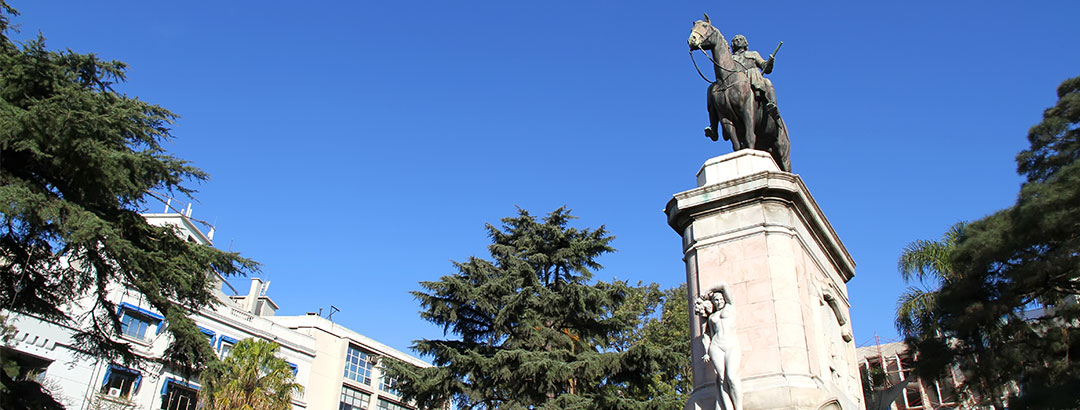
For several weeks now, Plaza Zabala—one of the oldest and most iconic public spaces in Montevideo’s Old City—has been at the center of controversy and protests over the installation of new street furniture along the ring road that surrounds it.
During the first week of May, the Montevideo City Government began a renovation project on Durango Boulevard, which circles Plaza Zabala. The project involves closing one lane of the road and adding new benches and planters, as well as repairing sidewalks, repainting, maintenance, and providing irrigation for one year.
The initiative is part of a master plan by the Montevideo City Government called “Ciudad Vieja a Escala Humana” (Old City on a Human Scale). Its goal is to reduce car use within the neighborhood and to transform former vehicle lanes into pedestrian walkways.
The start of the project coincided with a time when residents of Ciudad Vieja had organized to file several complaints about the poor condition of the facilities and the lack of municipal initiatives to preserve the plaza, which is a National Historic Monument. This prompted an immediate reaction and the formation of the group “Friends of Plaza Zabala,” which has since spoken out on multiple occasions to protest the city government’s actions regarding this urban space.
The impact on assets
It is important to highlight the historical and urban significance of Plaza Zabala in the city’s founding and development. This space was inaugurated in 1890 and was designed by the French architect, landscape architect, and botanist Édouard André. In colonial times, the site of the plaza was occupied by the fort of the walled city, which served as the governor’s residence and the viceroy’s temporary home when he traveled to Montevideo. Inside the fort was the Parade Ground, where the celebrations marking the proclamation of Kings Charles IV and Ferdinand VII took place. In late 1978, during the dictatorship of Colonel Lorenzo Latorre, the fort was demolished and a public square was built in honor of Zabala.
One of the main concerns of the neighborhood association and the community at large is the heritage value of the square, which has been a National Historic Monument since 1975. On May 15, the National Cultural Heritage Commission issued a statement in which it affirmed that it had been consulted by the Montevideo City Government’s Public Parks Department and had rejected the municipal agency’s proposals.
“The Department of Public Parks of the Montevideo City Government shared with the CPCN a series of proposals for the development and paving of this unique space, none of which were approved. The Heritage Commission reaffirmed the idea that any project in the area occupied by the first colonial building, constructed in what later became Montevideo, should serve as a means of commemorating that significant event.”
The statement concludes by noting that the seating areas located around the perimeter of the square were not authorized by the Heritage Commission.
Residents and friends of Zabala Square speak out in its defense
Residents state that on other occasions, the city government’s actions regarding the Old City have been appropriate and responsive to the neighborhood’s needs, but that this has not been the case here. They complain that the installed street furniture does not interact with the plaza or the surrounding buildings. They also state that the budget should have been invested in improvements to the plaza, which is currently in a state of serious disrepair, and that in recent years, the green areas have been maintained by residents in the face of the city government’s silence.
Since May 24, residents have submitted a petition to Christian Di Candia, Mayor of Montevideo, calling for a halt to the project. As of today, the petition has been signed by 6,475 people and continues to grow. In addition, they released a letter through the media calling on the Urban Development Department to halt the project and hold a meeting to find a solution to the problem.
Architect Silvana Pissano, Director of Urban Development for the Municipality of Montevideo, responded to the request for a meeting from the Ciudad Vieja neighborhood association with a letter in which the agency commits to conducting a qualitative and quantitative assessment of the rest areas within eight to nine months, during which time residents are invited to evaluate the plaza. This is a very long time to wait to assess the urban consequences of the project, which has already caused traffic problems for ambulances and other vehicles.
The necessary steps
In a new statement issued on June 3, the Association of Friends of Plaza Zabala reiterated the measures it considers necessary for the proper functioning of the plaza:
- The immediate removal of the furniture from the Durango Beltway, as, regardless of its design, it clashes with the plaza, which is the quintessential gathering place.
- A new evaluation of the project by the Heritage Commission, since the previous one was not conducted correctly or clearly.
- Relocation of the furniture to various open spaces in the Old City that serve as potential gathering places, where the pieces can play a leading role for citizens.
The association took the opportunity to convey to the agency several points that could contribute to the proper maintenance and upkeep of the square, such as:
- Installation of new benches in the square, based on the original design, to restore the total number of benches to 25 and repair those already in place.
- Restoration of the streetlights.
- Maintenance and restoration of the green spaces.
- Reinstatement of the position of a permanent, on-site park attendant.
- Maintenance of the children’s play area and fitness area.
- Restoration and repair of the Monument to Marshal Bruno Mauricio de Zabala.
- Renovation of the plaza and restoration of the drinking fountains from the original project.
We are awaiting a response from the relevant government agencies to hear their reactions to these views.
The university and the square
The School of Architecture at Universidad ORT Uruguay closely monitored the renovation process of the plaza and the actions taken by both parties—residents and the municipal government—regarding the site’s development. It is essential that any work undertaken in heritage spaces be guided by the preservation of the city’s historical and collective memory.
Furthermore, any urban plan or project is based on the idea that citizens are the city’s main stakeholders, which is why an exchange of views between the Friends of Plaza Zabala and the Montevideo City Government is necessary. The goal is to ensure genuine and timely participation by users in the decisions made regarding the space.
In university classrooms, students are taught that the street is the quintessential public space and that public squares are the first democratic spaces; therefore, government agencies must take action to improve the city and uphold these principles.