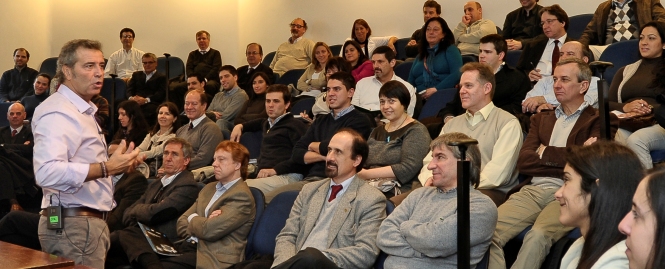
Norbert Monfort, a professor at ESADE Business School—one of Europe’s top business schools—and a visiting professor in programme Management Development (PMD) at the Faculty of Administration and Social Sciences at Universidad ORT Uruguay, explained how to lead groups to foster optimal work environments. The lecture took place on Friday, August 16, 2013, at ORT Pocitos, before a packed auditorium.
“Our responsibility as managers is to create the right conditions so that people can give their all,” Monfrot pointed out, adding that while the environment can facilitate effective task performance, it is up to managers to manage that environment.
Monfort, a psychologist with master’s degrees in human resources and organizational development, and co-founder and managing partner of the consulting firmCookie Box, highlighted the three main generations currently working in organizations. The Boomer generation, who, due to their age, generally hold positions of greater responsibility. They were raised in a culture of hard work. Next comes “Generation X,” who go to work because “they have to make a living.” And finally, the youngest generation: “Generation Y,” who fundamentally just want to have fun.
“Give them opportunities to learn from their mistakes,” Monfort said of “Generation Y.” In his view, unlike the Boomers, these young people are used to always having another chance. That’s why we need to teach them through play and allow room for error. “We must be cat herders. Cats always come when they want to,” just like “Generation Y.” “Loyalty isn’t in their DNA. These people want to adapt based on the challenges. They want to be happy with what they do.”
On the other hand, Monfort pointed out that companies rely on a single measure of success for everything—except when it comes to managing people. “When it comes to hiring, they go in blindly, without a method. But when it comes to managing people, there is a method.”
The professor then showed the audience a clip from *The Fantastic Four*, who possess the superpowers necessary for a good manager. On the one hand, they have flexibility, which is necessary to adapt to what people ask for. They also have determination and passion, to manage everyone. And finally, the most essential superpower according to Monfort: invisibility, which implies humility and the ability to delegate. “We’re going to step back so people can work autonomously. Management must be based on trust. And we Boomers weren’t raised to trust.”
“What does it mean to lead?” he asked himself. Leading is “getting others to act.” “I don’t have to do it myself. I have to get others to do it. I set the direction, but they’re the ones who do the work,” he said, adding that companies should allow their employees to grow in their areas of technical expertise so that people who don’t like managing others can also thrive.
Monfort mentioned a different professional profile: the “tecnager,” a hybrid of technician and manager. “People need to know that you’re not the best at something, but that you know about it.” However, when it comes down to it, he prefers the manager, since it is this role that will inspire enthusiasm. “The technician knows what he’s doing, but he’s the one who’s going to do it.”
He then showed a video in which Riccardo Muti, the former music director ofLa Scalaopera house in Milan, was receiving an award. In the video, Muti outlined the key qualities a good manager must possess. First, storytelling—the ability to tell stories. “Let’s tell stories, explain things, and convey emotions to people,” he explains.
A sense of humor is also important. Furthermore, no company can guarantee success by being too serious. Finally, humility. “Self-centeredness ruins everything. Let your people take center stage,” says Monfort. “Let’s forget the idea that managers need to be served. Managers are there to serve.”
“Disappearing” is the key word, according to the professor. “Above all, let’s break away from the paradigms that have led me to success but that, if I keep using them, no longer serve me.”
Finally, he spoke about high-performance teams, which must have three key elements. The first is, quite simply, their level of performance, which is far superior to that of other teams. “They’re paid more and perform better,” he says. Next comes autonomy. The manager’s role is to maintain cohesion, not to issue orders. Finally, stability: “I can’t build a high-performance team with constant turnover.”
He showed several videos to illustrate these examples. One of them was from the U-20 World Cup match in which Uruguay eliminated Spain. Juan Verzeri, the head coach of that Uruguayan team, happened to be in the auditorium. Monfort invited him to the front so the audience could applaud him and even asked to take a photo with him.