This initiative aims to recognize, from an academic perspective, those individuals and projects that, through their leadership, creativity, innovative spirit, and professionalism, stand out in the creative industries within fields related to technology, education, or entrepreneurship, leaving a lasting impact and inspiring new generations.
https://www.youtube.com/watch?v=6xwrKQcezaM
As it has done every year since 2019, the School of Communication and Design at Universidad ORT Uruguay its Awards for Creativity and Innovation, recognizing the contributions of professionals whose work has helped advance both their professional field and Uruguayan society.
The event was hosted by journalist Christian Font, took place at the Audiovisual Hub, and was streamed on the Faculty of Communication and Design’s YouTube channel.
"Last year, at the time of the 2021 awards, we were still somewhat uncertain about when the post-pandemic era would arrive and what lessons these years of semi-isolation would leave us with. Today we are pretending to live a life without COVID, even though we know that the threat of a new wave will be with us for quite some time," said Eduardo Hipogrosso, dean of the faculty, who added:
"Over the past two years, humanity has shown that when faced with a global threat, it is capable of working together to tackle the problem, and that everyone—no matter where they are or what resources they have at their disposal—will be able to bring about change in order to survive. Our ability to adapt to this new normal has led to changes in habits that entail transformations at every level. Some of these people will even seize this opportunity to grow, because beyond solving problems, they see a horizon of possibilities for improvement, and they have the attitude and courage to set out to discover those new horizons. They are the ones who see the glass as half full."
Awards 2022
-
Luis Ara
For his creativity, commitment to the national film and television industry, and international vision.
"I am very proud and deeply honored to receive this award. I would like to thank ORT University and the School of Communication and Design, as well as the committee that selected me for this award. I see that there are many friends and acquaintances from long ago.
The other day, at a forum, I was asked what I thought might be the best path for Uruguay’s future development, and I said that we had to invest heavily in creativity, because I understand that innovation arises from creativity—which is precisely what allows us to do things differently. To set ourselves apart from the rest.
And to the extent that one sets oneself apart from the rest, one gains independence and becomes indispensable to others because one is doing something that others likely aren’t doing. Those two things—both creativity and innovation—have a lot to do with education."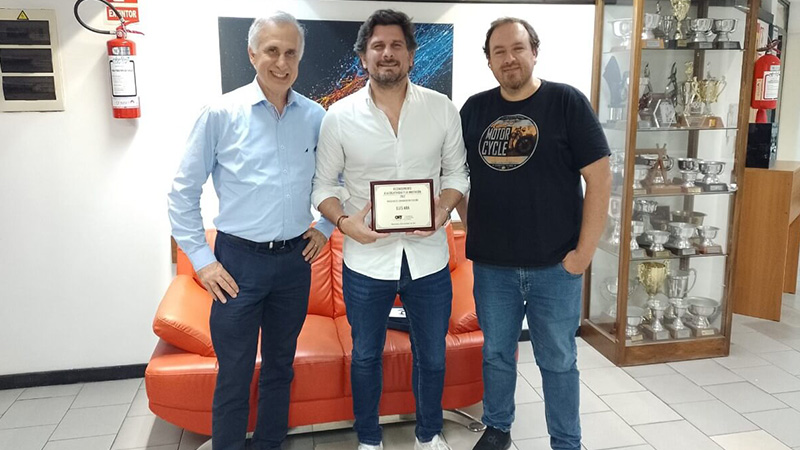
His background in the cultural and creative industries and in entrepreneurship runs in the family. His grandfather set up a film distribution company in our country, and as a child, he would accompany him, watching and critiquing the content. As a teenager, he was already working in movie theaters, delivering supplies and managing the audience.
After Study Business Management and Administration at Universidad ORT Uruguay, he went his own way, but a few years later, life brought him back to the world of film and television. His first film took him nearly two years to make and celebrates its 10th anniversary in 2022. It was inspired by the story of his mother, Cecilia, who had to undergo a heart transplant. The film was titled 12 hours and 2 minutes, the time that passes from when Juan, the protagonist, receives the news that he has a donor until the operation. It is a message of hope conveyed by people who were given a second chance at life.
This was followed by stories about life, sports, geography, and culture, and today he has a dozen projects to his credit—as a director, screenwriter, and producer—through his two ventures: Ska Films and Movie Trailers, which he co-directs with Ignacio Jaunsolo. Beyond his artistic creativity, he had a unique vision for the film business, managing not only to screen his content in theaters but also to earn the trust of HBO, Amazon, and Netflix. This year, it made headlines after developing the Netflix's first production in Uruguay, Togo, which brought performances from the Palermo neighborhood to 190 countries and more than 221 million viewers. -
Lía Cambre and Agustina Zuasnábar
For his enduring creative and innovative spirit.
Zuasnábar:
“Thank you very much, Universidad ORT Uruguay, for this recognition. Over the past 12 years at Wasabi, we’ve placed a strong emphasis on co-creating and fostering spaces for innovation and creativity. And this has truly been a team effort. Today, more than half of the people at Wasabi are graduates of this university, and we are very grateful for that—for all the support you’ve given us over the years and for the talented people you’ve helped shape (...)”.
Bend:
“I wanted to say three things: First, I want to thank my mother and my grandfather, who taught me the value of hard work and entrepreneurship. The second is: thank you to ORT, because we aren’t from ORT, and this is an even greater honor, because, obviously, when you come from other universities, for ORT to recognize you and have supported you throughout the entire process—in fact, we applied to ANII thanks to ORT, and thanks to ORT we won the innovation award—so the truth is that it’s a university that opened its doors to us from a very young age. We are very grateful to Eduardo and to everyone.
Finally: for us, regardless of the fact that we are in the world of metaverse (...), beyond the technologies we work with, innovation and creativity for us have a lot to do with championing our profession and making advertising transparent—a legacy we’d like to leave behind. Beyond technology and all the people who work with us—who strive precisely for that—in a world where things sometimes appear to be one thing when they’re not, especially today, we’d like to leave this as our legacy. Thank you very much."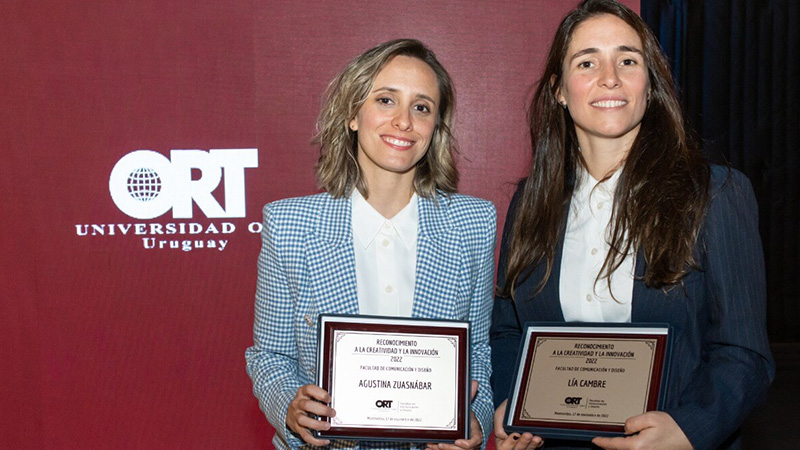
One of them had been talking about brands, campaigns, and advertising since she was a child, right at home. Under the guidance of her mother, an advertising professional with extensive experience, she began working at her mother’s agency at age 14. While studying communications, she held various roles in the industry and later joined a travel agency, where she created Uruguay’s first digital magazine. There she discovered digital advertising and decided to start her own business, creating her own agency. She holds a Bachelor’s degree in Communication with a focus on digital commerce.
Her partner also studied communication, digital marketing, and people management, and today her focus is on developing high-performance teams and workplace culture, with the goal of being at the forefront of how to lead a digital company.
Her purpose is“to create a positive impact on people’s work lives.” has Diploma in Digital Marketing from the Digital Marketing Institute in Ireland and a Digital Marketing Certificate from New York University. She also has a Diploma in Ontological Coaching from SbS and is an Associate Member of the UK.
Both received training from the Google Ads program in Silicon Valley, in partnership with Singularity University. They believe that a very powerful effect can be achieved with very little. That defines wasabi, a Japanese condiment, and Wasabi, their agency dedicated to advertising and digital marketing with offices in Uruguay and Spain.
Wasabi stands out for its strategy, creativity, technology, and a constant quest to stay at the forefront of changes and the advertising revolution in the digital age. Wasabi Digital is the first Uruguayan agency based in the metaverse: Wasabiland. This year, they acquired land in the Spanish metaverse Uttopion and are building a virtual space similar to their physical office in Montevideo. -
Guillermo Varela
For his commitment to the digital industry, his vision, passion, and leadership.
“Thanks to the university, which I consider partly my home, so I don’t want to go on too long with my thanks because it would sound like a family member praising the family [laughter].
As I listened to you, Eduardo, I found myself thinking back to my own student days (which were a long time ago), and the world you’re describing now is a much better one than the one the dean would have described back then.
When I graduated from high school, the main political debate in Uruguay was whether or not private universities were a good idea. Back when I was in high school, private universities hadn’t been authorized yet. And my fellow activists in high school would paint banners against globalization, spending their time writing “No to globalization” as if one could possibly oppose the law of gravity.
I’m sharing this to provide some context—to show how it defines different periods and eras. The context we’re living in now, in a digitalized, post-pandemic world, is a much better one. It’s dynamic; it allows anyone—as Eduardo mentioned—to work from here to there, from there to here, from here to here, from there to there… the possibilities are endless, and there are countless new fields. in our sector we have full employment in almost all categories of our companies, and, at the national level, a need to inspire the rest of society to move toward a Uruguay driven by knowledge, to leverage ourselves as a society through education and knowledge, since the world hadn’t stood still for many centuries and left us all on equal footing.
What happened during the pandemic was that the world came to a standstill. We had hoped for a fresh start, and that hope remains; I believe it is within our power and our ability to build a better world. Students entering the workforce, college, and academia now will have tools that I didn’t have—search engines, access to tutorials, access to master’s programs (…). Therefore, it’s reasonable to suspect that the professionals coming up will be much better than we were.
“So, with that promise, with that invitation, I want to express my gratitude for the affection that this recognition means to those of us who are clearing the brush (…). Happiness to those who believe in the things to come, because they help build them.”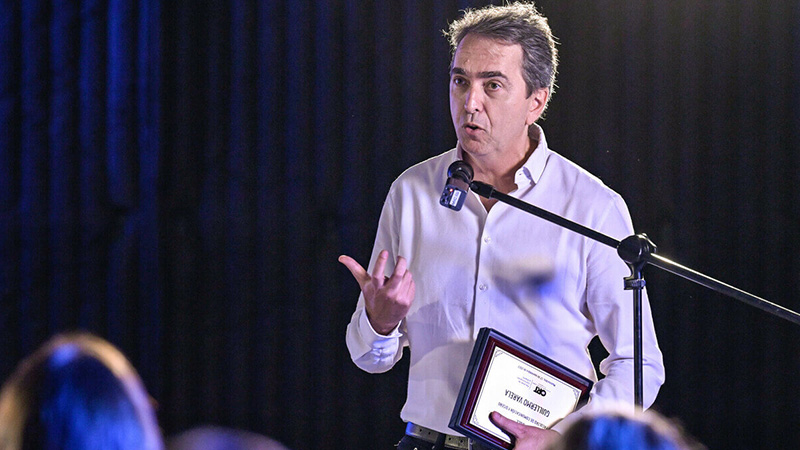
As a teenager, he saved up his pocket money to buy Jules Verne books and read them over and over again, trying to see beyond the surface. He was a pioneer in launching business ventures in the digital world. He laughs when he sees that people consider him a veteran of the industry, where he’s been for over 15 years: “Where have you ever seen a 15-year veteran?” he says. He believes we’re all novices, since everything has changed so quickly, and that forces us to tackle a dual task: learning and building, simultaneously.
That is how he began—by starting companies and taking on challenges to drive the changes he believes we Uruguayans need. He believes people fall into two categories: those who envision and create a future, and those who wait for things to fall into place and for the path to be laid out for them. And true to that philosophy, he has consistently been part of the first group.
He is currently the director of Plexus Uruguay and Mexico—a company focused on digital financial transactions that works with brands such as Visa, MasterCard, and American Express—founder of Handsoft—a provider of communication and technology solutions—and gOOva —where they develop dozens of apps for major companies that require user experiences sophisticated and robust—
He dedicates his time and takes risks to build a collaborative ecosystem in Uruguay, which is why he has been a member of the country’s most important business networks and is currently the president of the Uruguayan Chamber of Digital Economy. -
Maggie Ferber
For her responsible attitude, entrepreneurial spirit, contribution to the fashion industry, and commitment to the sector and its development.
“I am incredibly proud that we were considered for this award. I know I’m the one accepting it, but it’s on behalf of the entire team at Vopero—precisely to keep driving innovation, keep generating new ideas, and bringing design to the forefront of the Vopero experience and everywhere else, because breaking down barriers isn’t something you do alone, but with a team (...).
This is something that started as a dream and as an extra room; although we always had that vision of making it huge (...), we always envisioned it with that impact, with that magnitude that we are fortunately seeing today in the world.
So, once again: it is a source of pride, it is an honor, and I hope that my presence here leaves you with (...) that little spark of belief that an idea, a dream, can indeed be realized, and that we are here to demonstrate that with a lot of hard work behind it, we can get there. And let’s keep growing together.
A big thank you also to several of the ORT teachers, who have opened their doors to the three of us, to their classes, to inspire, to spread the joy, to do what we love to do, which is to showcase and open the doors of Vopero (...), thank you very much.”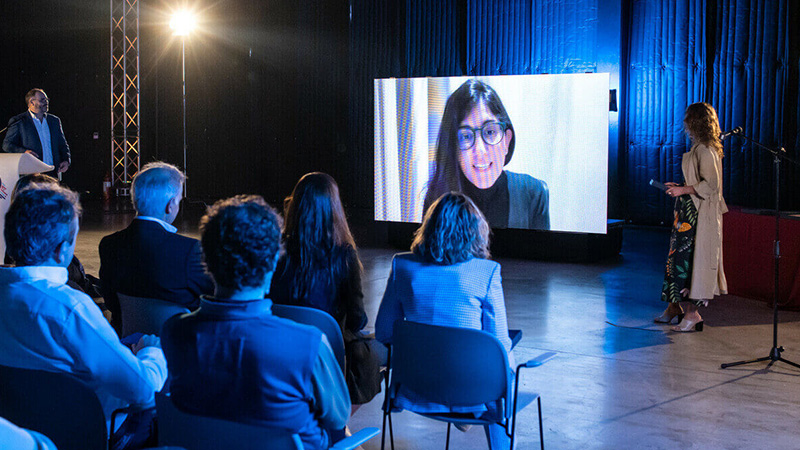
After studying and living in Miami for a decade, specializing in branding, and helping many entrepreneurs bring their ideas to life, here are some trends in the North American and European fashion industry helped helped her see an opportunity and a personal need: to pour all her energy into her own venture.
This is how she created a business model that seeks to transcend, which she defines as a “movement that generates movement.” With this spirit, Vopero was born—the Uruguayan startup that aims to revolutionize the circular fashion industry in Uruguay and transform the relationship with clothing in Latin America, starting from the world of second-hand goods.
Aware that we can achieve less on our own than when we find good allies, he shared his inspiration with like-minded partners to amplify the impact they sought: they had to work to make their mark across the entire continent.
And so they have grown; they started with three people a couple of years ago, and today there are nearly 200 people behind a mission: to inspire a new generation to consume more consciously and sustainably.
Their commitment extends not only to entrepreneurship and sustainability but also to educating a public that, at the start of their project, was not yet ready to understand that this business model reduces the carbon footprint and helps democratize fashion, making it more accessible. As a result, garments that do not pass their quality control are donated to various institutions. -
Giselle Della Mea
For their social commitment, ability to inspire others, and vision for taking design to a new level of action
“Thank you so much—that really moved me. For me, ORT is the cradle of entrepreneurs. Without a doubt, coming from a small town, being a student from the countryside, and receiving all the tools ORT provides—moving from theory to practice—what it left me with was a significant sense of empowerment. Being able to say, ‘With what I’m studying, I can start a business; I can create a value proposition,’ I realize that it was my cradle, where I took my first steps as an entrepreneur.
Over time, I expanded my understanding of what design means for this emerging world that Eduardo spoke of: the new generations, in addition to being immersed in new technologies and well-informed, also live in an increasingly uncertain world, where resources are finite, climate change is a reality, and there is fear of pandemics…
In fact, many call them the “crystal generation.” Why? Because they demand a higher level of transparency, but also because they demand to work toward a purpose. They don’t just pursue financial gain; they also pursue a legacy, seeking to solve social and environmental problems.
And for me, that is fundamental: putting creativity and innovation at the center to see how we—who are privileged to study at ORT and other universities—can begin to solve the global challenges the world faces today. I am very grateful to our dean, to Sabrina, and to the entire committee, but especially to ORT for having that entrepreneurial spirit and that spirit—which it instills in all of us who pass through its doors—of innovation, creativity, and design, of being at the forefront, from Uruguay to the world.
So thank you very much; I am very grateful for this recognition. And thank you to my family, who puts up with me for wanting to change the world.”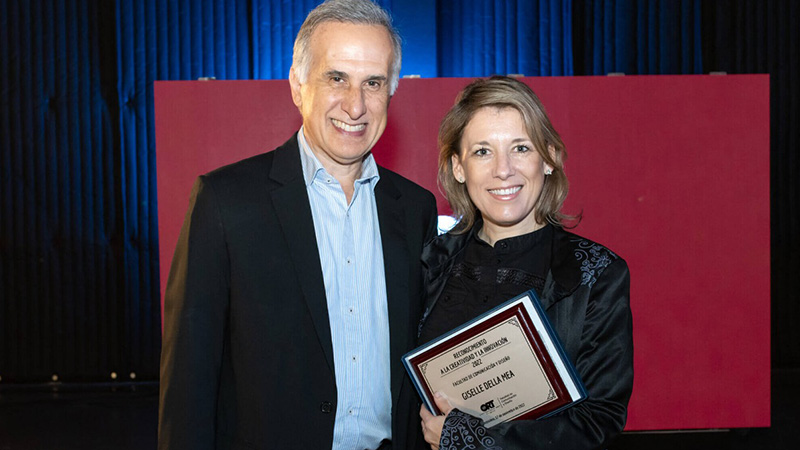
She was born in Dolores, and there’s a story that captures her spirit. One Thursday at 2:00 p.m., a hunch made her return to her hometown. The next day, a tornado struck Dolores and destroyed 40% of the town. Amid the shock and rubble, she founded “Reconstruyamos Dolores,” bringing together business leaders and volunteers to form an NGO that raised $800,000 to support the reconstruction effort.
has a degree in design from Universidad ORT Uruguay she also teaches—and has Master’s has in Business Design from Domus Academy in Milan. Drawing on this background, she applied the design thinking to inspire through action: driving cultural change and process transformation in organizations, communities, and businesses.
She was selected by The Economist such as “Changemakers”—those agents of change who have the potential to become influential figures in the coming decades.
It was in that spirit that he founded 3Vectors (Uruguay's first Company B), a circular and sustainable design agency. She is a co-founder of Innodriven, a firm specializing in design thinking and emerging economies, as well as the founder of the Sistema B Movement in Uruguay, "the best companies for the world."
She describes herself as “restless, visual, and experimental—convinced that design can change the world.” Convinced that “success shouldn’t be measured by how much money I made, but by how much impact I had on society,” she is also the founding curator of the World Economic Forum’s Global Shapers Community – Montevideo Hub; a licensee of TEDxPuntadelEste; director for Argentina and Uruguay of the Design Thinkers Group network, founded in the Netherlands; and co-author of the book Business Model You; contributor to the Spanish edition of *Business Model Generation*, and a member of the "Marca País" group at Uruguay XXI and the Uruguayan Ministry of Tourism. She has co-led campaigns and events focused on sustainability and social innovation and has won several national and international design competitions. -
Álvaro Zunini
For their social commitment, ability to inspire others, and vision for taking design to a new level of action
"Thank you so much for this recognition. To be honest, it really moves me, and I have nothing but words of gratitude for all of you. Truly, my two stints at this university—both as a student and as a professor—have left me with very cherished and positive memories."
Whenever I think back on my time as a student—probably the period when I learned the most—I immediately think of leaving my hometown of Salto when I was 17, a drastic step that surely presents the same challenge for most students who move from the countryside to the capital: on the one hand, dealing with academic demands and making the most of opportunities, and on the other, coping with the nostalgia of being away from family, friends, and the comfort of everything familiar.
Looking back now, I can confirm that if we don’t step outside the box in which we were raised, we’ll hardly ever fully grasp just how vast the world is—and how important that step is as we set out on our journey.
I really can’t attribute this recognition to merit, but rather to luck. To the good fortune of having had parents who allowed me to attend college, of having had an exceptional faculty that managed to motivate and inspire me; to the professional connections fostered by the Alumni Department, which, in turn, led to other key connections in my professional journey that later took me to other countries; to my friends, and now, when one is immersed in the whirlwind of work and still trying to find time to make art or independent films, I am fortunate to have my wife Laura, and my children Luciana and Pablo, who are very patient with me and give me the inspiration and love necessary to keep pursuing my dreams.
“Thank you very much, everyone.”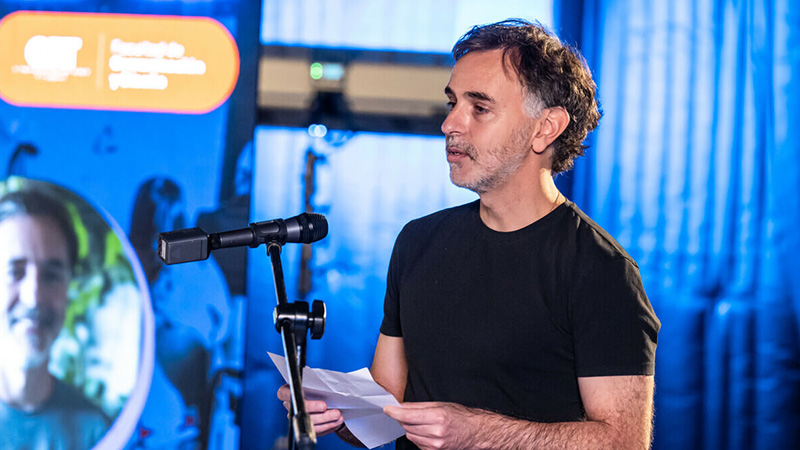
He began his artistic training as a child in Daniel Amaral’s studio. At age 18, he moved to the capital and began training as an artist in a painting studio and as graphic designer at Universidad ORT Uruguay, among the first generation of artists in what was, at the time, a groundbreaking field. He also traveled to the Dominican Republic to continue his studies in design. His creations quickly began to gain recognition. In 1995, he was awarded the National Comics Prize, and in 1996, the President’s Prize at the 6th Salto Spring Biennial.
In 2000, he moved to Buenos Aires to work as an art director in the advertising industry. Shortly thereafter, he traveled to Mexico City, where he continued to pursue his career as an art director. There, in 2006, he was awarded the National Young Artist Award and was selected to participate in two painting biennials at the Rufino Tamayo Museum, in 2004 and 2008.
His work in Mexico has been exhibited in museums and galleries in Mexico City, Oaxaca, Sinaloa, Querétaro, San Luis Potosí, Tlaxcala, Coahuila, and Aguascalientes. In 2005, he also exhibited in Uruguay, at the Italian Cultural Society in Salto and in the Montevideo subway. He has participated in contemporary art fairs in Miami, Madrid, and Caracas. His work as a designer has been recognized at international competitions in Argentina, Mexico, France, the United States, and the United Kingdom.
In 2021, he won the 8th Illustration Award, organized by the Ministry of Education and Culture. This November, he will be in Seoul to participate in the 37th Korean International Design and Illustration Competition and present his work, "Mural of Connected Universes," which is part of an animated short film project he has been developing independently for many years. In this project, he serves as director, screenwriter, and illustrator, but he is also dedicated to raising funds to complete it. He continues to work for Mexico, but thanks to the pandemic and remote work, we have him back home. -
Ximena Aleman
For his perseverance, ambition, entrepreneurial spirit, and for showcasing Uruguayan talent on the international stage.
“I wanted to start by thanking ORT, but I want to thank ORT not only for this award, but also for the trust they placed in me. The trust they placed in me—not just now, with this award, but more than 15 years ago, when I applied for the academic excellence scholarship, a scholarship they awarded me that allowed me to work and pay for my studies. And from that point on, for continuing to trust me. Thank you so much for that.
Second, I want to thank my family. My husband, Rodrigo; my mother, Estela; my sisters, Victoria and Miranda; my mother-in-law, Ana; my children… one receives the awards alone, but achieves them as a team. So thank you so much, because behind every call, every hour of overtime, every business trip, they are there. Thank you for your support and for the encouragement you give me every day.
Thirdly, I want to tell you something. In the Prometeo office, we have a framed quote by Roberto Juarroz, an Argentine poet, that reads: “The world is a naked call.” That phrase reminds us, every day, that the world calls on us to constantly build it. That is why I want to share this award with my partners, Rodrigo Tumaian and Eduardo Veiga, and with the more than 50 Prometeo teams across Latin America, working and trusting in us every day.
Because, as the manifesto we have at Prometeo says: ‘Together, we carry the world we want to build on our shoulders, and as we go, we ignite the future.’ Thank you very much.”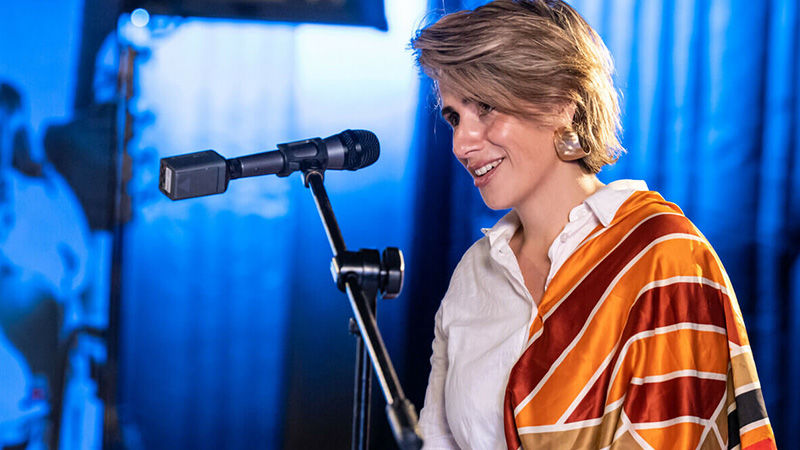
He started out studying economics, but switched to communications and then earned an MBA, both degrees from Universidad ORT Uruguay in Universidad ORT Uruguay... As a journalist, he worked at the newspaper El País, where he covered technology and developed a passion for stories about how companies were born and grew. Once he found his niche in technology content, he dedicated himself to telling the stories of what business leaders and entrepreneurs were doing. That’s how he became fascinated by innovation.
In 2015, he founded his first startup, and after several business transformations,Prometeo was launched in 2018—an open banking company that connects businesses with banks and processes over 1.5 million “calls” to banking APIs across 10 Latin American countries. Through its system, it operates not only in Uruguay but also in Argentina, Brazil, Chile, Ecuador, Peru, Colombia, Panama, and Mexico.
After growing 25% annually, she now expects Prometeo to double its business in 2022 and, within four years, become the next Uruguayan unicorn—that is, to be valued at over $1 billion.
Throughout her career, she has been recognized as one of the most innovative women in Latin America by the IUPANA organization, as one of the 2020 Disruptors, and as MBA Entrepreneur of the Year at the 2022 AMBA & BGA Excellence Awards.
This year, she was ranked 91st among the top 100 fintech leaders worldwide.
“From journalism, I apply the skill of understanding how things are connected; the task of journalistic production applied to a startup is an everyday one,” she says. -
Luciano Supervielle
For its combination of talent, training, constant innovation, and commitment to the cultural and creative industries.
"Thank you, Christian; thank you, Eduardo Hipogrosso. To all of you. I truly feel very honored by this recognition. I’ve always viewed my work as an adventure, as a leap into the unknown; every project is a new adventure, a chance to reinvent myself."
My academic background has been very important. When I was studying piano at the University School of Music, my classmates saw me as a weirdo because I was also part of this hip-hop group, Plátano Macho, and my bandmates in Plátano Macho saw me as a weirdo for playing classical music. My whole life has been shaped by that; I don’t consider myself a great concert pianist—I’m not one—and I don’t consider myself a cutting-edge DJ—I’m not one either—yet the music I make is unique.
I think that’s really where the value of my work lies. I’ve composed music for ballet, film, documentaries, and plays, and, well, every time I take on a new project, there’s a huge challenge in reinventing the technique—in figuring out which technique I need to apply at that moment—and there’s a great deal of effort involved in adapting to each project. So I think that’s been a big part of my work and my development; it’s actually something that’s constantly evolving. Ten years from now, I have no idea what I’ll be doing; it will surely be based on all these projects I’m developing, but new things will also come along (...).
I’ve received several awards recently (...) and I truly see them as recognition of my work, my effort, and my dedication and commitment to what I do. Every project challenges me and compels me to do my very best.
You never really know if what you're doing will have an impact, if it will turn out really well or not. There are things I've done that I like more and others I like less, but I'm always committed to doing my best. And I really value that a lot.
"Thank you so much, Eduardo, and all of you. Thank you very much."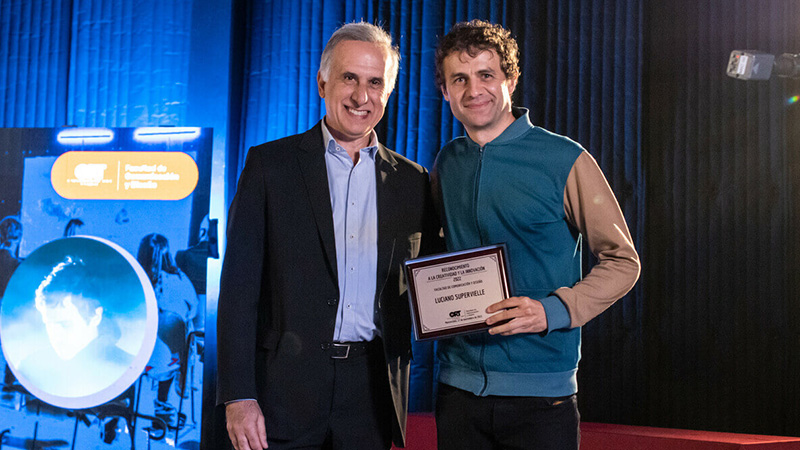
At age 4, he played his first instrument: a drum set made from pots and pans. Once in Uruguay, an aunt gave him a real piano. He began studying guitar at age 8, and by age 10, he was certain that music would be his path. As a teenager, he doubled down on his commitment and enrolled in the University School of Music.
In Montevideo, meet Gabriel Casacuberta, a friendship and musical partnership that we recognize in the group Male Banana. At the age of 23, he began working with Jorge Drexler and shortly thereafter joined Background, a group of Uruguayan and Argentine musicians who blend music from the River Plate region with other rhythms and a unique style highly innovative.
Today, with a long solo career behind him, his creative and innovative spirit This has driven him to reinvent himself periodically, always guided by the belief that challenge and enjoyment are more important than virtuosity—which we know comes as a result of hard work: he always tries to venture “into uncharted territory,” as he puts it.
Throughout his career, he has toured Europe and Latin America and has received awards for his work, including the Gardel in Argentina, and the Graffiti and Iris awards for Best Album of the Year in Uruguay. It is one of the Uruguayan artists one of the most versatile artists of recent decades, with a discography that has spanned hip-hop, classical music, tango, and electronic music.
His contributions to the audiovisual industry include composing and recording music for films such as The Pope's Bath, Artigas: La Redota and Creole, included on the musician's latest album: Episode (2021), which has just been recognized as Best Instrumental Music Album at the 2022 Graffiti Awards.
We know what he’s done so far, but we can’t say for sure what he’ll have accomplished in 10 years, since his identity is tied to innovation. “Composing is a way to leave your mark,” he says, and boy, is he leaving one.