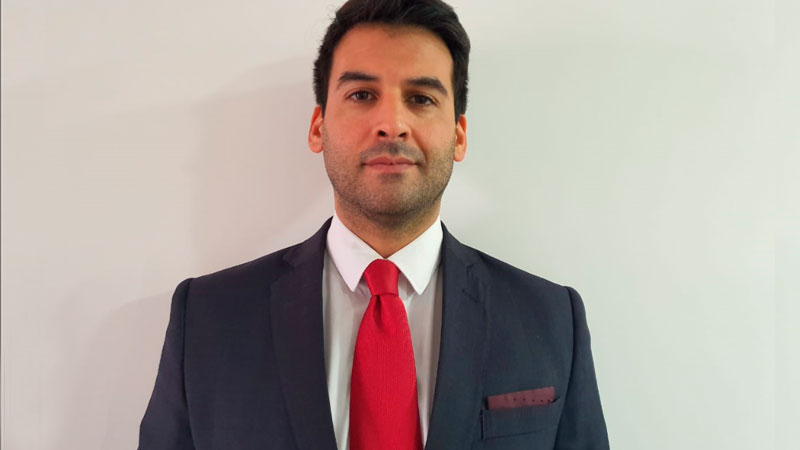
Dr. Juan Manuel Rivero Godoy, professor of public international law at the School of Administration and Social Sciences at Universidad ORT Uruguay, was appointed secretary of the Mercosur Permanent Review Tribunal (TPR) for the term from January 1, 2020, to December 31, 2021.
In this context, Dr. Rivero Godoy spoke about his recent appointment, the challenges he expects to face, and how his new responsibilities relate to his role as a professor of public international law.
What are your goals as secretary of the Mercosur Permanent Review Tribunal (TPR)?
The primary objective is to support and collaborate with the Dispute Settlement Mechanism, which is enshrined in the Olivos Protocol (signed on February 18, 2002, in the Argentine city of Olivos by the Mercosur member countries, and which entered into force in 2004, with the aim of resolving conflicts and minimizing differences among the states). This involves a phase of advising, supporting, providing logistics, and other assistance to those resolving the dispute.
What challenges do you expect to face?
There are several challenges. First, everything related to budget management—which is public—and with which, especially now due to COVID-19, we must be frugal while still meeting certain objectives, such as maintaining quality systems, continuing to publish the court’s journal, and developing additional products. Organizing academic activities, which are also part of the functions carried out by the TPR Secretariat. In addition, there is everything related to promoting the Dispute Resolution Mechanism itself.
We—the Mercosur Permanent Representative Office—are the final authority in the event of a dispute. We stand ready, and if a dispute arises or an advisory opinion is issued, we must provide all necessary human and material resources to address the issue.
In general terms, what does the Dispute Resolution Mechanism entail?
The Dispute Settlement Mechanism is part of the Olivos Protocol. Previously, there was the Brasilia Protocol.
What the Olivos Protocol did was to directly establish the role of the Permanent Court of Arbitration (PCA). In other words, it is a dispute resolution mechanism that can be brought before ad hoc tribunals formed for a specific case, but there may be an appeal to the PCA; or, if the parties (the States) agree, they may proceed directly to the PCA as the sole instance.
On the other hand, there is the advisory function, which, in the context of international law, has the advantage that bodies or a State may submit a question to the court so that it may issue an opinion on how a rule should be implemented or interpreted; however, this opinion is not binding, meaning it is not enforceable.
What are the main responsibilities of the TPR?
The tribunal’s role is to resolve disputes or issue advisory opinions as requested. On the other hand, the role of the TPR Secretariat, which I oversee, involves providing all necessary logistical support to the arbitrators when they need it, as well as fulfilling the functions of the secretariat itself, which include administrative and accounting duties, legal counsel, IT support, and records management, among others. The work of the secretariat lies at the intersection of legal and administrative functions.
What does managing an organization of this kind entail?
Management entails staying abreast of all current dispute resolution mechanisms, that is, being prepared for specific circumstances that may require the involvement of the TPR and the Secretariat, and, furthermore, complying with all Mercosur regulations.
The body I work for has a distinctive feature: it is a legal body. Here, we all must respect certain principles, such as due process, equality, transparency, neutrality, and impartiality. We must safeguard them. This is different from other Mercosur bodies, which perform other functions. Our scope of action is different.
How can you enhance your activities at the TPR through your role as a professor in the Bachelor's Program in International Studies?
Having a professor with ties to the practice of international law is a major asset, because while academia has many strengths, it also has certain shortcomings. At times, it can be very theoretical—and that’s fine—but sometimes we need to bridge the gap between those two worlds: academia and practice.
The purpose of academia is to identify problems and work together to solve them. I say this after 15 years as a professor. You gain experience over time, and in that sense, I think it’s good to have the opportunity to hold a position like this, because it allows you to see how the concepts studied in academia are later validated in practice.