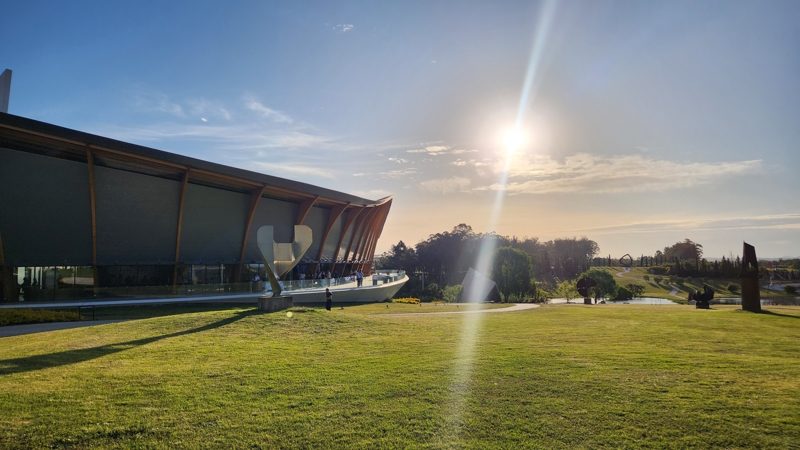
With notable exhibitions such as the one featuring 140 works by Joaquín Torres García—marking the start of the year that will celebrate the Uruguayan artist’s 150th anniversary—MACA will begin its third year of operations with a wide range of cultural offerings.
Since 2022, when it opened, the museum located in Manantiales (Maldonado) has attracted attention not only from the general public due to the building’s unique structure, but also from architects, as it is a structure that incorporates glued-laminated timber in its design. For Dr. Laura Moya, architect and academic coordinator of the Specialization Diploma in Design, Calculation, and Construction of Wood Structures at Universidad ORT Uruguay, this sends an interesting message to Uruguayan construction professionals, demonstrating that, in addition to traditional concrete, locally sourced wood can also be used to build large-scale structures.
In this interview, the scholar and researcher explains the main features of MACA’s architectural design and of wood as a building material.
What features of MACA stand out to you the most?
It is the first complex spatial structure designed in Uruguay using glulam elements with variable cross-sections and double curvature. It features a series of frames constructed from locally sourced Eucalyptus grandis wood. These structures require a modeling approach and structural design that differs from traditional methods.
The structure was designed and engineered by a firm of Uruguayan and Spanish engineers specializing in the design, engineering, and construction of wooden structures. The result is a structure with a space—conceived by architect Carlos Ott—that is very spacious and inviting, as all the components of this portico are left exposed.
In your opinion, what kind of message do you think is conveyed by the decision to build a cultural venue out of wood?
I believe the message it conveyed is extremely important: that domestic wood can be used in engineered wood products to create visually striking structures and iconic spaces or buildings. In this way, users, visitors, and professionals in the construction industry alike can see that wood is just one of the materials that can be used to build large-scale structures in Uruguay.
Are there any other large wooden buildings in Uruguay with characteristics similar to those of the MACA?
I can mention the Daymán Municipal Hot Springs. There is at least one pool there that is covered by three-hinged glulam trusses of varying cross-sections, but the shape is quite different. The wood used for the MACA is Eucalyptus grandis, whereas the wood used at the hot springs is glulam made from pine species.
What are the characteristics of Eucalyptus grandis, and what benefits does it offer for construction?
Glued-laminated timber is an engineered wood product that allows for large spans and offers great flexibility in architectural design.
The MACA project is a prime example, because the arches that make up the porticos have a very distinctive shape; furthermore, the porticos vary in design—they are not all identical—making it a complex structure. This is made possible by the flexibility of the manufacturing process, which allows for the production of the various components of the portico.
Furthermore, glued laminated timber (and wood in general) has a high strength-to-weight ratio, which means that during construction, processes can be faster and simpler because the components are prepared in the factory. The only work done on-site is the assembly of these components.
In contrast, if we consider that these porticos had been built using reinforced concrete, a fairly complex formwork system would have been required. Next, the steel reinforcement would have been installed, followed by the concrete pour. All of this takes much longer than the assembly of glued-laminated timber porticos.
Regarding the species used— Eucalyptus grandis—it is worth noting that the MACA structure could also have been built using pine wood. Nevertheless, the choice was excellent, as the structure is visually striking. Eucalyptus grandis is a fast-growing species; for structural use, trees are typically harvested at approximately 18 years of age.
Why was the wood harvested in the country but had to be sent to France for processing?
To date, there are no companies in Uruguay that manufacture structural glued-laminated timber beams for use in construction. Therefore, the locally sourced timber was shipped to a factory in France, where it was processed to produce the components for the porticos. The process was supervised by a member of the engineering firm that designed the project.
There are indeed factories here that produce glued laminated timber, but they do not produce structural glued laminated timber. That is worth noting. For an element to be used in construction—in architectural and civil engineering structures—it must meet a series of manufacturing requirements backed by physical and mechanical tests that, in some way, certify that has structural has and can be used in those architectural and engineering applications. The glued laminated timber currently produced in Uruguay does not meet those manufacturing requirements; therefore, it is not structural.
What does that wood treatment process involve?
There is a great deal of literature on the subject, but, in short, once the wood has been cut into pieces—specifically, solid wood planks—it is dried, and imperfections such as knots, grain irregularities, and the presence of pith, among others, are removed. These defects are removed through cuts made in the board using finger-joint technology, which involves notching the boards. The pieces of the board are then joined using a structural adhesive with side pressing—often done with machines that allow for heat pressing under controlled conditions.
The joined panels, known as slabs, can be of unlimited length, depending on the structure to be built. Essentially, the limit is determined by transportation; in the case of MACA, the limit was likely dictated by the size of the containers used to transport the beams from France to Uruguay.
As the panels are joined together, they are stacked one on top of the other until the desired height of the beam is achieved.
Once that part of the process is complete, the specific holes and cuts are made. Typically, CNC machines are used, into which the various plates are inserted—in this case, metal plates that connect the sections of the porticos that make up the museum building.
How long does wood last as a building material? How are buildings made of wood maintained?
We must keep in mind that wood is an organic material; therefore, if it is not protected from destructive elements, it can lose its structural integrity. If wood is left exposed outdoors, it will deteriorate due to factors such as sunlight, water, fungi, and insects.
Wood is a different material from reinforced concrete, which architects and engineers in Uruguay are very accustomed to using. Wood must be protected from the elements outdoors and shielded from destructive factors, and indoors it must be protected from sources of moisture, which can lead to problems associated with these destructive factors.
In the case of the MACA, those glued-laminated timber arches are protected from moisture entering from the outside because they are covered by a facade. In addition, metal connectors are attached to the porticos where they would otherwise come into contact with the foundation, ensuring that the wood does not touch the ground.
It is also worth noting that if all these factors are taken into account when maintaining the material, the structures can have a long lifespan. There are examples around the world—specifically in Asian cultures—of wooden buildings known as pagodas, and there is evidence that they have existed since the 8th century and are still standing today.