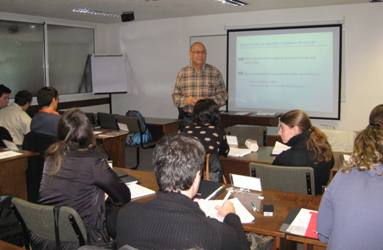
 Interview with Jorge Chávez, Ph.D., professor at the Adolfo Ibáñez University and visiting professor at the Master of Business Administration (MBA) from the School of Graduate and Executive Studies at the Faculty of Administration and Social Sciences.
-As an instructor for the MBA course "Supply Chain Management," what insights do you hope to share with students during your visit?
-First, to provide them with a different perspective on the company. A company can be viewed from various angles. Supply Chain Management offers a horizontal view that spans all of the company’s functional areas. It begins at the point of origin where the product is purchased, moving through transportation, warehousing, distribution, inventory management, customer service, and IT support, with the goal of optimizing this internal chain. Delivery times are becoming increasingly shorter. The complexity of managing all these aspects is enormous.
-What do you think the role of MBAs in society should be?
-MBAs must first and foremost be generalists, understand the business, and, above all, be able to identify problems. In most cases, we operate in a global economy, so your competition is global. Therefore, your only benchmark is the best in the world; competition no longer takes place at the local or regional level. This forces you to have performance indicators and productivity metrics that are equal to or better than those of your competitors; otherwise, you wouldn’t survive. This means that an MBA must be international—it cannot be focused on just one country. It is important for students to understand the realities of Europe, the United States, and Asia, and, of course, to be proficient in English.
There are three key qualities: leadership, an international perspective, and the ability to analyze problems.
-And why do you think it is important for the country's development to have business leaders with MBA degrees?
-MBAs develop leaders. A country’s intellectual capital is essential. For example, the United States has weathered many crises, but it has two strengths: an extraordinary infrastructure—roads, airports, communications—and intellectual capital. Intellectual capital is what makes the difference, and in that sense, Uruguay is suffering tremendously, because many highly qualified professionals who lack opportunities here have left the country, which to me is robbing the country of its future generations. We have many young Uruguayans living in Chile—highly qualified, very successful—and these are the people leaving Uruguay. It is not only important to educate people but also to give them opportunities to develop, and for this, it is essential to have companies led by MBAs.
-On that note, there are about 120 or 130 MBA students per year in Uruguay. How does this affect business?
-It’s a qualitative shift. Most MBA students in Chile aren’t thinking about getting a job, as was the case before, but rather about starting their own business or launching their own company. This is a very important development. The number of MBA students in Uruguay is small; the university where I work alone produces 500 a year, or more, and there are about 10 other universities that produce another 500, for a total of thousands. We’re talking about the fact that the number of companies that MBAs in Uruguay would be creating is potentially lower.