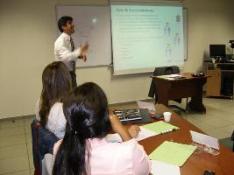
 Juan Carro Casabó, a clinical psychologist and biochemist, and visiting professor for the Master’s in Human Resources Management and the Specialization Diploma in Human Resources, spoke in April 2013 about the insights he shared with students and the importance of creativity and innovation.
-What insights did you aim to share with the students in the "Difficult Conversations" workshop you taught at the university?
-During the class on difficult conversations, we covered several key points:
- Every conversation has three aspects (emotional, physical, and verbal).
- In difficult conversations, it’s very important to prepare what you’re going to say, be open to the possibility that things may change as the conversation progresses, and be ready for that.
- Check in with how I'm feeling throughout the conversation and, in some cases, share that with the other person.
- Reflect on how each of us has contributed to the need for this difficult conversation.
- Pay close attention to where my thoughts are during the conversation, as they influence the way I interact with the other person.
- Use active listening and open-ended questions as tools to validate the person I am talking to.
- Being able to identify my own needs and help the other person identify theirs can go a long way toward smoothing the path to resolving a difficult conversation.
- It is essential to work collaboratively to resolve difficult conversations and avoid scapegoating as a quick fix for the problem.
-Do you think he succeeded?
-We focused on theory and put a lot of emphasis on practical application, and I feel that we achieved our goals. I think the workshop participants will also have to answer this question, since they play a key role in this active learning process, and it would be interesting to hear their feedback.
-What was your impression of the students in the faculty's Human Resources graduate programs?
-Participants who were highly dedicated to their work and eager to learn new tools that would better prepare them for the daily challenges they face within the organization. Their level of commitment was outstanding, as they completed the required readings, actively participated in the discussions, and engaged wholeheartedly in the group activities.
-In addition to the classes you taught at the faculty’s Graduate School and the conference , you gave a talk to graduate students aimed at helping them better understand how to use tools and identify defensive routines that hinder creativity and innovation in companies. Could you give an example of such routines that hinder creativity and innovation?
-One of the routines has to do with the mental models we have about creativity and innovation. For example, if I believe that “creativity is a waste of time and doesn’t lead to anything new,” this will influence how I approach it within the organization. I might end up with a thousand meetings, claim that I’m too busy, or even look for evidence within the organization to show that these initiatives have failed.
-How can they be prevented?
-The way to approach this is to take action; for example, holding a creative meeting every two weeks to explore areas of opportunity within the organization and begin to challenge the mindset I currently have. Today, organizations devote a maximum of 5% of work time to creativity.
-In the lecture you gave, you said that to innovate, you need a vision that involves “both the head and the heart.” How does “the heart” influence an innovative vision?
-The heart is the driving force that compels us to take risks and pursue our personal vision while contributing to the company’s vision. It’s about feeling alive and knowing that we can be agents of change at any moment if we set our minds to it. Another important point is that the heart is connected to our emotions; pursuing my vision brings me a wide range of experiences that may involve sadness, fear, anxiety, joy, and love.
Without heart, it is very difficult for us to achieve our vision, because it touches on the transcendent aspect that every person possesses.
-You’re a biochemist and a clinical psychologist—that’s not a common combination. How do you combine your two professions in your work?
-Having a background in engineering and a perspective rooted in psychology has allowed me to gain a much deeper understanding of the human processes at play within an organization. The engineering side helps me a lot when it comes to clarifying objectives, strategies, and action plans, since you have to be very decisive in this area. However, this is only one part of the process; the other has to do with the processes people go through, where my personal history, experiences, and the environment in which I grew up shape the way I see and act in certain situations. For example, I may be very clear on which part of the change involves having difficult conversations within the processes we experience in the organization, and I may even have very specific tools for this; however, if in my personal history difficult conversations were associated with keeping quiet or even feeling intimidated, this will shape how we approach these conversations at work.
In human processes, focusing solely on the technical aspects is like trying to run a race on one leg. Helping people find their own answers empowers them, and in this way, the organization can continue to grow.