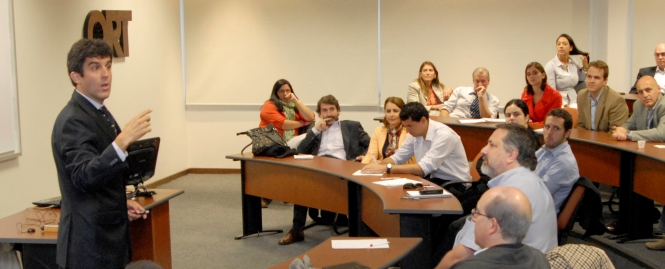
“Organizations That Learn Through Creativity and Innovation” was the title of the lecture given by Juan Carro Casabó, a biochemist and clinical psychologist, on Thursday, April 11, 2013, at the School of Management and Social Sciences at Universidad ORT Uruguay. This was the second presentation in the Management and Business Talks series.
Carro, a Uruguayan who has lived in Mexico since the age of seven, has been a partner and CEO of El Ombú Productos y Servicio de Excelencia—a company specializing in dulce de leche in Mexico—for the past 16 years. He also works as a consultant in Change Management, Creativity and Innovation, and Executive Skills Development for clients in Mexico, Argentina, and Peru, and is a visiting professor at the Graduate School of Universidad ORT Uruguay.
The lecture, attended by more than 60 people, focused on how to identify areas of opportunity where creativity can be applied. Using examples and highly interactive activities, Carro examined cases where innovation has been a key factor in the growth and sustainability of companies in the market.
“What is innovation?” Carro began by asking the audience, which consisted of students and graduates from the university. And, after a brainstorming session, he pointed out that innovation has a lot to do with emotion. “We tend to focus on structures and the types of tools we use, but this aspect is also very important,” he said.
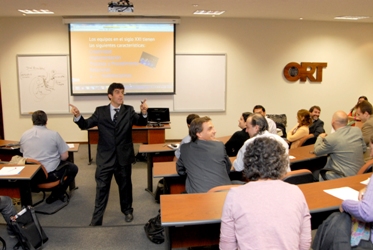 For Carro, professionals often stay within their comfort zones, while the challenges lie outside. “I start telling myself a story that things are great on the inside, and when I step outside, I realize I’m an emotional being, and that can paralyze me,” he reflected. “Growth hurts a lot, and sometimes we’re not willing to face that part. We prefer to stay in our comfort zone. But when you think you’re doing fine, the world has moved on. What’s happening outside is changing, and it matters,” said the expert, adding that we shouldn’t be afraid of mistakes because to succeed, we have to go through them.
Carro said that 21st-century teams must possess creativity, execution, processes and procedures, and relationships. After emphasizing the importance of multidisciplinary teams, he had the participants move five meters from where they were sitting. An example of the importance of change and movement.
“Anyone who introduces an innovation makes a difference. Innovation is a way of approaching certain problems,” he said. And for this, it’s important to have a vision—one that involves “both the head and the heart.”
Carro invited those present to try a meditation exercise, and everyone agreed to participate, though the results varied widely. The exercise involved closing one’s eyes, letting the mind wander to another place, and imagining oneself five years from now. “This is not the time to judge. It’s time to dream,” he said. Then, each participant was asked to draw something that represented what they had envisioned. 
“Innovation begins when you start observing. It’s the starting point for innovation. If we don’t get into the habit of slowing down, we’ll hardly ever find opportunities for innovation,” Carro said, adding that innovation and creativity require time, even though organizations often fail to recognize this.
He then asked the participants to write down five clients they would like to attract to their organizations, noting that the key to attracting them lay solely within the organizations themselves.
At the end of his talk, Carro stated that innovation is the successful launch of a product. “Innovation is 10% inspiration and 90% hard work,” he said. “A creative adult is a child who has survived.”