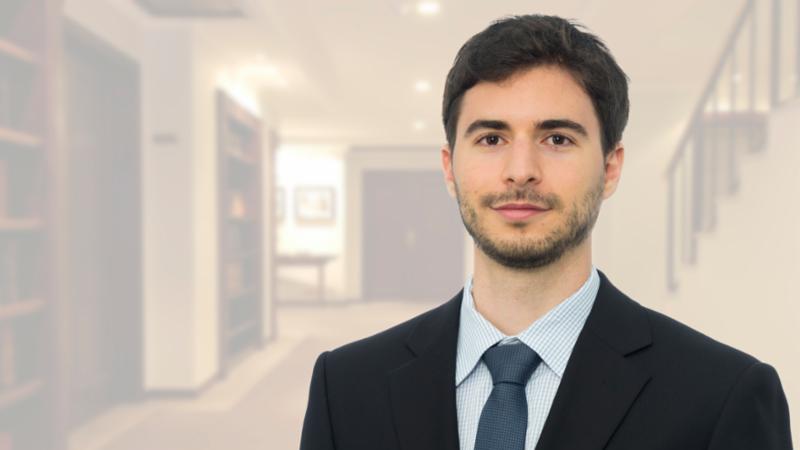
- “Product reliability and quality cannot be automated, but they certainly benefit from automation. Automation frees us up from routine tasks, allowing us to accomplish more in the same amount of time.”
- “Technological advances complement and enhance the role of the accountant.”
- “The role of the accountant is becoming more analytical, not just to compile data but to add value to it.”
- “Without these programs, we would waste a lot of time on activities that don’t add much value.”
-Why did you decide to study accounting at ORT?
-Choosing to study accounting wasn't difficult. I already knew in high school that it was what I wanted to study. After attending an informational session, I felt that it was the program that best aligned with what I was looking for in my professional future.
I also found the combination of numbers and rules interesting. What I was looking for, too, was a degree program that would give me the best tools for managing a business. And I realized that an accounting focus, combined with the theoretical and practical foundations of management, would be the perfect mix for that.
I chose ORT because I liked what they had to offer. My decision was based on recommendations from friends and family and an informational session I attended. The four-year curriculum, with a schedule that’s ideal for balancing work and study, the university’s prestige, and the quality of the faculty ultimately sealed the deal for me.
-What was your experience like as an ORT student?
-I'm really glad I attended ORT. It met all my expectations. I especially appreciated the planning—at the start of each semester, I knew all the important dates and could organize my schedule with the confidence that there wouldn't be any surprises or unexpected changes.
In addition, I had some very talented teachers who sparked my interest in subjects I had never before thought could be interesting. They helped me get started in the professional world with their valuable knowledge and advice.
I can’t help but mention the classmates I had during my eight semesters as a student, who were a great source of support during the most stressful times.
Finally, ORT gave me the opportunity to participate in an exchange program at the University of the Basque Country. This was an enriching experience that helped me develop my skills and grow, both academically and, above all, personally.
-What's the most valuable thing you've learned?
-If I had to choose just one thing, I’d say it’s dedication. I learned that to achieve your goals, you have to devote time and energy to them. Determination is a very important quality, and with it, you can go a long way.
I learned to have confidence in myself and to know that with perseverance, I could achieve my goals. College isn't just about knowledge; it's about discipline. It teaches you to be methodical and to plan ahead, and those are valuable skills when working in any organization.
-You earned your MBA from Torcuato Di Tella University and participated in an exchange program at the Kellogg School of Management. How do your accounting and MBA educations complement each other?
-After graduating in 2016, I knew I needed to pursue a graduate degree to continue my professional development. I believe one should never stop learning. I decided to take a few years off from academia to focus entirely on my career, but always with this future goal in mind.
Based on conversations with friends and career mentors, I felt that an MBA was the best graduate program to pursue. I ended up confirming this decision with a former professor from my undergraduate program at ORT, who guided me in this direction.
I was looking for a graduate program that would enhance my knowledge of organizational management.
In 2019, I began the MBA program at Torcuato Di Tella University. I had to travel to Buenos Aires every two weeks. Then, in the first semester of 2021, I had the opportunity to spend a quarter of the MBA program at the Kellogg School of Management, the business school at Northwestern University, one of the most prestigious in the world.
This experience was very valuable, yet also challenging due to its high level of difficulty. In any case, I felt very well prepared at both universities, and that is largely thanks to ORT.
I believe that an MBA is a great addition not only to a career in public accounting, but to any career.
-You are currently a partner at Guyer & Regules. What are your responsibilities and challenges?
-At Guyer & Regules, I work as a mid-level associate accountant in the free trade zone department, where we provide accounting, labor, tax, and corporate advisory services to companies operating under that regime.
Our responsibility is always to provide reliable, high-quality service to our clients and to perform our duties to the best of our ability. I believe that what matters most is the relationship with the client—building a connection and trust that make the work enjoyable for both parties.
There are many challenges, as we’re constantly dealing with deadlines and know that mistakes can be costly. That’s why organization and planning are essential. It’s something I pay close attention to.
-Technological innovations are bringing about a series of changes in the profession. Given your professional and academic experience, how do you see these changes affecting the roles of accountants?
-There are definitely changes taking place, and I see that as a very positive thing. Accounting systems are becoming increasingly useful tools. They allow us to focus on more important matters.
One thing I've learned over the years is to value time and try to use it efficiently.
Without these programs, we would waste a lot of time on activities that don't add much value.
Technology allows us to focus on fine-tuning details in ways that may not have been possible before. It has also made it easier to generate detailed reports for better data analysis.
The role of the accountant is becoming more analytical, not just to compile data but to add value to it. As these advancements continue, our expertise in regulations and related topics will remain essential. That is the added value we provide.
Product reliability and quality cannot be automated, but they certainly benefit from automation. Automation frees us from routine tasks, allowing us to accomplish more in the same amount of time.
Technological advances have shaped and enhanced the role of the accountant. On a personal level, I have experienced several changes and have welcomed each one of them.
-As a graduate of the program with extensive professional experience, what advice would you give to current students?
-I recommend this degree program because it provides a broad education that opens the door to many career opportunities.
Whether you’re looking to work as a professional and manage a company’s finances, start your own business, or work in corporate administration, this program will give you the tools you need to succeed in your field, along with the knowledge and understanding of the subject matter.
My advice to current students is that, as they progress through their studies, they should start figuring out which area they like best and which one they want to focus on. That way, they can start building their careers early on.
If you're not sure what you want to do or don't want to specialize in a single field, this degree program offers a wide range of options. It gives you the chance to take a more general approach and learn a little about everything, which will open up various opportunities for you over the years.