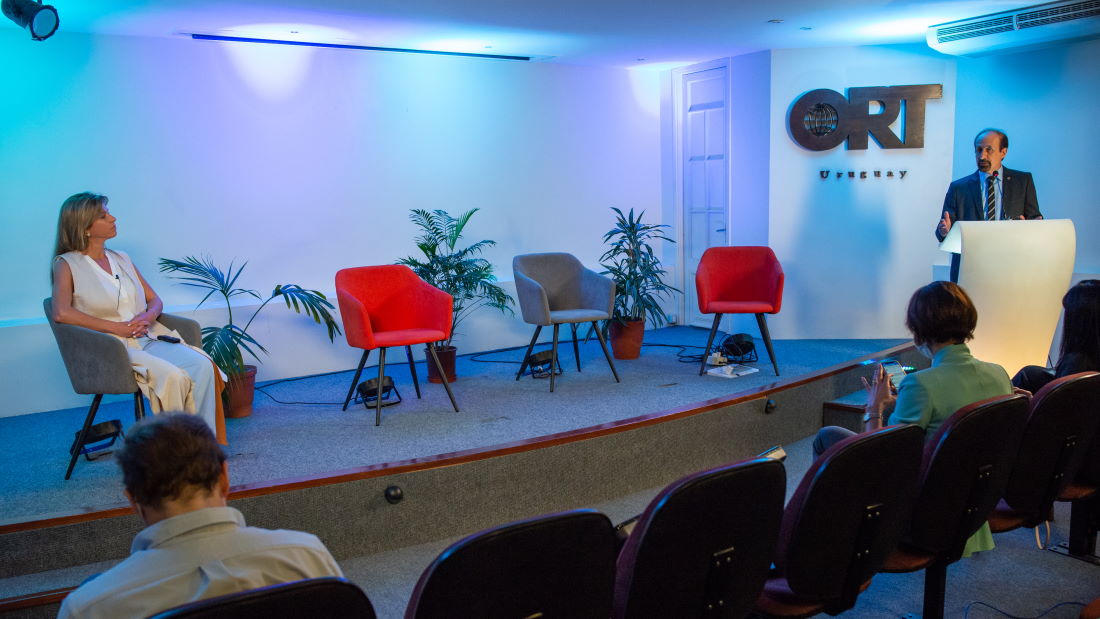
This initiative has been taking place worldwide since 2013 and in our country since 2019, bringing the total number of participating nations to 144.
In his welcoming remarks, the dean of the school, Eduardo Hipogrosso, stated that this is “an event that inspires women entrepreneurs, an event designed to foster exchange and promote best practices on the path to entrepreneurship, which is gaining increasing momentum.” Due to the health emergency caused by COVID-19, he said, “economies have transformed, and entrepreneurship has likely been one of the paths forward.”
I believe that entrepreneurship can be learned, but I also understand that it is linked to people’s experiences. I have no doubt that promoting entrepreneurship is a way to help our economy grow and also to foster equity.
For her part, Dr. Cristina Bertolotto, WEDO’s ambassador for Uruguay, stated that WEDO is an organization that does not compete with other women’s organizations, but rather that “to be powerful, we must not isolate ourselves; instead, we must come together and respect one another.”
Creativity in the Face of Adversity
The first speaker of the day was Lorena Ponce de León, a technical engineer and the creator and driving force behind the Sembrando program of the Office of the President.
“When we were about to hold our first event, COVID-19 put a stop to it. So we had to get creative quickly and come up with a way to help entrepreneurs,” said Ponce de León. They reached out to various experts, businesspeople, and academics, asking them to volunteer to mentor one entrepreneur per day.
In the first two months, the virtual Sembrando service handled more than 2,500 cases.
They moved on to Plan C—since the pandemic left them no other choice—and launched a six-session individual mentoring program, with the goal of creating jobs through that venture.
It wasn't until after that phase that they were able to start traveling around the country. Their first stop was Artigas. Next came Salto, Cerro Largo, and Tacuarembó, and their next destination is Flores.
Win-Win: An Opportunity to Drive
“The significance of WEDO in a year marked by the pandemic and the international crisis is particularly relevant,” said Dr. Lorena Lamas, “because it invites us all to think together, collectively, about a more inclusive, fairer, and more sustainable socioeconomic path forward.”
Lamas is the head of UN Women’s Win-Win Program for Uruguay, an initiative that promotes financing and coordination within the private sector to advance efforts to support women in alignment with the 2030 Agenda for Sustainable Development. In this regard, she explained, the goal is to have a positive impact on several of the Sustainable Development Goals: gender equality, reduced inequalities, decent work and economic growth, and partnerships to achieve the goals.
Ganar-Ganar has three lines of business:
- The work they are striving to coordinate by promoting the activities of female entrepreneurs and businesswomen.
- The work they do with companies to help them incorporate a gender perspective into their corporate management.
- Work within the financial system, “because we understand that it is important to have funding for this innovation driven by women.”
We have a proven business case: in addition to being an ethical imperative and a matter of social justice, gender equality is good for business, for markets, and for society as a whole.
Facing invisible barriers
Ten years ago, for every ten men who started a business, four women did the same. Today, there are six women for every ten men.
These figures were provided by Joaquín Morixe, executive director of Endeavor Uruguay, who explained that it is on the path to entrepreneurship that “barriers that seemed invisible” emerge, such as low self-confidence, a lack of role models, or difficulties in accessing financing (although, statistically speaking, women are better at repaying loans than men, he added).
We have worked to address these barriers and mitigate them, and today we can say that we have narrowed the gap, but we must continue our efforts. The formula or playbook for male entrepreneurs to succeed does not apply in the same way to female entrepreneurs.
He concluded with three reflections:
- The road is not smooth.
- You have to enjoy the journey.
- Treat every rejection as a learning experience.