
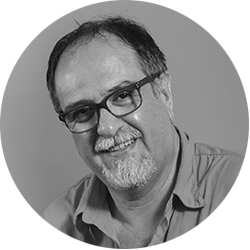
Millán, a professor in the Fashion Design program, was responsible for the set design and costumes for the three-act opera *El corsario*.
The Sodre curtain workshop team consists of six people, supplemented by about six additional staff members for specific projects.
The designer spoke about his role in *Le Corsaire*, the premiere in Hong Kong, and the importance of teamwork.
How did you end up being nominated for the Hong Kong Dance Awards?
I was given the chance to redesign something, which doesn't happen very often. In design, products can be adjusted for another production run, but once mass production has started, it's difficult to make changes without a new investment—whether in molds, tooling, or whatever else is needed.
The same thing happens in the performing arts. You design a production; that production is created because it’s a cultural product, and the set design and overall staging have a limited lifespan—they’re meant to be used “for as long as they last.” In other words, if you don’t want to update it, it can last indefinitely.
Generally, you bet that the sets and costumes will last about 10 years, and that there will be an opportunity to revive the production three or four times after you've made the investment.
What was the work process like?
In this case, for the National Ballet’s first production of *Le Corsaire*, they had used a set rented from elsewhere; so when they decided to revive *Le Corsaire* in the repertoire, Julio Bocca invited me to design the set from scratch, giving me complete creative freedom to create something without any predefined constraints.
It was a wonderful experience from that perspective. Although we worked as a team and I consulted with him—who was the artistic director at the time—on many things, at one point he told me, “It’s your dream; you have the freedom to do it.” And then he gave it the green light. Now, having the opportunity to revisit that dream or that project and make adjustments or corrections has been a truly rewarding experience.
The set design is the same, but we made some adjustments. For example, in terms of technique (letting the brushstrokes flow more freely, making the colors darker). These are adjustments that really pay off on stage. There are certain backdrops—known as “generic” backdrops—for which we created a new design because the old one didn’t work.
We had to make adjustments based on the materials, which we couldn't find. Sometimes we couldn't find the right color, and sometimes we couldn't find the right material. So we had to improvise as we went along. It was an experience of discovering how to make it work exactly as planned. From a design perspective, that was fantastic for me.
The other challenge was working on a production from a distance, with all its surprises and uncertainties. Luckily, the set design was done here; it was a good experience because they had the training—they’d worked on other productions since *El Corsario* —so that went very well.
What was it like to see your designs in a different market?
That wasn't part of the plan; it never occurred to me that I'd be able to create something for another market that would turn out well, be well-received, and be nominated in both categories (production design and costume design).
The video and lighting special effects are also nominated—I worked on them with a collaborator (Leonardo Scarone). I know what I want to do, I know what I want to happen, but I don’t have the technology to do it. So, I called a friend—also a designer—who works in animation, and he did it for me. In this case, he’s also nominated for the awards.
It really is strange—at least it is to me. I don't know. I feel just as excited as I did any other time I won an award for the first time. I've worked in carnival, and it's rewarding to have your work appreciated, to know that people liked it. It's the same in theater.
You really enjoy a nomination, especially the first time it happens. It’s a real wake-up call. Recognition is always welcome. But I see it as something more—I’m much more interested in the processes themselves.
I appreciate it, and the team does too, because everyone who participated has taken this in stride with great joy. Although the nomination is for my design, there are a lot of people involved who made it possible. I may be the designer, but the workshop is essential—valuing each other’s work and working as a team. Without the workshops, you’re nothing; it’s impossible to get anything done. Welcome, and a round of applause for the whole team.
How was the premiere in Hong Kong?
The curtains were shipped in April 2017. I arrived in Hong Kong on October 20 because the premiere was on November 3. I went to oversee the final preparations, and it’s also interesting to see the premiere in a large theater with a live audience.
What colors and textures dominate in *Le Corsaire*?
The first act has a rose-like texture because it all takes place in a slave and merchandise bazaar; there are rocks and sandstone colors. The second act takes place in the pirate’s treasure cave. It’s a cave that looks like it’s made of amethysts, with violet and pink hues. The third act is inspired by the palm trees of the oasis. There is a grand emerald-glass palace. I was interested in working on the set design with [Antoni] Gaudí.
How did you discover your interest in set design?
I started out in graphic design. My shift toward set design happened naturally. I’ve been drawing and designing since I was a teenager, and I’ve always worked in those fields; I’ve taken courses, always staying true to my passion. There hasn’t been any drastic change in my career—I’ve never worked in a field that had nothing to do with design. There’s a sense of continuity. In that regard, I’m privileged because I’ve always done what I love. I’m truly lucky.
What is it like to connect with such a diverse audience?
It’s wonderful to be able to communicate with each other through the stage design. Even though we speak such different languages, we share a common language: the stage. We understand each other completely—it’s really lovely.