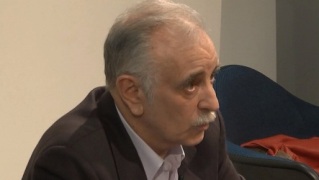
 The conference “Migration, Globalization, and Multilateralism: The Role of the International Organization for Migration (IOM)” was held, organized by the Department of International Studies. The talk was presented by sociologists Juan Artola and Alba Goycoechea. Artola has over thirty years of experience at the UN and 25 at the IOM, and specializes in migration issues. Goycoechea holds an M.A. in Latin American Studies and has published several articles and research papers on migration. The event took place on September 11, 2013, in the auditorium of the School of Management and Social Sciences.
As Artola explained, the rise in migration since the 1990s is directly linked to globalization. The global economy has created a disparity between the Global South and the Global North, as well as a massive oversupply of labor in Asia, the expert explained. This is accompanied by high rates of job insecurity and unemployment, which drive migration. Furthermore, the fertility rate in countries of the Northern Hemisphere is limited and low. As these societies tend to age, they rely on migrants from regions with high population growth rates, such as Africa and Asia. The rise in migration is also explained by the growing expectations of families, facilitated by the revolution in transportation and information and communication technologies. Other reasons include natural disasters, wars, and ecological degradation caused by climate change—a phenomenon of globalization, Artola explained.
Globalization, the sociologist noted, sparked a debate over whether migration policies should be unilateral (that is, left to individual nation-states) or discussed within a multilateral framework. An example of the former is the United States, which has implemented restrictive migration policies, particularly following the attacks on the Twin Towers. As a result, the “securitization” of immigration intensified, Artola explained, a phenomenon that views the movement of people as a national security issue.
In light of these perspectives, a debate has emerged between those who favor control and security and those who advocate for free movement and the rights of migrants. Irregular migration is another aspect of the discussion, pitting those who argue that illegal migrants should be deported (a policy prevalent in the United States and Europe) against those who prefer to regularize their status. The social agenda on migration also includes the problem of the “brain drain”—the exodus of highly skilled workers—and the utilization of remittances that migrants send to their countries of origin. Another aspect is the imbalance between assets and liabilities caused by the migration of younger people, which leads to demographic shifts in the social security systems of countries of origin. The issue of human trafficking (a phenomenon that has intensified with globalization) is also on the agenda for debate, the sociologist said: 2.45 million people are forced to migrate for this reason.
There is no legal framework or specialized agency for migration, Artola noted, but there is a UN Special Rapporteur on migration issues. Since 1995, there have been forums and conferences on the subject, but they have been criticized for the lack of global consensus, a restrictive approach, a scarcity of initiatives, an overly structured debate, and the limited space given to civil society. “We are far from a global regime on migration. There is a strong divergence of positions, and the debate is not fully integrated into the UN agenda due to pressure from powers such as the United States or the European Union,” which are receiving countries, Artola noted.
Goycoechea, for his part, explained how the IOM operates—an intergovernmental organization established in 1951 that now has member states. The IOM was created to address the migratory movements that occurred after World War II. It is not part of the formal UN system, although the two organizations work together. The IOM’s presence in countries is determined by the migration needs of each region. For example, it concentrates its efforts on migrants crossing into Europe via North Africa. The IOM’s mission is to promote economic development through migration, for instance by connecting the diaspora of highly skilled workers with their countries of origin. But above all, it is to ensure migration that is “orderly and beneficial for migrants and society,” said Goycoechea. “Our approach is to advise states on how to frame their migration policies from a rights-based perspective, which is gaining prominence on the migration agenda.”
https://youtu.be/lNaZhQWyIm8?si=a23QphWYTU0tn_YI