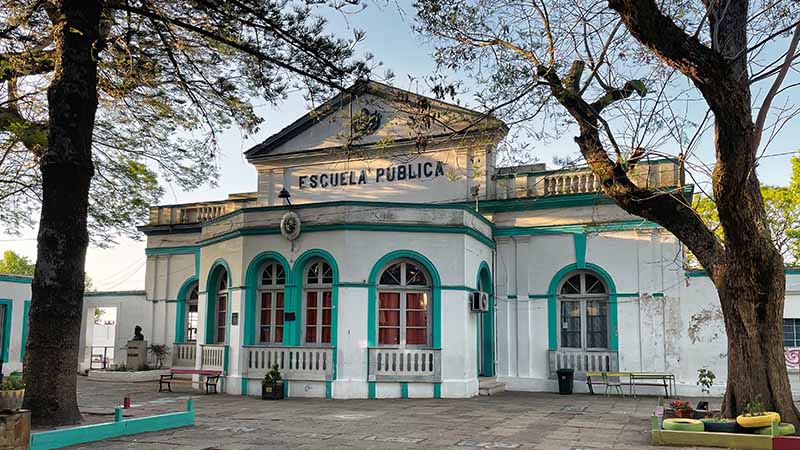
As part of an event that has become a tradition in Uruguayan cultural life, Adriana Careaga, M.A., a graduate program advisor at the Institute of Education, and Paula Cardellino, Ph.D., a faculty member and researcher at the School of Architecture at Universidad ORT Uruguay, discussed the celebration, which this year focuses on architecture and education.
A celebration of national identity
“In Uruguay, celebrating Heritage Day has taken on enormous significance and has become a classic family outing for more than a quarter of a century,” said Adriana Careaga, M.A.
But why is that? According to the graduate program advisor at the Institute of Education at Universidad ORT Uruguay, one of the main reasons lies in the fact that“heritage is inextricably linked to identity and collective memory”: “It is about seeking out what unites us as a nation, what identifies us as a people, and what brings us together as fellow human beings.”
This celebration, which I would call a true pagan festival, is a celebration of our identity. People are eager to learn about, appreciate, and preserve our heritage. And they want to do so as a family, in the company of others, because heritage belongs to everyone.
Adriana Careaga, M.A.
According to Careaga, the fact that the 2023 edition of Heritage Day highlights architecture and education is undoubtedly “very important.” However, he recommended not limiting oneself to “mere contemplation” of the object itself, no matter how “harmonious” it may be.
"We need to consider what took place within those walls, what dreams came true, what kind of citizens were shaped there, and how they influenced the society in which they lived. In other words: what happened there," he said.
Furthermore, through the various expressions of architecture, it is possible to observe the evolving concepts of education. “From the hygienist perspectives that emphasized playgrounds and spacious classrooms with large windows, to buildings that accommodated new educational approaches in line with the times—such as experimental schools,” Careaga explained.
Architecture: A Key Element of the Educational Process
Dr. Paula Cardellino agreed on the importance of honoring the builders of schools and high schools: “I believe that, this year, this recognition is particularly significant in the context of the educational transformation the country is currently undergoing, as it reinforces the existing commitment to education.”
Furthermore, according to a research professor at the School of Architecture at Universidad ORT Uruguay in Universidad ORT Uruguay, educational infrastructure is an essential component for the development of education.
In fact, he pointed out that, when analyzing the evolution of educational architecture, there are periods in which “the relationship between architectural design criteria and the transformation of teaching and learning processesis clear.”
“Contemporary pedagogy suggests moving away from the classroom as the sole setting for learning and encourages student autonomy through school designs based on open spaces, which allow for flexibility by eliminating partitions both inside and outside the school building,” he added.
And, in that sense, the physical space becomes an “active participant in the educational project”and can be regarded as an agent of learning. “It plays a central role in creating environments that help to consolidate changes in teaching and learning practices,” he emphasized.
Educational architecture is an essential part of the educational process. And the physical space can—and should—be regarded as the third educator, after the teacher and the student.
Dr. Paula Cardellino
“The architects being honored represent key periods in architectural production that were pivotal for teaching and learning in their time,” Cardellino stated. While he highlighted the ability of Alfredo Jones Brown, Juan Antonio Scasso, and José Scheps to “capture, in their architectural work, the new pedagogical ideas of their time,” he placed special emphasis on Scasso’s work, particularly his contributions to experimental schools.
What to See This Year on Heritage Day
“Fortunately, there are plenty of places to visit. It all depends on each visitor’s tastes and interests,” Careaga said when asked which places she would recommend visiting on Heritage Day.
The only caveat, in her view, is that she suggested choosingthose sites that are open to the public only on Heritage Day, and saving the ones that are always open for other tours throughout the year.
Cardellino, for his part, recommended visiting the Brasil School, located at the intersection of Brasil Avenue and 26 de Marzo Boulevard. Built in the early 20th century by architect Américo Maini, it was designed in accordance with the School Construction Plan and, in his words, “is a clear example of the architectural style used during that period.”
- You might be interested in:2023 Heritage Day Guide
Heritage is a collective phenomenon that unites us as a society, and it is of the utmost importance to recognize that we have the right to shape, build, and enjoy it.
Adriana Careaga, M.A.
Heritage Education: Teaching Materials for Educators
In August 2023, the Institute of Education at Universidad ORT Uruguay Heritage Education: Guidelines for Teachers. This resource, developed by Mag. Adriana Careaga, aims to provide insights for reflection and practice in heritage education through concrete examples.
In addition to highlighting current approaches to cultural heritage, it aims to provide ideas for incorporating heritage into the classroom that teachers can adapt to their specific contexts.
As Careaga pointed out, the publication allows readersto “discover new ways of exploring heritage from the perspectives of diverse realities and communities.” In his view, heritage is more closely tied to the present than to the past, because “it is from the present that we assign value to what we wish to preserve for ourselves and for future generations.” “And that is the value of heritage education: forging an intergenerational connection, ”he said.
“This material offers a way to reflect on what we do to educate students so that they become active and engaged citizens. We want future generations to uphold their values, and teachers play a key rolein that, ”he concluded.