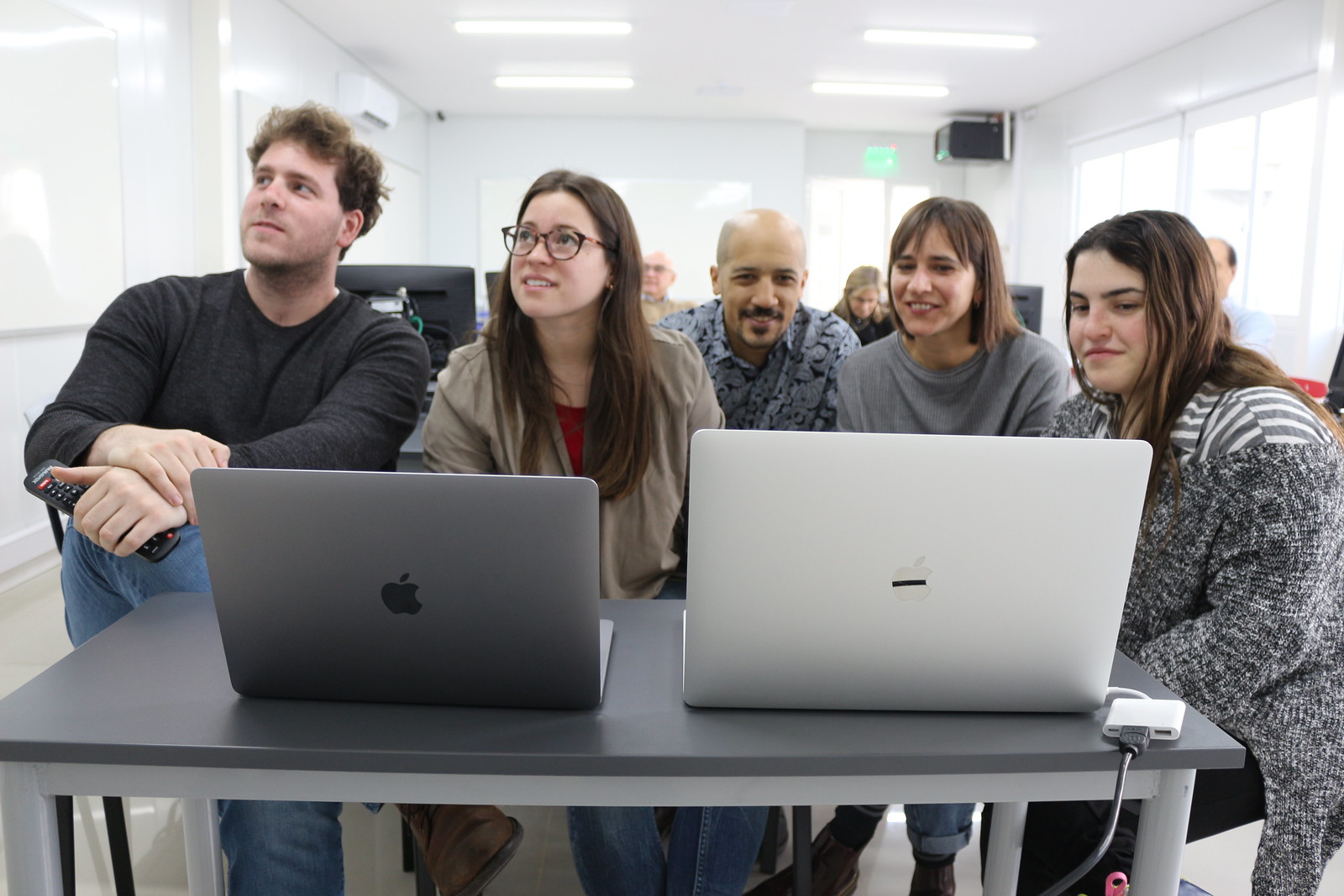
Half a dozen design and communication professionals worked for 15 days at the School of Communication’s Media Lab —and, of course, remotely—while staying in constant contact with the other teams based in Amsterdam, Austin, Milan, and Kyoto.
This international event was called the Migration Challenge and sought, across its five venues, to provide solutions for migrants in an era of high mobility.
Once the process was complete, the Uruguayan team contacted their Japanese counterparts via Skype. First, the local team presented their project: a collaborative app where migrants can ask for help (ask questions, seek advice) and local users can provide answers or offer guidance. The Japanese team listened, asked questions, and asked follow-up questions. They spoke for over an hour and a half in English. Then it was time to hear the Asian team’s proposal: a card that compiles all of a patient’s health information, regardless of their nationality or whether they speak the local language.
Integrate
The Uruguayan team consisted of communication professor Leroy Gutiérrez; students Micaela Chebi, Federica Silva, and Juan Espiga; design student Valentina Mejía; and coach and Media Lab professor Daniela Golby.
With their distinct and well-defined personalities, they scheduled an initial meeting to get to know one another and begin assigning roles and dividing up tasks—which seemed a bit odd so early on, given that they had never met or worked together before.
However, that wasn’t a drawback but rather a plus. “I never would have imagined such a great experience,” Silva said. “When we sat down and saw everything that needed to be done in just two weeks, I said, ‘Really?’ Discussing roles with people you don’t know!” Meanwhile, Golby says they were very lucky. “I’d never had the chance to work with such a great team before; everything went so smoothly, and that was a real plus because the energy was always high.”
Espiga, a sophomore majoring in Communication, appreciated being able to work alongside her classmates.
I was really looking forward to it, but I didn’t know how it would turn out. When we met, I saw that there were teachers, students, and alumni; and everyone could choose to contribute nothing if they wanted to, or share their perspective. I want to emphasize that, in this type of innovation workshop, people may come with a lot of skills in a particular area, but they also come with an open mind to listen to others; at this table, there might be someone who hasn’t finished their degree, like me, speaking on equal footing with someone who has a graduate degree.
Gutiérrez said that, as a Venezuelan, he found the subject matter “very compelling.” Espiga said his motivation was: “Anyone can become a migrant at any time.”
Echoing his colleague Espiga, Gutiérrez commented: “It’s not so much about coming here to learn something as it is about coming here to put things into practice; the interesting part is proposing small-scale solutions—we didn’t want to solve everything, because that’s unrealistic; design thinking helps us avoid being overly ambitious and instead set more effective goals.”
Chebi, meanwhile, emphasized the importance of empathy when addressing issues such as migration: “Taking the time to see things from the other person’s perspective and, from there, creating something with their needs in mind—rather than just doing what you want to do from your own perspective.”
“I’d do it again,” says one. “Me too,” replies another, and everyone nods in agreement.
Facing the challenge
The topic the six teams worked on was migration, which they all agreed is the defining issue of the 21st century.
Daniela Golby, who is Chilean, recalled her experience upon arriving in Uruguay: “I felt very lost; I had a hard time fitting in, feeling included, getting invited places… I even felt lost with things as simple as the dialect: even though we all speak Spanish, it’s different here; there are things that are said one way in Chile and another way here. I never understood what ‘bedelía’ meant until I was here. It was really hard for me; I didn’t know, I had no reason to. All those details that seem minor start to affect someone who comes from outside.”
The rest of the team discussed other structural challenges in the immigration process. Silva noted that Uruguayan law broadly protects the right to freedom of movement, although “there are certain obstacles to certain rights (to work, to education),” such as “requiring proof that one is not a political refugee.”
A step toward a solution
The team’s goal, then, was to provide migrants with clear, consistent information on key issues to help them effectively integrate into a new country. The platform, they explained, is divided into two parts: immediate needs and more complex needs. “It’s kind of like Uber: you ask for help, and within a short radius of where you are, a local can assist you. This creates a collaborative network between locals and migrants.”
For someone who was born and lives in Uruguay, providing a specific answer can be very simple, and at the same time, it can save an immigrant a lot of time searching for information, they said.
“We also asked ourselves, ‘Why would people want to help?’” Silva said. “To attract more people—perhaps those who aren’t naturally inclined toward charity—we came up with a network of benefits for local businesses, such as incentives, discounts, and so on.”
They agreed that getting the platform up and running “would be great.” “We’d need a budget and more details on the business model,” Golby noted. Silva, in turn, pointed out that there might be “simpler implementations”: a social network or an existing platform or channel that could “provide that information and facilitate a back-and-forth exchange, so we can experiment and see how it works, and then scale up based on that.”
Thinking and Designing
Design thinking is a creative process used to solve complex problems. The goal is “to generate completely new ideas that can transform a system and break with the status quo.” That is how Daniela Golby, the coach for this project, defined it some time ago.
Chebi pointed out that with this methodology, “you can see all the variables before implementing your project.”
It’s like a recipe for creating: how to create, be imaginative, and plan, following a step-by-step process. It’s the combination of wanting to create something new and good, figuring out how to make it practical, and determining what’s needed.
“Design thinking can be applied to ‘your profession, your field, your area of expertise,’” says Silva. “In this case, even though we likely already had some empathy for the subject, we were starting from scratch, so the context-building and research phase took time and was intense.”
Because of the nature of the work itself, each team member had to push themselves beyond their capabilities and (what they considered to be) their limitations. Espiga emphasized this point: “We didn’t know how to do the things we ended up doing; designing an app was something we had absolutely no idea about, but thanks to Daniela, we were able to pull it off. More than just learning something, it was like learning how to plan a project: how to set deadlines, how to organize ourselves, how to commit.”