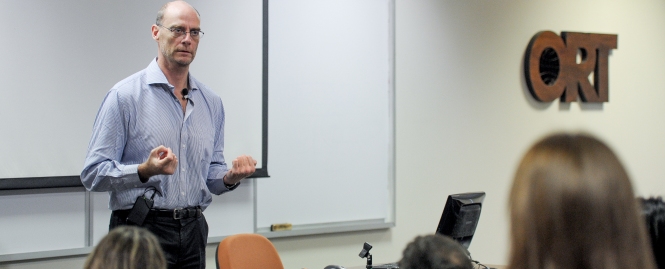
On Thursday, May 30, 2013, the lecture “Internationalization of Uruguayan Companies—Manos del Uruguay, the NGO That Conquered Markets” was held in the auditorium of the School of Management and Social Sciences. The talk was given by the organization’s General Manager, Rodolfo Gioscia, a graduate of the university with a Bachelor’s degree in Management and Administration and an MBA, who described how the firm crossed borders by positioning itself as a “country brand,” without losing its identity rooted in social inclusion and sustainability.
Manos del Uruguay was founded 40 years ago with the mission of promoting employment opportunities for rural women. In the 1960s, as Gioscia explained, there was a pressing need for work among rural women, partly due to a conservative culture in which husbands disapproved of their wives leaving their household duties. The first women began to organize into cooperatives, with “little business acumen but a lot of enthusiasm,” the General Manager explained. Later, a service center was established in Montevideo that to this day designs the commercial strategy for the products, including their export.
“Over time, and with the decline of the traditional textile industry, Manos del Uruguay had to ‘adapt to the market, think about what the customer wants, and not focus solely on production,’ Gioscia explained. The NGO ‘was working in a niche within a small market that wasn’t enough on its own, so we had to go out and look for that specialized niche elsewhere.’” Unable to compete on cost with the Asian textile industry, Gioscia explained that the company asked itself, “Who might like this and be able to afford it?” and that’s when discussions began with renowned international brands.
Today, it is a nonprofit organization with more than 160 independent artisans that exports its products and works with top brands such as Ralph Lauren and Marc Jacobs. Its most notable work involves clothing, but it also produces a variety of handicrafts made from wood, guampa, leather, and ceramics—materials that are characteristic of Uruguay.
“We realized that it wasn’t just the products that mattered,” but also the “flexibility” and “product development services we provided to the client,” explained the General Manager. An added value of the firm, according to Gioscia, was the fluidity of communication between the client (the brand) and the Manos del Uruguay design team. That team took advantage of the company’s small size: the team knew the technical process, the possibilities, and the limitations of the production chain, which allowed them to save time when fulfilling a client’s order.
Internationally, Manos del Uruguay “is focused on a niche market where artisanal quality is valued, and above all, artisanal dyeing, which is very hard to find,” said Gioscia, who was named 2012 MBA of the Year. The company focuses on markets that can afford high prices. In the international market, the NGO has committed to being a “standard-bearer for national identity. “We want to see it as a country brand.” To the extent possible, the company seeks to have international brands include on their labels not only a reference to the country of origin but also to Manos del Uruguay and the organization’s social responsibility. In Uruguay, the garments bear the name of the artisan designer to foster a sense of connection and closeness with the consumer, explained Gioscia.
The NGO’s logistics structure increases costs and makes quality control difficult, because the cooperative groups are scattered throughout the country while planning is done from the headquarters in Montevideo, Gioscia explained. This means that goods must be transported to and from different locations depending on the various stages of production. Combined with an unfavorable exchange rate, the seasonal nature of woolen garments, and a perception that Manos del Uruguay’s products are “expensive,” this makes social value more important than economic margins. The NGO also invests in training and pays its artisans during the courses to keep them motivated. Tools and raw materials are also provided by the service headquarters.
It is precisely this model that allows Manos del Uruguay, despite the costs, to “fulfill its original mission of bringing work to the people.” Any textile company would concentrate all its staff in a warehouse in Montevideo to save costs, Gioscia explained. “But that ends up forcing people to migrate to the city and often live in deprived conditions,” he added. “Social responsibility is in Manos del Uruguay’s DNA.”