The goal of the Master of Business Administration (MBA) Business Plan is to add value to the market and society. It aims to equip students with the tools and mindset necessary to launch a startup, whether within or outside of organizations. In some cases, the projects students develop end up being launched as actual businesses.
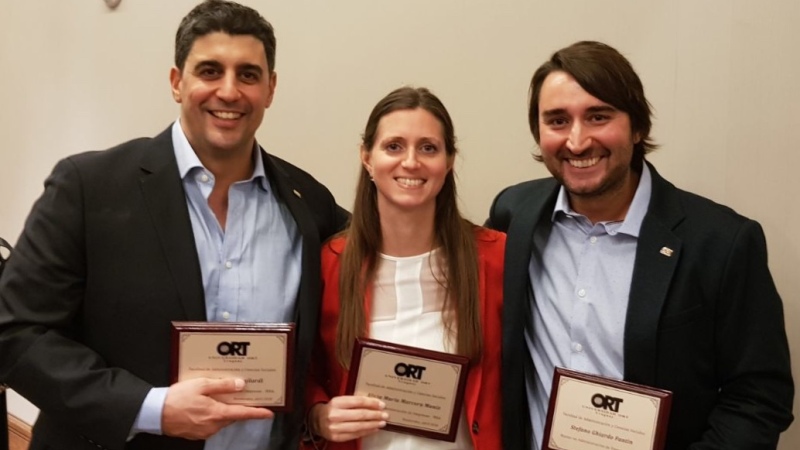
This was the case with GLÜFREE, the business plan developed by MBA graduates Stefano Ghiardo, Alicia Marcora, and Brian Rigby, which became the country’s first industrially produced line of gluten-free products. Today, the brand offers flatbread and sliced bread, muffins, individual and family-size pizzas, and puddings.
Business ideas often arise from observing one’s immediate surroundings. The students noticed that their family members and friends with celiac disease could only buy imported products at very high prices or more artisanal options, “often without certified quality or the necessary certifications, which made them unsafe,” the entrepreneurs explained. That’s how GLÜFREE came about.
MBA, Business Plan, and Real-World Projects
Ghiardo, Marcora, and Rigby were pursuing their MBAs at the Graduate School of Business at Universidad ORT Uruguay. In the Business Plan course, students apply all the knowledge gained from the program to a real-world business project under the supervision of experienced mentors.
The entrepreneurs took advantage of this academic opportunity to focus on their startup. “The business plan provided the necessary framework to organize the process and move from an idea to a solid project with real potential for implementation,”the graduates said.
“The market research for the plan and the analysis of the economic and financial model’s feasibility and robustness were conducted with sufficient depth, and, in general terms, the conclusions we reached remain valid, ”they added.
The next step was to put into practice what they had outlined in the business plan. Based on the experience of Group D—Vintelux —a family-owned business with 25 years of experience in the baked goods industry, where Brian Rigby serves as operations manager—they saw an opportunity to develop products free ofwheat, oats, barley, and rye (TACC) to meet the demand of people with celiac disease, gluten intolerance, or those who choose not to consume these types of foods. Following a research phase, they made an investment of $350,000.
During this process, with support from the National Agency for Research and Innovation (ANII) through its Innovation Implementation and Creative Industries Projects, and technical guidance from the Uruguayan Celiac Association (ACELU), a facility was established—approved by the Ministry of Public Health and ACELU—for the production of gluten-free products.
“GLÜFREE is the first brand to achieve industrial-scale production, which allows us to offer products at affordable prices while meeting the required safety and quality standards,” they said. “We have developed foods that do not need to be frozen and that, in most cases—with the exception of pizzas—can be stored at room temperature.”
“The challenge was to develop products that offered the same functionality as their gluten-containing counterparts, so that they wouldn’t be a limitation for consumers—products that are safe and taste great.”
Enthusiasm, commitment and internationalization
Santiago Fork, MBA, an associate professor of Business Planning, noted that, in his view, the project“took full advantage of all the opportunities the MBA program offers to strengthen what would later become the business plan.”
“At every stage of the plan, their presentations demonstrated enthusiasm and commitment, while they took note of the questions and suggestions from the various panels of professors,” Fork added.
“The outcome was excellent, featuring a comprehensive analysis of the industry and the market, a detailed implementation plan, and a highly effective application of the tools learned in the MBA program.”
According to El País, the company’s goal “does not end in Uruguay (…) The investment made in the new plant enablesGrupo D - Vinteluxto generate enough production volume to supply the local market and, in the future—once its product has been validated locally—to export to the region.”
The graduates noted that they are very proud to have brought their project to fruition. One of their main motivations for pursuing the MBA wasto “make a difference.” In this case, they succeeded.