This scholarship is offered every year and has spots: one for undergraduate students and another for master’s or research degree students. It covers airfare, full tuition for the Korean language course and the master’s program, health insurance, and a stipend for living expenses.
Salazar faces major challenges during his three-year stay in Korea, though he already has a head start because he knows the country and appreciates its culture. He says he isn’t nervous, even though he has less than 15 days left before his departure.
He will spend his first year there studying the language; “You must pass the Test of Proficiency in Korean (TOPIK), the official Korean language exam, to study at the university. The certification has six levels, and a minimum score of level three is required for the master’s program,” explains Salazar.
During that year, he will live in Daegu, Korea’s third-largest city, and then move to a smaller university town with a population of about 50,000 to pursue his master’s degree.
Your connection to Korea began before you received the KGS scholarship; you were in Seoul on an exchange program while pursuing your bachelor's degree. What was that experience like?
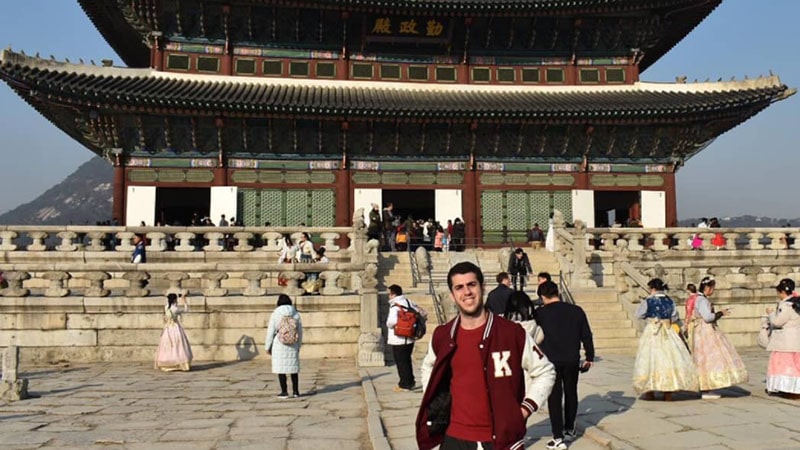
In 2018, halfway through my degree, I wanted to experience studying abroad, so I applied for an exchange program at my university. I was interested in Asian culture because I saw it as something very different; while looking into my options, one university in particular caught my eye—Korea University—it looked like a castle. When I left, I knew nothing about the language or the culture; I stayed for four months, one academic semester, and I loved the experience. When I returned to Uruguay, I knew I wanted to go back.
What did you like best?
So many things—the culture, the food, the language, the people. Since it’s such a different country from ours, it really opens your mind and gives you a whole new perspective.
Did you know the language?
No, I started studying when I arrived in Korea; that’s where I first got acquainted with the language, even though I spoke English in college. When I returned to Uruguay, I continued studying at the King Sejong Institute, located on campus.
What was the application process like for the Global Korea Scholarship?
It was a long and rather tedious process. I recommend that anyone planning to apply do so well in advance. The selection process consists of what they call three rounds: the first is an interview at the embassy , which is conducted in English—although English proficiency is not a mandatory requirement—the second involves verifying that all the documents you submitted are correct, and the third is acceptance by the university.
A very important part is the cover letter, in which you have to explain your motivations and why you chose to study in Korea. This section is very personal; I emphasized my previous experience, how much I loved the culture and the people, and how Korea is a destination that aligns with my career path because it is a technologically advanced country. Additionally, it’s a country committed to the circular economy and recycling—a topic that interests me and that I focused on in my final project.

Salazar's final project, carried out with three classmates and supervised by Dr. Helena Garbarino, was an app designed to encourage the use of household cooking oil recycling bins located throughout Canelones.
“We created an app where users scanned the QR code on the container, and when they deposited their oil bottles, they received credit that they could spend or redeem at businesses participating in the Canary Islands Environmental Seal program.”
This approach achieved two goals: promoting green initiatives and fostering the circular economy. The system was developed using blockchain technology, which enables greater transparency and traceability, as well as the ability to link and exchange green credits with other types of entities (such as electric taxis, LED lights, or organic products). The project was developed in collaboration with the Canelones Municipal Government, ALUR, and ICT4V.