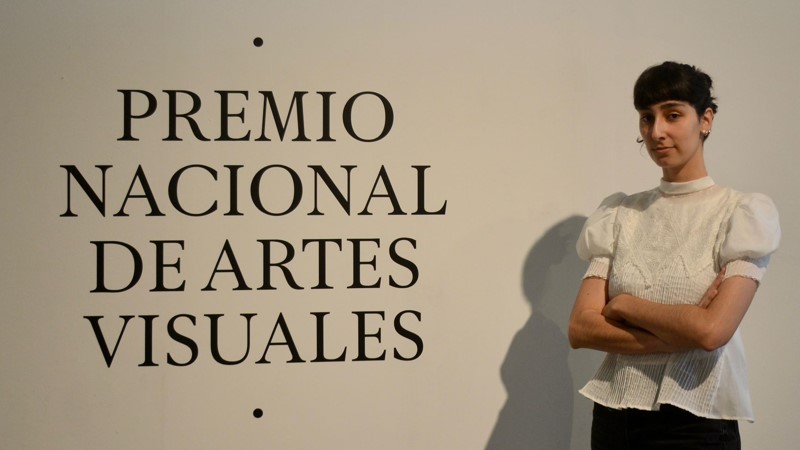
His artwork was displayed at the awards ceremony, which took place on September 20 at 7:00 p.m. at the Contemporary Art Space.
The Work Behind "Ritual del Río"
For Cortés, the decision to submit his work for the National Prize arose as a professional challenge:to submit his artistic works to the call for entries.
 "The National Prize is perhaps the most important competition in the country, and it didn't make much sense for me to enter without a track record, but this year's edition was only judging the work itself, not the artist's career. Plus, I was already feeling motivated after being selected for the Subte Joven, so I decided to go for it," says the artist.
The play *Ritual del Río* addresses current climate issues while exploring the feeling of being caught between extreme weather events and reflecting on human responsibility for climate change.
"We experience terrible floods, then devastating droughts—it’s like swinging from one extreme to the other. And the play, while critical, also seeks to evoke the feeling of being trapped in that cycle, at a point of no return," explains Cortés.
The central theme of the work was the idea of contradiction, a theme present in all of his works. However, the difference was that this concept was portrayed from an environmental perspective, whereas in previous works the theme revolved around human emotions such as pain or anxiety.
At the same time, the work sought to depict ancient rituals in which humans sought to communicate with nature through magical objects, in an attempt to beg for mercy from the intangible. The work was named after this concept.
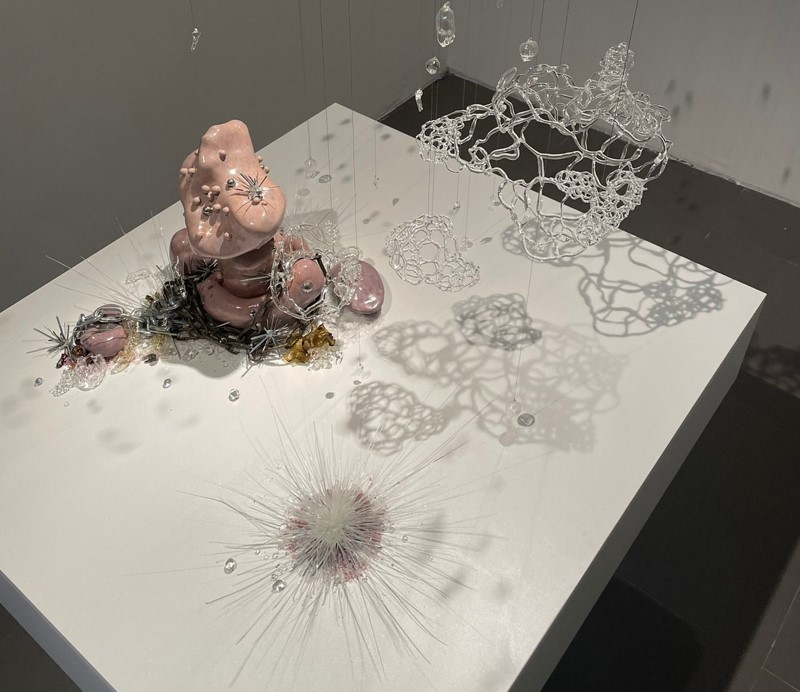
The installation combines elements such as glazed ceramics, glass, copper, silver, and mother-of-pearl—materials intended to evoke the delicacy and fragility of water—as well as African fetishes, figures embedded with nails and spikes that were used in rituals to invoke the supernatural.
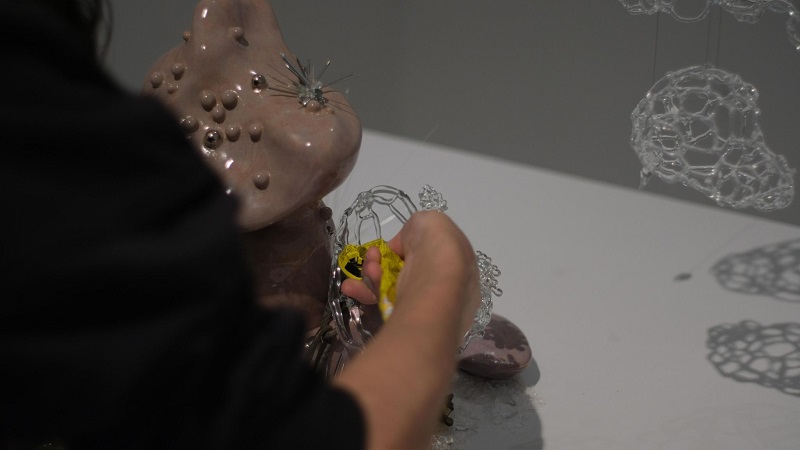
The production of the ceramic pieces, as well as the glass, took him several months of work: from firing the ceramics to the final touches with glazes and metallic materials, the process required meticulous attention to detail.
The Impact of ORT on Your Life
For Silvina, formal education at the Universidad ORT Uruguay was essential to her development as an artist because it provided her with the tools she needed to turn her career into a profession.
Beyond technical skills, what I value most is the interaction with the instructors, who are professional artists. Having that support and learning network was key.
In addition, he emphasizes the importance of knowing how to develop projects, put together presentations, and utilize technology, which enabled him to stand out in competitive calls for proposals such as this one.
What is the National Visual Arts Award?
The National Visual Arts Award, formerly known as the National Fine Arts Exhibition, is a competition that has been held since 1937. Organized by the National Institute of Visual Arts under the National Directorate of Culture, this competition invites artists to participate through an open call, giving them the opportunity to showcase their projects. The works selected for the exhibition will be on display until March 2025.
In its 61st edition, named after the Uruguayan artist Clever Lara, the award was open to individual artists and collectives, both Uruguayan and foreign, who are permanent residents of the country.
In addition, participants had to be at least 18 years old and could submit up to two recent works, with the freedom to choose their own artistic technique and theme.
Learn more about the programat
: Bachelor's Degree in Design, Art, and Technology