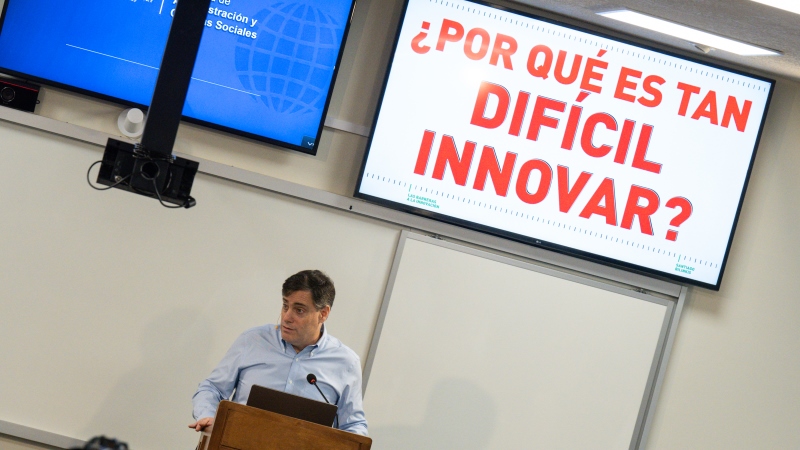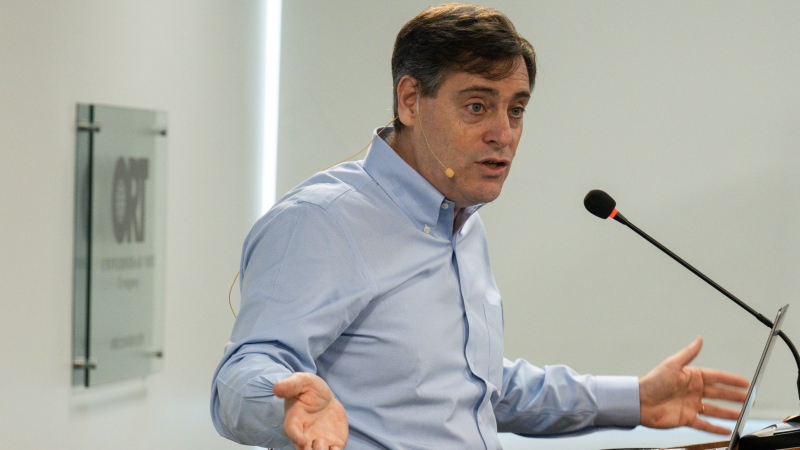
Bilinkis—founder of Officenet and author of the books *Passage to the Future* and *Guide to Surviving the Present*—gave a talk at Universidad ORT Uruguay part of the launch of the Mauricio Levitin Chair in Executive Education.
One of the topics you discuss is digital transformation. Where do you think that transformation is taking us?
The pandemic brought the unexpected rise of remote work. In many cases, it led to increased productivity, greater satisfaction, and a better work-life balance.
The challenge now is to move from talk to action. I believe that right now there is a stark contrast between the rapid pace of change—how much is said about it—and how little we have actually changed the way we live to address this issue.
Today, all companies encourage innovation and taking risks, but often when someone actually puts that into practice, it’s not looked upon favorably.
You've dedicated yourself to entrepreneurship with a focus on social issues. How is it possible to bridge these two worlds?
It is very difficult because capitalism is extremely powerful and effective at driving economic growth.
I think one of the biggest challenges is to preserve all the positive aspects of capitalism while ensuring that business goals do not overshadow social goals. We need to be more mindful of society and the environment.
In your book, you discuss the impact of digital devices on our lives. What role should they play?
I think it’s essential to teach young people how the digital ecosystem works. Some platforms can be extremely addictive.
For me, it’s very important—especially in elementary and middle school, but also for young people and adults—to understand how these tools work. We shouldn’t give them up; instead, we should use them to further our own goals.
In one of your recent interviews, you talked about the end of social media. What makes this a possibility?
They're already on their way out. Not because they're going to disappear, but because they're no longer social.
At first, they encouraged you to connect with your loved ones. Now they show a lot more content from people you don’t follow. They’ve become a form of entertainment whose ultimate goal isn’t to connect people. Everyone is in their own little world, consuming viral content.
It’s the end of social media; it’s become a trap that consumes a lot of our time, but has nothing “social” about it.
How can we take back control of our time?
There are several things we can do to protect ourselves and regain control of our time. One—which I consider very important—is to turn off notifications on our cell phones. The purpose of notifications is to interrupt us so that we stop what we’re doing. They’re a trap.
There are also tools for tracking how much time we spend using apps. I really like the analogy with a diet. Just as we should eat a varied diet, the same applies to our digital diet.
We used to consume content that had a beginning and an end. If we bought a 64-page magazine, we’d read all 64 pages, and then there was nothing left. Now, however, there’s always one more episode to watch, something else to read. The limit that used to come from outside—from technology—is now something we have to set ourselves.
The Mauricio Levitin Chair in Executive Education, which ORT is launching, aims to provide professional development opportunities professional development people working in fields undergoing rapid technological transformation. It will also allow people from across the country to participate. What do you think of the opportunities that technological development offers?
We’re used to a pace of change that’s different from what we’re experiencing now. Our society is set up to function at a certain pace, but suddenly that pace has doubled, and a lot of things are out of sync.
What we need to do is adapt our institutions, practices, and education so that we can keep pace with the rate of change and adjust more effectively.