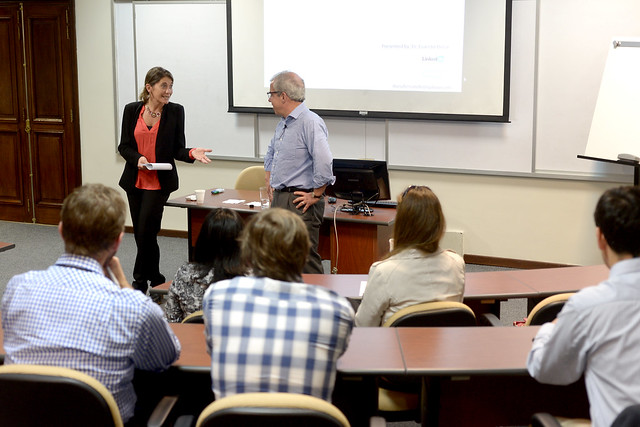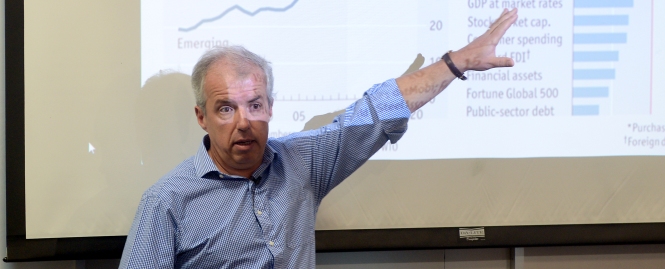
“Companies have three options: win, sell, or go out of business,” said Dr. Evaristo Fernando Doria during the conference “Oasis: In Search of Extraordinary Business Growth Beyond Borders.” The final event of the year in the Management and Business Lecture Series took place on Wednesday, November 25, 2015.
Doria is a professor of international business at the J. Mack Robinson College of Business at Georgia State University in the United States and has served as a business executive at Fortune 500 companies. He has written and co-authored several books, including *Oasis: In Search of Extraordinary Business Growth Overseas* (with D. Bruce and P. Carrillo), on which the lecture was based.
The demographic challenge
A resident of Atlanta for several years, Doria began the conference by reminiscing about his youth in Uruguay. “I used to think Uruguay was small. Over the years, I’ve come to see it from a different perspective, and I’m very optimistic about its future,” he said.
He then addressed the demographic challenge facing developed countries and highlighted the decline in birth rates in nations such as Germany (a 21% drop) and Japan (a 15% drop). He noted that this has a significant impact on the economic situation in each country.
“A country’s economic growth is measured by the population aged 25 to 55,” he said, adding that with current birth rates, development is physically impossible. He also noted that low birth rates create an environment that is not conducive to the establishment of new businesses.
He also commented on the shift in attitude among the so-called “Millennial generation.” “Those born after 1980 want to advance more quickly. They expect to be promoted every one or two years.” This has a significant impact on how companies operate.
To meet the growth demands of their workforce, organizations must constantly create new jobs, and to do so, they need to increase their profits by double-digit percentages. However, the expert noted that growth expectations for developed countries are around 1% or 2%.
Double-digit growth and expansion in Asia
According to the expert, there are two ways to achieve double-digit growth: radical innovation and international business. Regarding the first, he noted that it is important to keep in mind that 96% of radical innovation projects fail.
Regarding international business, Doria cited the PricewaterhouseCoopers barometer, according to which most large companies expect overseas revenue to account for just 18% of their total revenue. He then explained this by referring to the existence of a “comfort zone.”
Given this outlook, he predicted that small and medium-sized enterprises would enjoy significant international growth. “We are at a point of convergence in the global economy,” he said, adding that this trend is set to continue and that the strongest growth is expected in Asia—particularly in India and China—albeit for different reasons.
India, for its part, is the country with the largest number of English speakers after the United States (more than 125 million people) and provides a low-cost workforce. China, meanwhile, has developed a highly attractive business infrastructure. “China consumed more cement in three years than the United States did throughout the entire 20th century,” Doria noted.
The opportunity for these two countries, however, could be seriously jeopardized by a shortage of an essential natural resource.
The resources of the future
According to the expert, fundamental changes are taking place in several areas. “We are entering the era of robotsourcing, ”he said, adding that many companies will continue to seek out cheap labor, but that this is not the future.
Doria argued that the management of natural resources will be a top priority in the near future, even more so than winning over new customers. In this regard, he placed special emphasis on one resource in particular.
“The main natural resource that is running out is water,” he said, noting that the problem was recognized at the 2015 World Economic Forum. “In the next 10 to 15 years, large companies are going to come to Latin America in search of water,” he warned.
The speaker referred to the study *The Limits to Growth*, conducted in the 1970s, which predicted the depletion of natural resources, and noted that another study carried out in 2014 confirmed the accuracy of those predictions, “even though we have mitigated the decline.”
“Water is just as important as oil, if not more so, and industry is the biggest consumer,” he said, giving a striking example. “Making a single cup of coffee requires 140 liters of water. If we consider the price of coffee, we’re practically giving away the water. This is going to have to change,” he stated.
A study on global water availability indicates that India and China are in a precarious situation. According to Doria, this is due to their large populations and scarce resources—two issues that the authorities are trying to address in various ways.
Against this backdrop, one Latin American country stands out from the rest. “Brazil is the country with the best conditions. It will be among the five or six most powerful countries in the world,” Doria noted, explaining the reasons behind this assertion. Considered “the Saudi Arabia of water,” Brazil has billion trees (at a rate of five per person worldwide) and is home to the Guaraní Aquifer, a water reserve that experts estimate could supply the entire world for a thousand years and which stretches from southern Brazil to northern Uruguay and northeastern Argentina.
“For established companies, now is the time to enter the Brazilian market,” the expert said, though he acknowledged that the difficulty in finding qualified personnel in that country is a challenge that must be overcome. “Organizations are made up of people, and if they don’t have the right people, they don’t function.”
Cooperation, Education, and Challenges
When discussing the situation facing Latin American companies, Doria emphasized the need to establish “competitive cooperation” among business leaders. This would enable businesses to grow and strengthen their positions as they prepare to compete with powerful companies that may enter the Latin American market in the near future.
According to the speaker, there are three possible outcomes for small and medium-sized businesses: “Succeed, sell, or go out of business,” he said, explaining that in this context, collaboration among business owners will be essential for survival.
When asked by the audience about educational policies and how they align with business objectives, Doria said that schools need to focus on two areas: effective communication and the ability to take responsibility and get things done.
When asked how to engage with government funding agencies and deal with perspectives that differ from those of business owners, he said that “even in developed countries, where it is easy to secure funding, governments play an important role” in the early stages of a business. Finally, he suggested viewing problems as challenges and finding ways to turn them into opportunities.
Video:
https://youtu.be/1sVnaeUtR40
Image gallery: