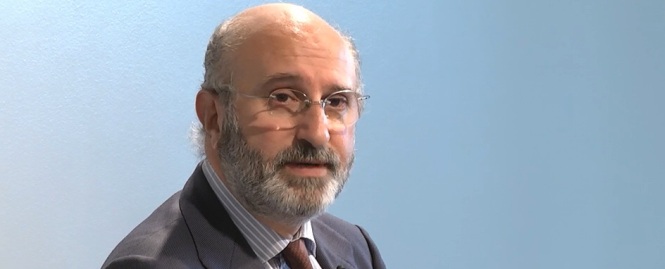
Universidad ORT Uruguay titled “European Union (EU)-Mercosur Agreement” was held in the auditorium of the Faculty of Administration and Social Sciences at Universidad ORT Uruguay . The event, organized by the Department of International Studies, took place on Tuesday, September 24, 2013, and was led by the EU Ambassador to Uruguay, Juan Fernández Trigo, who provided details on the status of the negotiations.
The negotiations have been ongoing for more than 15 years and have been among the most “complex” in history, Trigo acknowledged, adding that it is not certain that an agreement can be signed starting in November, when negotiations resume. In 2013, the crisis in Paraguay prevented progress, resulting in lost time in the negotiations. The upcoming elections in Argentina are also an obstacle and reduce the “room for maneuver,” said Trigo. Meanwhile, in 2014 the EU will elect a new European Parliament, which means positions on an agreement with Mercosur may shift. “It won’t be an easy year, but there is room for hope,” the Ambassador assured. “There continue to be differing views on free trade. There are countries that protect their industries, and we have doubts that this is the right approach,” Trigo said.
The agreement consists of three parts. The political component has been in place since the 1990s, and there is consensus on the protection of human rights, the fight against organized crime, and so on. The second part, which consists of cooperation agreements, is already “significant” because it amounts to 50 million euros in sectors such as education, biotechnology, and the audiovisual industry. The most challenging aspects are those related to investment and trade.
On the one hand, Mercosur wants to promote the import of cattle, sheep, and poultry into the EU, but the EU faces internal challenges in granting zero tariffs on these products. The solution currently being negotiated is the establishment of import quotas for these products. Other products, such as fruit juices, are also facing resistance from European producers. In Europe, there is also a strong belief that designations of origin for quality products must be protected. For example, they are reluctant to allow the import of Burgundy wine produced in Mercosur, a product for which Europe seeks exclusivity. At the same time, the EU has a restrictive policy regarding intellectual property. On the Mercosur side, there is a certain tendency toward protectionism for “emerging” industries such as the automotive sector, a sector the EU wishes to introduce in the Americas. The EU also wants to liberalize services such as banking and transportation, and is requesting greater access to public tenders at the regional and departmental levels. Furthermore, there is concern about confusion regarding the origin of products, an issue on which the EU wants to establish clear rules so that Chinese products entering Mercosur do not indirectly benefit from an agreement with the European bloc.
Trade between the EU and Mercosur amounts to 125 billion euros, and EU investment stands at 286 billion. “There is great potential in free trade because there are 750 million consumers across both regions,” said the ambassador. “They are neighboring, democratic regions that place a strong emphasis on human and social rights, so it is surprising that there is no agreement.”