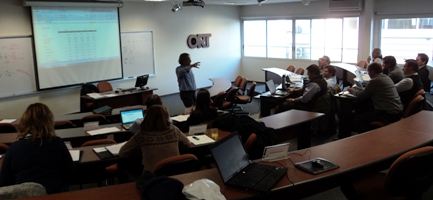
 Interview with Dr. Jordi Fabregat, professor at ESADE Business School and visiting professor in programme Management Development (PMD) at the School of Graduate and Executive Studies within the Faculty of Administration and Social Sciences. Fabregat, a specialist in finance, spoke about the current state of the Spanish crisis.
-In the lecture you gave last year at the university, you said that Spain hadn't hit rock bottom yet. Do you think it has now?
-No, we still have two or three quarters to go before we see positive growth. We'll hit rock bottom in six months. Hopefully, we'll start growing in 2014.
-How has the crisis in Spain unfolded over the past year?
-Things have gotten worse. GDP has fallen, young people can’t find jobs—youth unemployment stands at 50%—and we still need to resolve two major issues. One is completing the cleanup of the financial system; a major reform has already been carried out, but the next step is still needed. The second is that the pension system is not sustainable in the long run. We have to introduce some changes that, whether people like it or not, will mean lower pension levels in the short term. This is inevitable; other countries have already done it. It’s what’s called a sustainability factor, which basically links pensions to contributions.
-What is the current situation regarding retirement in Spain?
-The situation is complex. Pensions aren't astronomically high, but they are high relative to the final salary. They amount to about 80% of the final salary received, whereas the European Union average is 50%.
-Do you believe that the underlying causes of the Spanish crisis have been resolved at the systemic level?
-One of the problems we face right now is the amount of debt held by households, states, and businesses. So it won't be resolved anytime soon. It will take years to return to normal debt levels—this could take 10 years.
-Do the structural factors that led to the crisis still exist?
-The thing is, the consequences are too severe to be resolved in five years. We're going to need at least five more.
-Do you think it could happen again?
-It’s unlikely to happen again because I don’t think we’ll let families get into such deep debt again; we won’t see the kind of lending we saw during the real estate boom. But we’ll have to be patient, because these kinds of imbalances aren’t fixed in a couple of months. It doesn’t depend solely on us; if we can get the European Union to grow just a little more, things will be easier for us.
-How is the Rajoy administration performing at present?
-He does what he can. He is completely at the mercy of what Brussels dictates, because it is Brussels that provides the funding—with a set of conditions he must meet, whether he likes it or not. Anyone in his position would have no choice but to follow orders.
-Do you think the government was right to cut public spending on education and healthcare?
-This is a bit tough. We have a public deficit that will end up at 6.5% this year, and that can’t be financed; we have to bring it down by any means necessary, and by 2016 we have to get it down to 3%. We have to make cuts; I wish we could do it elsewhere, but it’s very difficult not to cut the biggest items.
-There has been criticism that the government implements austerity measures but does not apply them to itself. For example, the German government cut its own salaries by about 30%. Do you agree with this criticism of the government?
-In part, yes. This is more of an aesthetic issue than anything else, but it’s true that it hurts during a crisis. It would be more important to look for other kinds of imbalances. For example, members of parliament receive lifetime pensions—I don’t understand why they get them—as do former heads of government, or widow’s pensions, which should be limited based on income or net worth. But that alone wouldn’t be enough.
In Spain, we face a difficult challenge. We need to reduce the public deficit while at the same time spending enough to keep the economy from collapsing. We need to spend more wisely. We shouldn’t be spending on high-speed trains—we already have the second-largest high-speed rail network in the world after China—or on airports that haven’t even opened yet.
-As a professor at ESADE and ORT, what role do universities play in preventing future crises?
-In addition to a very solid conceptual foundation, we need to cultivate a sense of humility and try to see what’s really happening on the ground, where people live. But sometimes macroeconomic decisions are made based on very large numbers, overlooking the hardships people face on a personal and microeconomic level. Moreover, it turns out you might be wrong; circumstances change, and the economic truths we knew before aren’t necessarily the same. What we’ve learned from this crisis is that excessive debt eventually leads to problems. We’ve learned this at the individual level, at the corporate level, and at the national level.