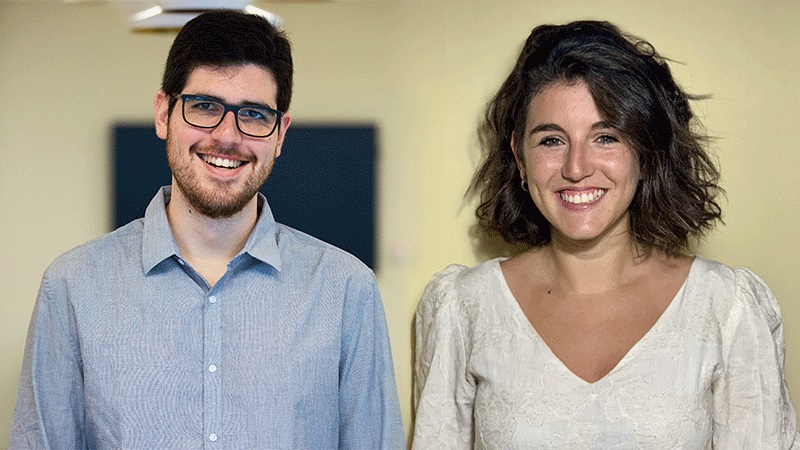
Agustina Affonso, Emanuel Schertz, and Martín Grunwald, graduates of the Bachelor of Economics program at Universidad ORT Uruguay, have been accepted into top-tier international universities to pursue doctoral degrees in economics. Schertz will pursue his degree at Harvard University; Affonso and Grunwald will do so at Arizona State University.
Schertz and Affonso discussed what doctoral programs entail, the career opportunities they offer, the moment they realized they wanted to pursue a career in research, what the application process was like, and how they chose which university to attend.
-
What do PhD programs in economics entail?
Agustina Affonso: The Ph.D. program provides us with the training necessary to conduct economic research at the highest level. The first two years consist of very rigorous courses, and the following three focus on the doctoral thesis, during which students conduct independent research under the supervision of their advisors.
Emanuel Schertz: As for the initial courses, the first year consists of general classes in economic theory, while the second year focuses more on the areas of economics in which each student wishes to specialize.
-
What kind of career path does someone pursuing a PhD typically aim for?
Affonso: People who apply for a Ph.D. program usually aspire to pursue an academic career, typically in a university’s economics department, conducting research and teaching.
But there are also excellent job prospects in government or multilateral organizations, as well as in the private sector. In recent years, the demand for PhDs in economics from large companies such as Amazon, Facebook, Uber, etc., has grown significantly.
Schertz: It varies greatly. In general, it tends to be divided into two paths: the academic world and the professional world or international organizations. In the first, one engages in research and follows a path similar to that of a PhD within a university, publishing papers and teaching classes. The second, in the case of economics—unlike other fields—is more oriented toward technology companies or consulting firms. When it comes to international organizations, these might include the Inter-American Development Bank (IDB), the World Bank, etc.
-
At what point in your time as students or recent graduates did you realize you wanted to pursue a career in economic research?
Affonso: I remember my first foray into research with a final paper for an advanced course in Labor Economics, in which I analyzed gender pay gaps and segregation in Uruguay.
From that moment on, I fully understood the potential of this discipline to answer many questions I had been asking myself since I was a child. For example, why did my father earn more money than my mother, if they both worked the same number of hours and in the same profession? I think that was when I finally realized that research in economics was what I wanted to do.
Schertz: I think it wasn’t a single moment but a process. I remember a conversation with Professor Flavia Roldán after class that lasted a couple of hours, during which I discovered this possibility. Many conversations with other professors and alumni, such as Professor Francisco Rosas and Santiago Acerenza, also influenced me. For a year, I worked on research with the coordinator of the Bachelor’s Degree in Economics, Dr. Néstor Gandelman. That period was also crucial.
-
Applying to universities for a Ph.D. program is a highly competitive process. Could you explain this?
Affonso: That's right; the process is very competitive. Universities receive hundreds, even thousands, of applications, and the groups generally consist of between 10 and 25 people. The global economic crisis made this year even more challenging.
On the one hand, many universities have cut their budgets, which means they can accept fewer students. On the other hand, many programs received a record number of applications.
Schertz: It’s an intense and complex process. A lot of groundwork is needed for universities to even consider you. Plus, organizing everything and submitting it is quite a bit of work.
You have to submit your resume, academic transcripts, a cover letter, and various other requirements that vary by program. The process is very competitive. This year was especially difficult because several programs accepted only half as many students as in previous years.
-
You were very successful. Can you tell us which universities accepted you and what that acceptance entails?
Affonso: In my case, at first I was really scared by the number of people I knew were applying this year and by the budget cuts at most universities, so I applied to a lot of places. In the United States, I was accepted to several universities, including the University of Wisconsin-Madison, the University of Maryland, Boston College, and Arizona State University. I was also accepted into very prestigious European programs such as CEMFI, the Tinbergen Institute, and Bonn.
Fortunately, all of my acceptances came with full funding, which includes tuition waivers, an annual living stipend, and health insurance for five years.
Generally speaking, in exchange, universities require you to take on a light workload as a research assistant or teaching assistant. But it’s also possible that you might be exempted from this. At Arizona State University, for example, during the first year we can focus solely on our studies.
Schertz: In my case, I was lucky enough to have to make a very difficult choice between Harvard, Berkeley, Princeton, Northwestern, Michigan, and Brown.
-
How did you decide which college to attend?
Affonso: It was a tough decision. I made my choice based on trying to maximize the academic quality of the university and some personal considerations. As a result, I ended up turning down some very attractive offers from programs ranked among the top 15 in the United States, such as the one at Wisconsin-Madison.
I’ll be attending university alongside another ORT classmate, Martín Grunwald, who also chose this program at Arizona State University (ASU). In his case, he chose ASU over Minnesota, another highly prestigious program in macroeconomics.
Schertz: The process is a lot more complicated than it seems. There are many program rankings that serve as a good initial guide. But some departments excel in certain areas more than others. And it’s important to try to go somewhere that excels in the area you’re interested in.
I chose Harvard because it excels in the vast majority of fields. It wasn't an easy decision.
It's easy to lose sight of the bigger picture and get caught up in comparing minor details, but it's good to remember that all three of us ORT candidates had a range of incredible options.
-
Did ORT support them throughout this decision-making and implementation process?
Affonso:My professors always motivated me and encouraged me to pursue an academic career. They devoted a great deal of time to our application process, from the initial selection of which universities to apply to, all the way through to receiving the results. They also wrote letters of recommendation and reached out to their colleagues at universities abroad. I would particularly like to highlight the support I received from Néstor Gandelman, Flavia Roldán, and Francisco Rosas.
This process is very stressful, and it’s tough when the first rejections come in (which usually arrive before the acceptances) and you start to think you won’t make it. During those difficult moments, the support from my professors made all the difference. They instilled confidence in me and offered encouragement; after every conversation, I became convinced that things would turn out well. And they did.Schertz: I am very grateful for the support I received from the professors in the Department of Economics, both during the application process and throughout all the steps leading up to it.
Their help was invaluable, whether it was writing letters of recommendation or spending hours talking with me to help me make the best decision.
-
What message do you have for today's students?
Affonso: Dream big and set high goals for yourselves. With hard work and the support of your teachers, you’ll be able to achieve your goals.
And here’s a bit of practical advice: don’t neglect your studies. In a way, your academic performance will be your calling card if you decide to continue your education.
Schertz: It's possible. You have to put in a lot of effort, and a little luck never hurts. But it's possible.