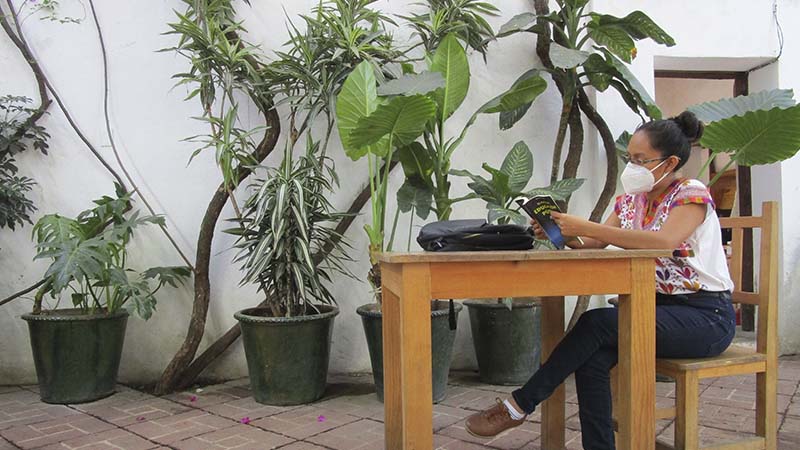
Why did you decide to do your internship at the Institute of Education at Universidad ORT Uruguay?
I have decided to conduct my research stay in Uruguay because of my interest in the topic of executive training. However, my interest is not limited to general aspects; I am specifically interested in educational management and school administration, as these are key areas related to executive training.
Given this interest, I began looking into opportunities that would allow me to pursue this path. But I also kept in mind the possibility of studying abroad. So, my goal was to find opportunities at universities overseas.
Suddenly, I came across RedAGE, which stands for the Educational Management Support Network. And here I see a much broader picture of schools and universities that are making strides in educational management and their training programs.
That's when I came across Universidad ORT Uruguay. I started doing a little more research and found the Master's in Educational Management program. I reached out via email to Ana Olmedo, and she put me in direct contact with Dr. Andrea Tejera. And the response was positive.
Given the pandemic, the situation was more than a little complicated. That’s because the responses I received from many other universities were that they couldn’t offer a virtual research placement. They told me that it wasn’t part of their plans to make room for me in this way
 Suddenly, they also told me that the courses were offered exclusively in person, which didn’t help my situation, given the mobility issues that weren’t being addressed at my institution. Also, suddenly, there were places where I never received a response, and that really wasn’t ideal, was it?
So, it was really important that Universidad ORT Uruguay gave Universidad ORT Uruguay this opportunity, wasn't it? There was a response, there was follow-up… Obviously, there was a formal part of the process.
But it was really thanks to this opportunity that arose that I was able to say, “Well, why not a virtual internship?” After all, everything was being done virtually anyway. And, in that sense, that was also one of the reasons I was able to do this research internship at the university.
What did you know about the institution and the Uruguayan education system at the time of your application?
The information I had at the beginning of my stay in Uruguay was very general: what you hear on the news and on the radio. Uruguay seems like a very pleasant place, in the sense that you don’t hear about conflicts or social or economic problems. Or, at least, I’ve never come across that kind of information about Uruguay.
In the master’s program I’m enrolled in, we examine many educational contexts from a management perspective. At one point, we got around to discussing the Uruguayan context. That’s when we realized that Uruguay has a very high standard of education. It was the second country, after Cuba, to have a well-established educational system of high quality. And I found that interesting.
But that was really the extent of my knowledge—nothing more, nothing less. So, when I started making arrangements for my stay, I said, “Let’s see what Uruguay is all about. What’s there in Uruguay? What’s it like?”
And so, I began to look into it. It turns out I came across this aspect—which really appealed to me about the Uruguayan context—where there is a focus on innovation and education… On creating a new approach, a new educational model, and strategic efforts in the training of teachers and administrators through the Ceibal Plan and the Global Learning Network.
It's really interesting, actually. I didn't know much about it before, but now, thanks to my interactions with the students at the Institute of Education, I'm starting to understand what Uruguay's educational approach is all about.
Specifically, what tasks are you working on at the Institute?
I am working on the course "Management of Educational Institutions" with Dr. Andrea Tejera. Currently, the tasks I am carrying out during my research internship involve facilitating discussions, providing feedback, fostering interaction, and sharing opinions with the course participants. This includes working with readings in the forums, reflecting together, and following up on the conversations we have within the group. I am also involved in providing feedback on the final projects, offering my perspective and pointing out elements that may be missing from the students’ reflections.
 In addition, regarding the management of educational institutions, a forum was held. There, participants discussed the challenges they face in the context of the pandemic and listed the tools they are implementing. As a result, there is a very comprehensive database.
Together with Dr. Tejera, we are working on an article about the challenges faced by the directors of the four cohorts of the Diploma in Educational Planning and Management in the context of Deep Learning, both before and during the COVID-19 pandemic.
What differences and similarities did you find between the education system in Uruguay and that of your country? What aspects do you think could be strengthened or improved here?
The main differences I see between educational administration in Mexico and that in Uruguay are that, in a way, Uruguay has already made progress; there’s work being done… I see it as well-established in the field of educational administration.
We are talking about training that has been provided to teachers and school administrators through the Global Learning Network, and which has reached a large portion of Uruguay’s educational community.
One major difference is that Uruguay has reached a fairly mature stage in terms of educational management, but under new paradigms and with new elements related to shared learning, teamwork, and collaboration
While they do have their challenges, at least there is a shared understanding that is beginning to take hold in schools. And in that sense, we are talking about a new approach to education.
This is the main difference I see compared to the Mexican educational context. In my country, there is actually work being done. It’s quite isolated, though, because we haven’t yet managed to coordinate all these efforts at the national level.
But there is one similarity—and we need to identify the reasons behind it—: administrative work, at least for school principals, continues to be overemphasized. This is true in both Uruguay and Mexico. Educational work requires a great deal of pedagogical effort and a focus on pedagogy. Yet, administrative work continues to take over our time.
That is what Uruguayan principals tell us, and something very similar is happening in Mexico. So, it is important to understand what administrative work is based on, and why it continues to permeate schools and the work that principals do.
As for the research internship, how would you sum up the experience? What do you think you’ve contributed to the Institute, and what have you taken away from it?
My main goal is to share my experience with the work being done in Mexico and some of what I’ve learned during my master’s program.
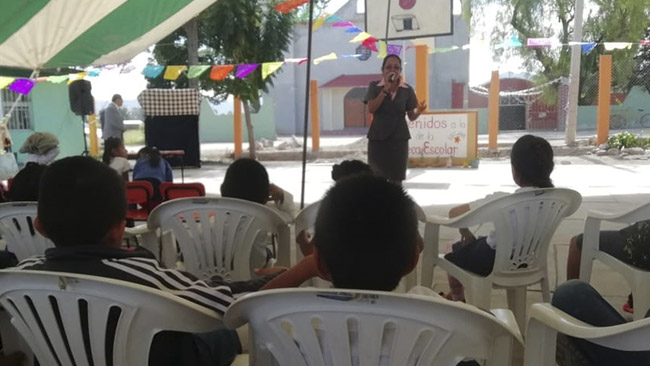
I am an elementary school teacher with 10 years of experience. I want to share some of what I have experienced as a teacher and how that relates to school administration. Basically, that is what I have been able to contribute, and, well, it is one of the things I have really enjoyed sharing with the students at the Institute of Education.
And, on the other hand, I’ve learned so much from their experiences. I’m not a director yet; that’s my goal for the future. And for me, it’s been very, very important to gain this insight into what a director actually does, what their main challenges are, and what their work strategies are. Everything I’ve studied, I can see reflected in reality. And this has been very enriching.
I think we should focus on international collaboration, on creating more opportunities for academic mobility, for connecting with people, with the field, with professionals, and with the academic community. It’s a core component.
What do you think is the value and importance of having the opportunity to do an internship like this? Would you recommend it to other students?
I believe it’s very important to allow yourself that space for interaction, for building relationships, and for learning about other contexts beyond your own national, state, or regional context. It’s essential to step outside of that. To break away from your own perspective—your own view of what is familiar and what you know.
When you allow yourself to step outside that context and engage with other realities, your horizons ultimately broaden. In this sense, I’m able to see myself, get to know myself, and understand myself better by observing another reality—by seeing what’s happening elsewhere. When I see them, I then turn my gaze back to my own context and say, “Well, I can understand it better from a different perspective.”
And I think that’s the best part of having an international experience—that you can say, “Okay, over there it’s like this; here it’s like that.” And there are things that we can share between there and here, right?
I definitely recommend it. I believe it’s an essential part of professional development, at any level. I think this aspect of the exchange is enriching: it enriches one’s professional development, personal growth, and expectations.
Working with colleagues who are in the process of training is invaluable. Ultimately, we should invest more in and work harder to promote academic mobility and strengthen ties. It is invaluable.