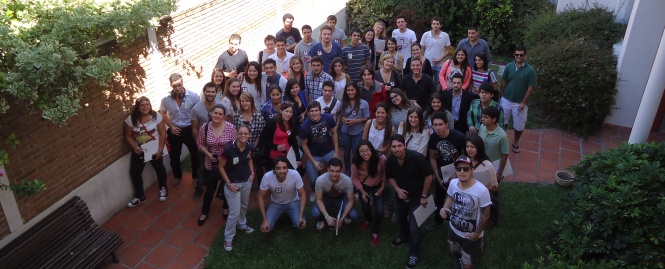
With the start of the new academic year, 14 exchange students from Germany, Brazil, the United States, England, Mexico, and Portugal arrived at the School of Business and Social Sciences in March 2013 to take part in this academic and cultural exchange program.
Eighteen students are participating in the exchange program at the college, as four joined last semester and one more will remain. A total of 25 international students arrived at the university, in addition to nine others who joined last semester. Added to this number are the 42 students from China participating in the joint program with Harbin Normal University.
These students, with the exception of those from Harbin, are still deciding which courses to take and have until April 1 to do so. “The trend is to choose courses with a focus on national culture: ‘Uruguayan Economy and Society,’ ‘Uruguayan Politics and Society,’ and ‘Contemporary History of Latin America.’ But also subjects such as ‘International Trade,’ ‘Operations and Logistics,’ ‘New Ventures,’ or languages,” said Miriam Kemna, Student Exchange Coordinator.
On March 6, a welcome and orientation event was held for new students, during which they were also given some advice for their stay in the country.
Kemna, on behalf of the Exchange Office, offered a few words of welcome and then went on to provide practical details about the university. The students were also given some information to help them become more familiar with the country’s reality; they were shown a video about Uruguay and invited to take part in sports activities and events organized by the university. And, for those interested in volunteer work, the “Colibrí Project” was presented—an initiative that brings together young people and children from the Marconi neighborhood. “The idea is to take international students to that neighborhood so they can interact with the children and experience a different environment, and so that, in turn, the neighborhood children—who have little social contact outside the area—can meet students from other countries,” said Kemna.
The Student Exchange Coordinator explained that students choose Uruguay for their academic exchange programs because their home universities have agreements with Universidad ORT Uruguay, “due to Montevideo’s safety compared to other Latin American capitals and its proximity to other countries in the region.”
Adapting to life in the country is a very personal experience for each student, Kemna says. “Some have a harder time than others. There are many things that are different in Uruguay—from the way people greet each other to the way they speak,” she explains.
The Exchange Office and the student advisors from the various faculties provide guidance to the students during their stay in Uruguay. In addition, each student has mentor who accompanies them throughout their stay. Unless the student expressly states that they do not want one, all students are advised by this mentor, and there may even be several mentors assigned to each student. Every year, a call for mentors is issued, and the last time, Kemna said, 150 people signed up.