
-
Jewish Diary
On that occasion, the Jewish Diary was presented, dedicated to the writer Shalom Aleichem on the 100th anniversary of his death.
Shalom Aleichem has been called "the Jewish Mark Twain" because their writing styles were similar and both wrote under a pseudonym. Both authors wrote for adults and children and gave lectures throughout Europe and the United States.
Speeches
-
Charlotte de Grünberg - General Manager
I would like to welcome everyone who has worked with us throughout the year to make our university what it is today—our committee, the friends of Universidad ORT Uruguay all our friends.
The year 5776 will begin at sunset on Sunday, September 13.
This year, our calendar is dedicated to the 100th anniversary of the death of Shalom Aleichem (1859–1916). Universidad ORT Uruguay tribute to his memory in this calendar.
"Shalom Aleichem is considered not only the father of modern Yiddish literature, but also the Jewish humorist, the artist who knew how to capture the purest essence of Eastern European Jewry and bring it to life in stories that evoke those vanished villages inhabited by incurable optimists and the downtrodden, those ancestors of ours who transformed hardship and struggle into endless fantasies of carefree living and community."
A lot has happened between September of last year and the start of this new year. I’ll mention just a few.
Our university welcomed 2,027 new students, enrolled in our various programmes , graduate, technical, and short-term programmes .
1,182 professionals graduated from our schools in 2014.
More than 120 international students are studying for one or two semesters at our university, and 97 of our students are doing the same at partner universities abroad.
Special Projects
Based on the concept of smart, self-sustaining social housing, students from the Schools of Architecture, Communication and Design, Engineering and Management, and Social Sciences came together to build a house that will participate in the Solar Decathlon in the city of Cali later this year and compete against teams from Colombia, England, Mexico, Panama, Spain, Chile, and Germany.The house is prefabricated and will take only 10 days to build. It is powered by solar panels and helps promote energy efficiency. What makes this project extraordinary is that it is the result of a joint effort by nearly all of our schools, working together under the leadership of the School of Architecture.
The documentary *Giza, the Girl in the Suitcase* won the Best Film Award at the Jewish Film Festival in February 2015. The film is a co-production of the Blanquerna School of Communication, URL, Barcelona, and Universidad ORT Uruguay.
Students’ Notable Achievements There have been many such achievements throughout the year. We will mention just one. Once again this year, a student (Natalia Cohn) from the Bachelor’s Program in International Studies was the only Uruguayan student selected for the Botín Foundation’s Programme Strengthening the Civil Service in Latin America. The Botín Foundation, a Spanish organization, offers an eight-week training program at universities in the United States, Brazil, and Spain.
Institutional Agreements New academic agreements have been signed this year, adding to a portfolio that includes more than 150 universities and institutes in 28 countries.• Deakin University, Melbourne, Australia.
• COPPEAD (Graduate School of Business), Federal University of Rio de Janeiro, Brazil.
• Pontifical Catholic University of Rio Grande do Sul (PUC RS), Brazil.
• Polytechnic University of Valencia, Spain.
• University of Lodz, Poland.
• Communication University of China, Beijing, China.
Two non-university agreements were also signed with the Embassy of the Republic of Korea in Uruguay, for the establishment of the King Sejong Institute in Uruguay; and with the National Institute of Vocational Training of Honduras (INFOP), to provide technical assistance.Publications by Academic Staff
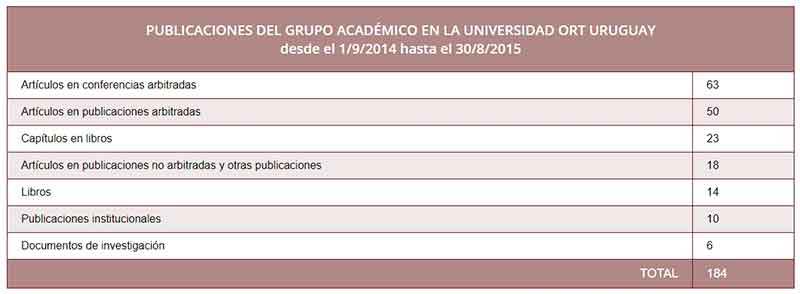
Graduation Ceremonies
Several improvements have been made to the graduation ceremonies held at the Solís Theater, with the aim of enhancing image quality, lighting, and sound.Current Projects
I invite everyone who hasn't been there yet to stop by and visit the new Biotechnology Center at 1237 Mercedes Street.Plans are in place to expand the entrance hall at the Downtown Campus and relocate the offices, which we hope will be up and running by the start of the new academic year.
Department of Jewish Studies
On July 2 of this year, the Pocitos Campus hosted the premiere of the children’s opera *Brundibár*, presented for the first time in Uruguay. The opera was composed by Hans Krása in 1938 and was performed at an orphanage for Jewish children in Prague and later at the Terezín concentration camp.The play deals with the eternal struggle against tyranny and unchecked power and was performed at the Adela Reta Hall at the Sodre. The premiere was attended by Ela Weissberger, the sole survivor of the concentration camp’s children’s choir. Today, at 84, Ela lives in New York and remains an inspiration in the fight for freedom.
The entire year of 2015 was devoted to analyzing anti-Semitism around the world from the perspective of visiting scholars from foreign universities and local faculty members.
The topic was chosen due to the rising tide of anti-Semitism in Europe, particularly in France and Belgium, including outbreaks in Latin American countries. Holocaust denial persists despite laws prohibiting it. It is impossible to close the book on this issue, so it is necessary to take note of what is happening and strive to raise awareness at all times that this evil remains very active and is greatly facilitated by social media. And we must be fully aware of this.
I’d like to conclude with an example from my own life. Few people here know my maiden name. My maiden name (Strawczynski) is the one you see displayed on the screen.
I recently received this material from my Israeli grandnephew, Noam, who went on a school trip to Auschwitz a couple of weeks ago.
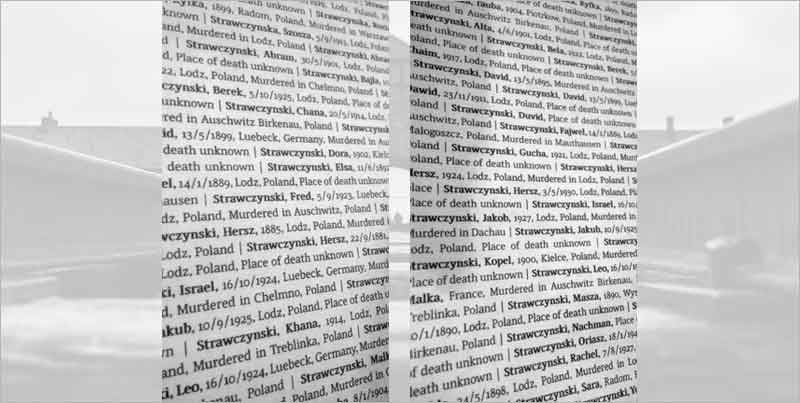
The boy is 17 years old and had been chosen to speak on behalf of his class. While searching for information about his family at the Auschwitz camp, he came across the materials on display. Noam has the same last name as me, as do all those listed—many of whom were certainly members of my family, from the same city of Łódź in Poland. They were all exterminated.I’m sorry to dampen the festive spirit, but this is important to know, because 70 years have passed and here we are again with refugees walking hundreds of kilometers to escape persecution in one place or another.
Nothing was learned.
As members of a university, all of you—well-educated people—cannot remain indifferent to the events unfolding in the world.
Thank you very much.
-
Erica Yac – Coordinator of the Department of Jewish Studies
As we do every year, we have gathered here today to celebrate Rosh Hashanah, or the Jewish New Year.
We meet up and catch up with colleagues we might only see once a year, as is the case this time. We enjoy a pleasant time together, accompanied by the delicacies of Jewish cuisine.
As many of you know, next Sunday, the 13th, when the first star appears, we Jews will enter the year 5776, with Monday the 14th marking the first day of Tishri on the Hebrew calendar.
Rosh Hashanah: In Hebrew, "Rosh" means "head" and "Shana" means "year."
We can see that the very name of the holiday invites us to pause and reflect. We don’t say “New Year”; we say “New Year’s Day.”
We will see later that there are other ways to refer to this holiday based on its very nature.
In the Torah (the text containing the law for the people of Israel), it is referred to as Yom Teruah (Day of Blowing the Horn), Yom Din (Day of Judgment), and Yom Hazikaron (Day of Remembrance).
What are we commemorating or celebrating at the start of the year, at this beginning?
From the perspective of Judaism, the anniversary of the creation of the world. The first day of Tishri corresponds to the sixth day of creation, the culmination of God’s work. The creation of man, his appearance on Earth, and thus the beginning. In the days prior, God created everything necessary for this man’s life: light, water, the heavens, and the earth. And then He created man in His own image and likeness as a divine creature breathed into with His own breath.
We are talking about the anniversary of the creation of the world and about this creation as an ongoing, continuous process.
It is also a day when we remember that our actions shape our future. It is a time of judgment. This first man, created in the image and likeness of the Lord, was judged when he sinned, and just as he was judged, so too will the world be judged by God.
Rosh Hashanah marks the beginning of ten days of reflection that culminate in Yom Kippur, or the Day of Atonement. We enter a new cycle of life marked by spiritual contrition and introspection, which we have had the opportunity to engage in since the previous month (Elul). We analyze our behavior, repent, ask for forgiveness, and—most importantly—make amends. We cultivate the ability to accept apologies and erase resentment and vengeance from our souls. We forgive any harm that has been done to us.
The sound of the shofar—the horn that reminds us of the ram sacrificed in place of Isaac, Abraham’s son—stirs us deeply. And in it, God—without words—is absolute and eternal. A sound that calls us to awaken spiritually and connect with the depths of our soul.
As we can see, Rosh Hashanah is a time of spiritual significance; to keep these meanings alive and ensure they are continually remembered, they are expressed through rituals.
And, of course, they’re connected to food, among other things. We’ll eat apples with honey to ensure a sweet year.
We will eat pomegranates, whose number of seeds—it is said—is similar to the number of mitzvot, or commandments, that must be observed in Judaism, to remind us that good deeds will multiply in the coming year.
We will eat dates to ward off our oppressors, as well as a lamb’s head or fish to remember the sacrifice of Isaac, but also the principled stance and leadership that the children of the people of Israel must strive to embody.A round loaf of bread is a must—to remind us of life’s cyclical processes and to keep in mind the passage of time.
The Midrash (that is, the sages’ interpretation of the Holy Scriptures) states that on Rosh Hashanah, three books are opened in which we will be inscribed based on the judgment of our actions: the Book of Life, the Book of the Dead, and the Book of the Intermediate.
These books are laid out before each of us. The book in which we will be recorded is the result of our choices and decisions. And, therefore, it reflects the daily accumulation of our actions.
It is my deepest hope that they will be inscribed in the Book of Life.
Happy New Year.

-
https://www.youtube.com/watch?v=ORfShnqjEGcSun Shiqi, a master’s student in education at Universidad ORT Uruguay, performs two traditional Chinese songs on the erhu during the Rosh Hashanah ceremony on September 11, 2015.