
-
Jewish Diary
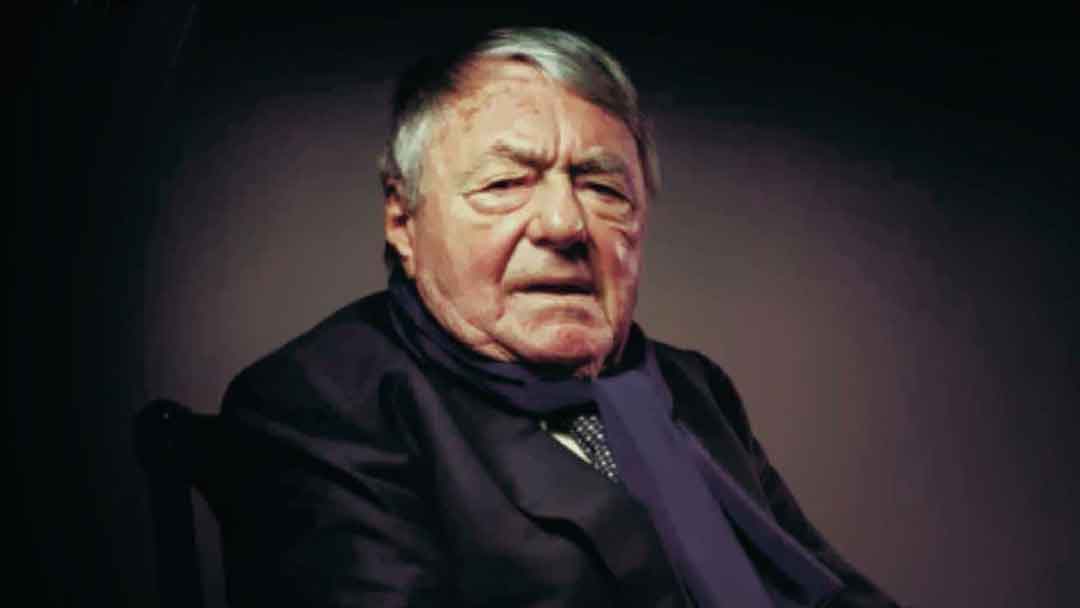
During the celebration, the Jewish Diary was presented, dedicated to Claude Lanzmann, who, with his film *Shoah*, created an extraordinary documentary—one that is essential in the fight against the possibility of allowing the accounts of survivors, and, with singular audacity, the accounts of the *Mitläufer* (active and passive collaborators), to fade into oblivion.
Speeches
-
Charlotte de Grünberg - General Manager
The year 5779, which begins this coming Sunday, September 9, at sunset, finds us gathered once again to celebrate Rosh Hashanah, the Jewish New Year.
Welcome to everyone, and especially to those who have recently begun working with ORT.
As you may have noticed, this year our technical team proposed creating an audiovisual presentation to showcase the university’s activities.
So many activities and developments take place every day that our presentation can hardly cover every aspect of university life; therefore, what you see here is a brief overview of what we believed would be of greatest interest to everyone.
For more than 20 years, ORT Uruguay has been producing a thematic calendar for Rosh Hashanah. It always commemorates exceptional figures and/or events. This year, the calendar is dedicated to Claude Lanzmann, the recently deceased French filmmaker and director of the memorable film *Shoah*, which runs over 9 hours. The film’s length is just one of the unusual aspects of this production.
In this documentary, dedicated to the history of the Jewish Holocaust known as the Shoah, Lanzmann approaches the subject through interviews—or perhaps we could call them conversations—with key figures, victims, survivors, and, incredibly, also with active or passive collaborators. By chronicling the various perspectives on the events, he creates a new way of telling the story of such a complex and dramatic subject, one in which the horrors themselves do not appear. The French newspaper Le Monde wrote in its obituary, “Claude Lanzmann changed the history of filmmaking forever.”
This year marked the 7th edition of the Shoah Course, a program for educators that has been designated as being of educational interest by the relevant authorities.
We also participated in the Punta del Este Jewish Film Festival for the fourteenth consecutive year, complementing the film screenings with our lecture series.
As it is every year, this gathering where we’re all together is one of the happiest moments of the year for me, because ORT and all of you play a very important role in the growth of our organization and in my life.
I would like to revisit a recurring memory that comes to mind, based on a comment by the great Israeli poet Abba Kovner, the founder of the Museum of the Diasporas in Tel Aviv, located next to the university. This museum is one of the most important museums dedicated to Judaism in the world. Abba Kovner described it as the “symphony of the Jewish people.”
To paraphrase that phrase by Abba Kovner, I, too, see us as a symphony—a chorus of voices, ideas, and a constant stream of innovative proposals that all come together in harmony.
I like that image; I think it captures us pretty well. With that spirit, we can move forward confidently into the 21st century.
I want to thank all of you for standing by me this year, which—like every year—has brought enormous challenges and some regrettable losses of colleagues whom we will miss.
-
Rafael Winter, Esq. – Vice President of the Montevideo Holocaust Memorial Center
We are just a few hours away from the start of a new Jewish year: we are entering 5779.
Next Sunday evening, when three stars appear in the sky, many members of our community will gather in synagogues around the world to listen to and participate in the prayers—led with care and brilliance by the cantor, whom we call the “chazan”—and each congregant will have their prayer book, which we call the “Machzor.”
When they return home, they will find a long table set with a white tablecloth, candles that have already been blessed, a cup of wine for the Kiddush, and traditional symbols, including an apple dipped in honey and a round challah, both of which symbolize the hope for a full, complete, and sweet year.
And among the traditional dishes, the good old gefilte fish...
There are surely many people gathered around the table: family, friends, and those in need in the community—and there are many of them—who obviously also have the desire and the need to celebrate Rosh Hashanah.
The next day, the following morning, I return to the synagogue once again, and there, during an extensive morning service, a magical moment stands out: the blowing of the shofar. Because Rosh Hashanah is also "Yom Teruah": the Day of the Shofar. A moment eagerly awaited by fellow believers of all ages. Not to mention the children!!
There are even those who go to the synagogue in the morning just for THAT moment: to hear the sound of the shofar. A very meaningful tradition.
As the biblical prophet Amos said: "Will the shofar be blown in the city and no one tremble?"
And that is, in a way, the purpose of the shofar: to shake us up! To rouse us from our slumber. To awaken our consciences! Calling us to reflection. Calling us to repentance. In Hebrew, "teshuvah."
This is a very important concept of Rosh Hashanah.
There is a prayer called "Unetane Tokef" which states that—even though God has already "determined" each person's fate—teshuva (repentance), tefila (prayer), and tzedaka (charity, social justice) can alter God's plans.
The holiday of Rosh Hashanah—remember: New Year’s Day, a day of joy, but a sober, measured, and restrained joy—has, like other holidays, alternative names.
One of them, as already mentioned: Yom Teruah.The other one is Yom Hazikaron: Memorial Day (not to be confused with the Memorial Day for soldiers who fell in defense of Israel).
This Yom Hazikaron (Rosh Hashanah), this Day of Remembrance, is also a Day of Remembrance, but in a different sense. Some interpret it as a remembrance of the Creation of the World. Others interpret it as a remembrance of the actions—good and bad—we performed over the past year.
This is associated with the "jeshbon hanefesh," a personal, individual self-assessment that we should undertake on Rosh Hashanah and even in the days leading up to it.
I want to associate Yom Hazikaron and Rosh Hashanah with the memory of times not so long ago—let’s say three generations back.
I’m thinking back to the years 1941–42 or ’43.
Rosh Hashanah in the Ghetto during the Holocaust in some of those years.
A ghetto in Poland, Russia, and Lithuania.
It could be Warsaw, Łódź, Vilnius, or Białystok.
Let's imagine a traditional Jewish family. It could be Shmuel, Reizel, and their seven children.
It could be Shloime, Blume, and their five children. Or it could be Itzjok, Gittel, and their entire family. All of them on Rosh Hashanah. In the Ghetto.
And you know what? They even “celebrated” Rosh Hashanah under the terrible conditions of the concentration-extermination camp.
The names mentioned above represent the millions of Jews who, in extreme circumstances unlike anything the Jewish people had ever experienced before, nevertheless managed to preserve our traditions and customs.
In other words, to ensure our continuity.
Unfortunately, however, almost all of them—once World War II, that is, the Holocaust, had ended—were unable to be part of that continuity.
Spiritual resistance.They probably weren't sitting around a large table.
It’s possible that they weren’t able to obtain some of the essential symbols.
In any case, Shmuel, Reizel, Shloime, Blume, Itzjok, Gittel, and all their children—along with millions like them—were celebrating Rosh Hashanah.And why did they do it, in such extreme situations? They weren’t forced to.
Faith prevailed; refuge in religion; keeping Judaism alive; defiance, ancient traditions... ancient traditions...Heszel Klepfisz, a survivor and author of a book about Rabbi Menachem Zemba (one of the great spiritual leaders of the Warsaw Ghetto), wrote in that book: "The Jews remained faithful to their sacred tradition. They gathered among the ruins of the destroyed synagogues to open their aching hearts to the Creator. They celebrated their religious holidays at the risk of losing their lives.”
They blew the shofar on Rosh Hashanah. They prayed fervently on Yom Kippur. They lit candles on Hanukkah. They proclaimed their unwavering faith in the defeat of evil on Purim; they celebrated the Passover Seder with heartfelt optimism and danced with great enthusiasm on Simchat Torah.
"The chroniclers who lived in the ghettos have left us, in their diaries, moving accounts of the Simchat Torah celebrations that took place in the destroyed synagogues. The Jews carried the Torah scrolls in their arms and held them close with a tenderness and love that cannot be put into words..."
And in this context, I am reminded of a story by Elie Wiesel, an Auschwitz survivor, a great writer, and a Nobel Peace Prize laureate.
In one of his books—“Being Jewish Today”—he tells a story about the Simchat Torah celebration in the hell of a concentration camp. It is the holiday that marks the conclusion and renewal of the annual cycle of Torah reading, which is celebrated with singing and dancing around the Torah scroll.
But in Auschwitz... in Auschwitz... there was no Torah!!
And on the happiest day of the Jewish year—Simchat Torah—Jews wanted to dance with the Torah, the holiest object in Judaism.
But there was no Torah! What were we supposed to do?
Someone came up with the idea.
"Look, look—there's a little boy over there. Let's lift that boy up, sing, and dance with him as if he were the Torah."
And that's exactly what they did.
They carried him on their shoulders. They sang and danced with the child being carried on their shoulders.
Elie Wiesel writes in his account that Simchat Torah was rarely celebrated with such joy.
Rarely.Celebrating the holidays under such subhuman conditions is one of the most sublime, heroic, and incredible things imaginable.
The Jewish spirit prevailed!
And in this context of Rosh Hashanah as Yom Hazikaron, the Day of Remembrance, we would like to pay at least a small tribute to Claude Lanzmann, who recently passed away.
Claude Lanzmann was a great French-Jewish filmmaker, screenwriter, producer, and journalist.
Born in 1925, he began his career in film in 1970.
His magnum opus is considered to be the documentary film "Shoah," which took him 11 years to complete.Since its release, "Shoah" has been regarded as a landmark event not only from a cinematic perspective but, above all, from a historical one. In preserving the memory of the Shoah, Lanzman and his extraordinary documentary occupy a prominent place.
It is only fitting to remember this great French filmmaker, thanks to whom interest in and knowledge of the Holocaust grew considerably at the time.
Dear friends:
Rosh Hashanah is a Jewish holiday, but its wishes, aspirations, and hopes are for all of humanity.
Wishing everyone a happy and sweet New Year!
HAPPY NEW YEAR!
-
https://www.youtube.com/watch?v=fKbpQgbI8A8"As it is every year, this gathering where we are all together is one of the happiest moments of the year for me, because ORT and all of you play a very important role in the growth of our organization and in my life."
Prof. Charlotte de Grünberg
Executive Director