
-
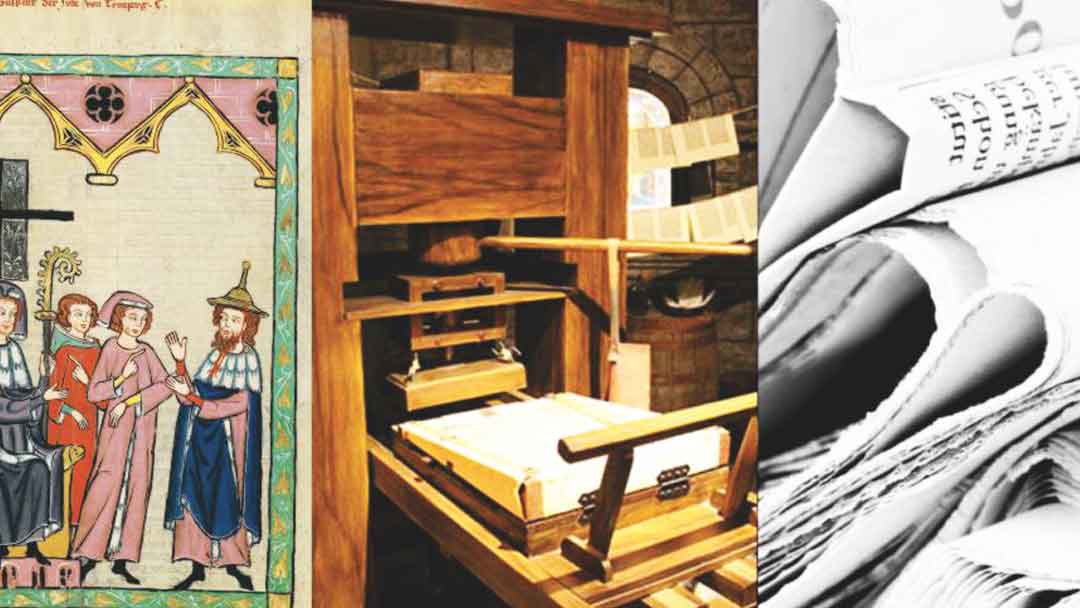
Jewish Diary
For more than 20 years, ORT Uruguay has been producing a thematic calendar for Rosh Hashanah, typically highlighting notable figures, significant events, and commemorations.
This year's program is the result of a reflection on the Holocaust, anti-Semitism, and modernity, viewed from a contemporary perspective.
Speeches
-
Charlotte de Grünberg - General Manager
Welcome to everyone: friends of ORT University, staff members, those who have recently joined the ORT community, and our special guests.
The year 5780, which begins this coming Sunday, September 29, at sunset, finds us gathered once again to celebrate Rosh Hashanah, the Jewish New Year. We are concluding a year filled with happy events, successful projects, and achievements. Students, alumni, faculty, and staff have all contributed to creating the atmosphere that surrounds us daily at our beloved ORT.
In a few minutes, you will be presented with a concise audiovisual summary of the highlights from the past year. Members from virtually every sector of ORT University have participated in the creation of the material you are about to see. It is a particularly rewarding experience for me to lead a team so committed to this project.
For over 20 years, ORT Uruguay has produced a thematic program for Rosh Hashanah, typically commemorating notable figures, exceptional events, and historical anniversaries.
This year’s agenda is the result of a reflection on the Shoah, antisemitism, and modernity, viewed from a contemporary perspective.
Why was this reflection chosen this year?
It is becoming increasingly difficult to be a clear-eyed witness in this global society, where familiar points of reference are being replaced by new ideas at an overwhelming pace.
Rumors, lies, and denialism permeate social media. The Truth is in danger as lies manage to prevail over values.
Denialism, a term coined by historian Henri Rousso, is a form of falsification of the truth and operates with far greater force and brazenness in nations where anti-Semitism is already widespread.
As early as 1948, just three years after the end of World War II, individuals had already begun to claim that the extermination had never taken place. Denialism is primarily driven by anti-Semitism. The fragility of truths threatens democratic societies.
What should be the response to denialist theories?
The historian does not necessarily challenge these attitudes in his writings. This is offset by scholars in the field producing books that describe the history of the Jewish genocide in detail. For their part, many Holocaust survivors, beginning in the late 1970s, began recounting their own experiences to new generations, urging them to honor the memory and look positively toward the future.
One could say that today, Holocaust denial belongs to the family of “post-truth,” generally defined as the entry into an era in which truth has lost all value in and of itself. It is the rejection of reality.
From an optimistic perspective, I embrace a quote from the great Golda Meir: “Pessimism is a luxury a Jew can never afford.” -
Jagay Alfassa - Liturgical cantor of the New Israelite Congregation of Montevideo
Shofar: The Sound of Freedom
The first thing we need to understand is the meaning of the word “Shofar”; its root comes from the word “leshaper,” which means to improve or beautify. It speaks to our journey toward improvement, helping us become aware of what we are capable of giving while enjoying our personal growth and, through that, our surroundings. It is a call to repent for our actions that do not contribute to a better place to live, marking a moment on the calendar to reflect on our daily lives.
The Torah mentions a special time for blowing the shofar. “On the first day of the seventh month, you shall have a holy convocation; you shall not perform any regular work. It shall be a day for you to blow the trumpets.” Bemidbar (Deuteronomy) 29:1
The first question that comes to mind is: Why celebrate the New Year in the seventh month of the calendar? This is because, in biblical times, the year began in the month of Nisan, when Passover—the Jewish holiday commemorating the Israelites’ exodus from Egypt—is celebrated. It is the rabbis who teach that on the first day of the month of Tishrei we celebrate Rosh Hashanah in remembrance of the creation of Adam Harishon, the first human being. On this day, we are commanded not to work, as it is a sacred, special day. The Hebrew words translated as “Day of Blowing the Trumpets” are “Yom Truá.” One of the sounds heard when the shofar is blown is the Truá, the meaning of which is explained in more detail below.
We blow the shofar throughout the month of Elul, but we refrain from doing so the day before Rosh Hashanah; this distinguishes the customary blowing of the shofar from the one prescribed by the Torah for this day.
Although today we hear the shofar on two occasions each year—Rosh Hashanah and Yom Kippur—in rabbinic times it was used to announce many other events in daily life. New laws and decrees were announced; it was blown to announce a person’s death so that people could gather for the burial; fasts were announced; and it was sounded when a Cherem or Nidui (excommunication) was decreed. One of the best-known occasions on which the shofar was blown is to announce a new month and the beginning of the holidays. Essentially, due to the delay in communication via the shofar blasts reaching the Diaspora communities, there is a difference in the number of Yom Tov (holy days) celebrated in the Land of Israel and in the Diaspora, where the holiday lasts one additional day. This custom is still observed, although the reason for maintaining it may be debated; it is a way to distinguish and preserve the tradition. Rosh Hashanah is the only celebration that lasts two days in both Israel and the Diaspora, as it is what is called in Aramaic “Yom Arichta,” an extended day, where the two days are counted as one long day.
A lesser-known but very significant moment is the blowing of the shofar on the eve of Shabbat, when it was blown six times. The first time, farmers stopped working the land; the second time, merchants closed their shops; the third time, people turned off their stoves and lit candles. Then a tekiah was sounded, followed by a troah, and finally another tekiah, and the people began their rest.
In the Talmud (a text of Rabbinic Judaism), in the tractate on Rosh Hashanah, there is a discussion about how long the sound of the shofar should last and what it should sound like. The Tekiah is a long, unbroken sound. Shevarim are three broken, medium-length sounds resembling a cry, as it is written: “And Sisera’s mother wailed (Tibeb)” (Judges 5:28). The Teruah consists of nine short sounds like a broken cry. Rabbinic texts tell us that the sound of the shofar represents a state of mind, a moment in the process of teshuvah (repentance, introspection, and reflection) whose goal is that one day those broken cries and wails may find unity in a warm embrace and come together in their very difference to resonate as the unified sound of the tekiah does.
It is interesting to note that in rabbinic times, there were two customs regarding the shofar blasts performed on Rosh Hashanah. The custom at that time was to sound two different blasts instead of three, as we do today. Some would sound the Tekiah and the Teruah, while others among the people would sound the Tekiah and the Shevarim. The Talmud tells us that Rabbi Abahu came and saw that it was beneficial to establish that the entire people of Israel perform a single act so that a simple difference in customs would not appear to be a division. Thus, he established that Tekiah, Shevarim, Teruah, and Tekiah be blown throughout the entire people of Israel.
From its very beginnings, our tradition has followed a path of continually adding to and uniting customs; throughout the calendar year, we combine flavors that connect us to our deepest roots and aromas that define each holiday. We blend and harmonize ancient and modern melodies in our prayers and remain open to incorporating new traditions into our lives.
May the Eternal One grant that, upon hearing the sounds of the Shofar, we may understand that the path of the Jewish people has always been unity in diversity. The integration of diverse customs, accepting traditions that have united us for millennia and help us build, teaching us that our path is the sum of all that strengthens us.

-
https://www.youtube.com/watch?v=OfKBIpJG9WQ"May the Eternal One grant that, as we hear the sounds of the shofar, we may understand that the path of the Jewish people has always been one of unity in diversity."
Jagay Alfassa
Liturgical cantor of the New Israelite Congregation of Montevideo