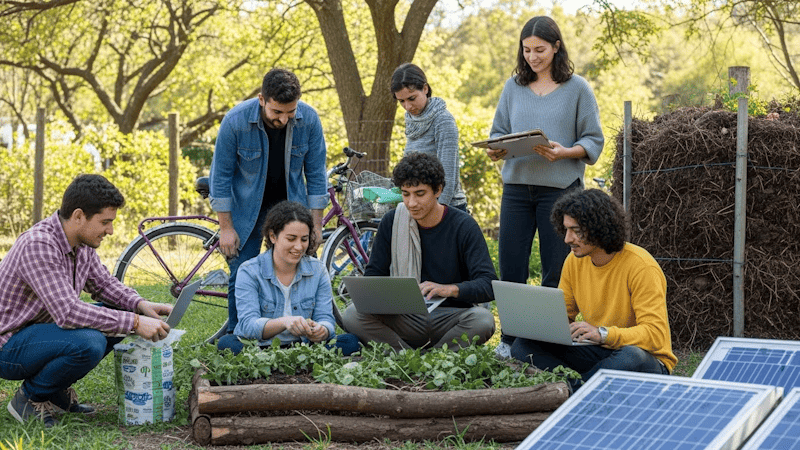
In recent years, initiatives led by young Uruguayans committed to caring for the planet have grown significantly.
Numerous projects have been launched to promote recycling, sustainable mobility, renewable energy, and, more broadly, a more comprehensive and coherent approach to sustainability.
It’s not just about creative ideas, but about initiatives that transform communities, raise awareness, and demonstrate that environmental innovation can emerge from any neighborhood, school, or work team.
Boom in sustainable projects
Youth-led environmental initiatives in Uruguay are driven by a combination of social, cultural, and technological factors.
Taken together, they have created a favorable environment for the emergence of innovative proposals.
- Greater environmental awareness among younger generations.
Both formal and informal education are increasingly incorporating content on climate change, the circular economy, and the efficient use of resources, laying a solid foundation for designing creative solutions.
- Community initiatives that encourage participation.
In many neighborhoods, local organizations, schools, and environmental groups have begun working together to create spaces where young people can present ideas, receive training, and lead activities.
- Access to digital technologies and tools.
Digitalization has been a key factor in expanding the reach of sustainable projects.
Mobile apps, social media, and collaborative platforms enable young people to expand their reach and raise awareness of their initiatives.
These factors have created the ideal conditions for new generations to get involved in issues related to recycling, sustainability, renewable energy, and initiatives that are better aligned with the Sustainable Development Goals (SDGs).

According Programme the Programme DevelopmentProgramme , the SDGs represent a global agenda to end poverty, protect the environment, and ensure human well-being.
This makes youth initiatives a key component of an international agenda that requires committed stakeholders and projects capable of making a real impact around the world.
The younger generations not only understand the climate emergency, but also embrace sustainability as part of their identity and the way they interact with the environment.
Success Story: Transformation Through Recycling
One of the simplest ways for young people in Uruguay to get involved is through recycling. The actions they can take are concrete and have a significant impact, yielding positive and immediate results.
What used to be waste is now a useful resource.
One specific example is Mare Sustentable, a company founded by Andrea Ramagli that aims to have a positive impact on the environment by reusing agricultural waste—primarily silo bags and other agricultural plastics—and transforming it into useful products.
Through sewing workshops in rural and semi-rural areas—many of which are run by women in vulnerable situations—the initiative creates dignified employment opportunities and produces sustainable products that are valued by consumers.
- In 2023, Mare Sustentable received the National Environment Award in the MSME category.
- The project also won the BiGPitch 2024 competition, which invites innovative startups from across the country to participate.
Mare Sustentable recycled more than 7,000 kg of agricultural waste, creating dozens of jobs and raising awareness about the circular economy among thousands of people.
https://youtu.be/lMbdNMZhbhw?si=1tHLq3oRsKlMZI7-
Their recycling initiative demonstrates how innovation, environmental commitment, and social responsibility can be integrated into a single project, yielding concrete and measurable results.
Mare Sustentable has become an inspiring example for those seeking to develop solutions aligned with the SDGs, particularly those related to responsible production and consumption, gender equality, and climate action.
Success Story: A Commitment to Sustainable Mobility
Sustainable mobility refers to transportation models that meet people’s mobility needs while striving to minimize environmental impact.
These strategies aim to reduce greenhouse gas emissions, optimize the use of existing resources, and promote cleaner and more accessible alternatives for the public.
A specific example of a Uruguayan company focused on sustainable mobility is TripWip, a digital car-sharing platform.
https://youtu.be/QJD8XD9J5s8?si=OTA44inzTEsdNdpA&t=23
Developed by Juan Manuel Pancic and Juan Andrés Vico, the initiative connects people who own vehicles with those who need occasional transportation.
In this way, TripWip not only makes it easier for its users to get around, but also helps reduce traffic congestion.
- Efficient use of resources: Car-sharing maximizes the use of vehicles, reducing the need to manufacture new ones and lowering the associated consumption of materials and energy.
- Positive environmental impact: By optimizing the use of existing vehicles, the platform promotes more sustainable transportation.
- Sharing economy culture: It encourages people to think of mobility as a shared service rather than individual ownership.
- Link to national policies: It aligns with Uruguay’s vision for sustainable mobility, complementing initiatives focused on efficient public transportation, active mobility, and the transition to clean energy.
In its first few months of operation, the company facilitated more than 3,000 rentals in Uruguay before expanding the platform to other markets in Latin America.
Their technology, collaboration, and environmental awareness make them sustainable models for the future.
In 2024, TripWip was selected as a finalist in the startup category of the PwC Uruguay Innovation Award.
Success Story: Environmental Awareness
Composting and the circular economy aim to reduce waste, cut emissions, and return nutrients to the soil, creating a more sustainable cycle of production and consumption.
In Uruguay, one example of a sustainable approach is Juntando Yerba, a project launched by a group of young people from the town of Pan de Azúcar, in Maldonado.
https://youtu.be/YEsomqUJuBs?si=9-2vcb0cQMlsmR4j
The circular economy initiative began at a public high school, where a group of students identified a problem with the accumulation of yerba mate and organic waste and turned it into an opportunity for learning and environmental impact.
The project involves collecting used tea leaves and other organic waste from both the school and the neighborhood, and then turning them into compost through vermicomposting.
- Better use of organic waste: Grass clippings and other plant debris are transformed into a useful resource, significantly reducing the amount of waste sent to landfills.
- Active environmental education: The project involves students, teachers, and community members, promoting sustainable habits within the community.
- Small-scale circular economy: Demonstrates how a closed-loop production cycle can be implemented and generate real environmental benefits.
Juntando Yerba was selected by UNICEF Uruguay to represent the country in the international Generation Unlimited Youth Challenge, where it stood out for its innovative approach and strong social component.
In 2021, they received a special mention from the National Environmental Award – Sustainable Uruguay, for their contribution to responsible waste management and environmental awareness in educational communities.
Projects like these, led by young Uruguayans, demonstrate that by combining creativity and motivation with sustainable practices, it is possible to develop solutions that have a positive impact on learning and the quality of life for an entire community.
Youth as a driving force for change
Throughout history, young people have led and driven movements for change, championing causes such as social justice, access to education, gender equality, and environmental protection.
According to the global analysis Young people’s climate activism, young people today stand out as the most frequent participants in environmental protests and campaigns around the world.
In Uruguay, environmental concern among younger generations is neither an isolated nor a recent phenomenon.
Since the early 2000s, but especially over the past decade, public awareness of issues such as recycling, the climate crisis, biodiversity, and responsible consumption has grown.
But how do the new generations differ from the previous ones?
- A long-term perspective: Young people understand that they will be the ones to face the direct consequences of environmental degradation, which motivates them to get actively involved in bringing about change.
- Ability to question: Historically, young people have tended to challenge traditional models—whether in consumption, production, or mobility—by proposing more equitable and responsible alternatives.
- Digitalization: The extensive use of digital tools facilitates the dissemination of ideas, collective organization, and the creation of innovative initiatives with rapid impact.
- Community engagement: Many youth-led environmental projects combine local action with a global perspective, integrating work in neighborhoods, municipalities, or schools with international goals such as the SDGs.
Today, young people in Uruguay are not only voicing their concerns, but they are also taking action.
https://youtu.be/WVuie3uOyts?si=PHpXOLqYvbalh78Y
By participating in volunteer work, launching green initiatives, and promoting awareness campaigns, they become key players in a movement for change that goes beyond the individual level.
The energy of youth has proven time and again that it can serve as a catalyst for driving change, both locally and internationally.
Today, that same spirit is focused on building a more sustainable future.
From tech startups to community initiatives and social innovation projects, young Uruguayans are proving that it is possible to drive change in recycling, sustainable mobility, renewable energy, and the circular economy.
Many of these projects originate in educational or community settings, underscoring the importance of fostering environments where ideas can be transformed into high-impact actions.
Sustainability in Uruguay is not just a passing trend, nor is it limited to certain generations.
More than just inspiring stories, these initiatives by young Uruguayans are examples that show sustainability is not an unattainable dream, but a real future for everyone.