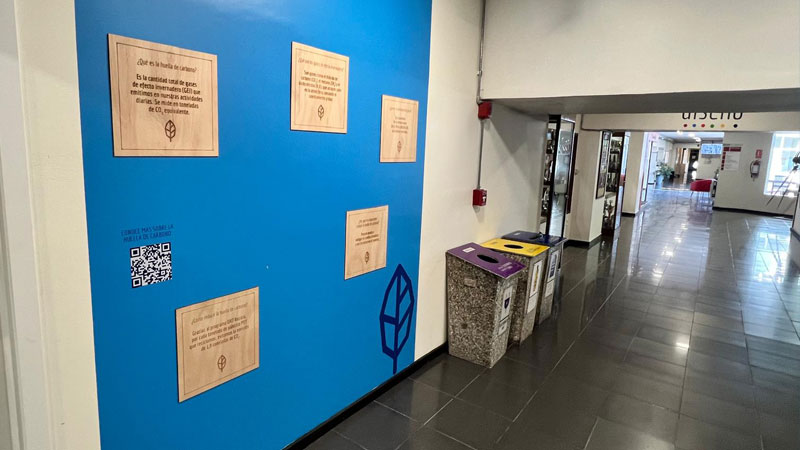
This initiative aims to inform students about the impact of their daily activities on the environment and encourage them to adopt more sustainable practices.
What is a carbon footprint?
A carbon footprint measures the greenhouse gas (GHG) emissions—particularly CO₂—generated by our activities.
Each person produces an average of four tons of CO₂ per year. To mitigate climate change, we should reduce that figure to at least two tons per year.
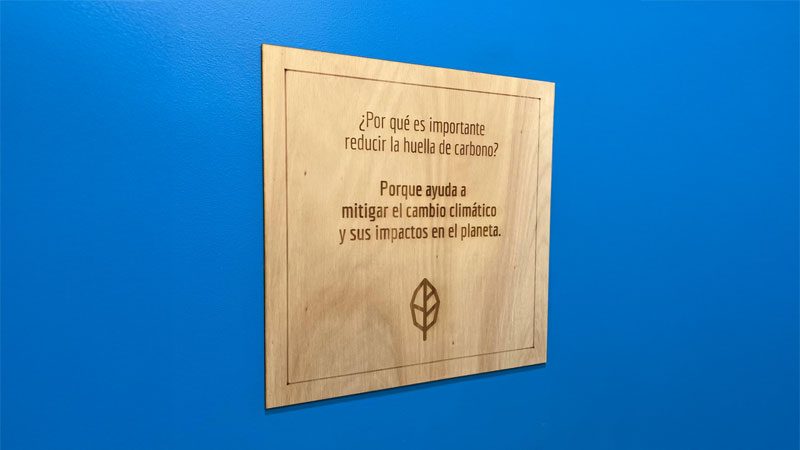
This initiative includes informational wooden signs, created in the university's industrial design lab, featuring simple messages on how to reduce our carbon footprint.
The design of the projects was carried out by Eugenia Palacio, who holds a degree in Interior Design from the ORT School of Architecture.
“I believe it is important to transform spaces with sustainability in mind in order to build a more responsible and conscious future, ”says Palacio.
Greenhouse gases (GHGs) are essential for life, but rising CO₂ emissions caused by human activity are leading to a rise in temperature, a phenomenon known as global warming.
The main greenhouse gases in the Earth's atmosphere are water vapor (H₂O), carbon dioxide (CO₂), methane (CH₄), nitrous oxide (N₂O), and ozone (O₃). CO₂ is the greenhouse gas that contributes most significantly to climate change.
A carbon footprint is measured in tons of CO₂ equivalent. This standardizes the climate impact of GHGs, making them comparable to that of CO₂.
The local impact of climate change
Global warming, caused largely by the burning of fossil fuels and excessive consumption, has raised the global average temperature by more than 1°C in recent decades.
In Uruguay, the average temperature has also risen by 1°C, with a 10% increase in extreme rainfall events over the past 60 years.
These changes affect biodiversity, agriculture, and people’s quality of life, underscoring the importance of reducing our emissions.
Small actions, big results
Each presentation includes information on carbon footprints and outlines specific actions to reduce both individual and collective impact.
"Environmental issues must be addressed with a global perspective, but with concrete actions at the local level," says Tiscornia.

At the university, the ORT Recicla program helps reduce CO₂ emissions:
- For every ton of recycled paper, 1.5 tons of CO₂ emissions are avoided.
- In the case of PET plastic, the reduction amounts to 1.8 tons of CO₂ per ton recycled.
- In addition, recycling one ton of electronic waste prevents the emission of 1.5 tons of CO₂.
Since 2004, for every university graduate, a tree has been planted in an Israeli forest, helping to capture CO₂ and mitigate climate change.
This project is being carried out in collaboration with Keren Kayemet LeIsrael (KKL), a nongovernmental organization dedicated to environmental protection.
On a personal level, choosing sustainable modes of transportation, such as walking or biking, significantly reduces our carbon footprint.
Reducing our carbon footprint
The benefits go far beyond reducing emissions: adopting a sustainable lifestyle helps preserve ecosystems, which provide clean air, water, and essential natural resources.
Reducing, recycling, and reusing contribute to a circular economy, reducing the strain on natural resources.
Commitment to the Future
Universidad ORT Uruguay is committed to environmental education and to engaging its entire community in the fight against climate change.
By putting up these signs, the school encourages its students to reflect and take action, because, as the campaign’s messages emphasize: “The footprint we leave on the planet shouldn’t be one of carbon.”