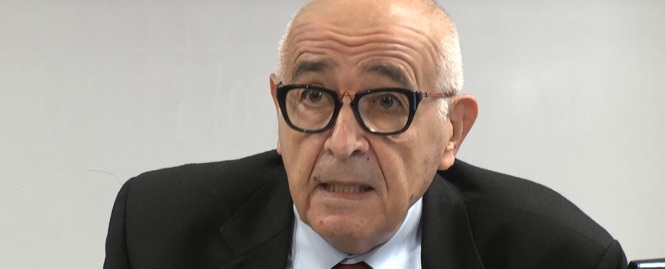
Dr. Oded Balaban delivered a lecture titled “Democracy, Liberalism, and Tolerance.” Balaban, who holds a Ph.D. in Philosophy from Tel Aviv University, is the author of numerous publications on epistemology as applied to the history of philosophy, and has been awarded the Technion’s Prize for Teaching Excellence a dozen times. At the lecture, which took place on October 29, 2013, in the auditorium of the School of Management and Social Sciences, Balaban spoke on the philosophical foundations of democracy. The event was organized by the Department of International Studies.
According to Balaban, “democracy is the only social and political system that acknowledges it has no source of legitimacy.” This is because, in a democracy, what matters most are not ethical or strictly political arguments, but the vote—an act that can be considered eminently “irrational” from a philosophical perspective, the professor noted. The vote is an “invention,” a formal method for collective decision-making. And from there, whatever the majority voted for is done, regardless of whether the arguments are rationally demonstrable, Balaban explained.
However, the fact that democracy has no source of substantive legitimacy does not mean that it is not legitimate, the professor clarified. Democratic laws have no source of legitimacy because their validity is derived from the majority vote. The weight of the majority constitutes a factual reality opposed to the legitimacy derived from values. In short, laws have a legitimacy based on facts, in the sense that they exist because the majority voted for them and not necessarily because they are based on values. According to the philosopher, “what exists—that is, what the majority voted for—is not what is legitimate.” “It is a conservative way of thinking to believe that what is, must also be,” said Balaban. Hence, “philosophers ask themselves what the validity of the notion of a majority is,” explained the professor.
The problem is that if values alone were the source of legitimacy, “there would be no democracy”: we would have to abandon voting because it is an “irrational” act, and experts in values would have to govern through “competition,” as Plato proposed, the philosopher said.
As “democratic consciousness” evolved, limitations were imposed to prevent a tyranny of the majority, Balaban explained. This “self-restraint” of democracy is called “liberalism,” he said. According to the professor, liberalism is a “counterpart” to democracy. “Both are opposing concepts but necessary because one without the other would be an aberration,” he argued. They are incompatible concepts because in democracy, theoretically, whatever the majority decides is done.
When limits are set for the majority, the question arises as to what those limits should be and how they should be determined. The question is how democracy can defend itself against tyranny that comes to power through democratic means, as Nazism did, the philosopher explained. That is where the limits come in. “Accepting values I do not share is part of democracy, but the question is to what extent they should be accepted,” he said. “If we must seek limits, philosophy can help establish a typology, a scale between basic values and those that approach the sublime.” A basic value is not to kill, he noted. It is basic because one condemns those who do not accept the prohibition against killing, but one does not praise those who do not kill. A sublime value, for example, is risking one’s life to save a shipwrecked person: one who does so is praised, but one who does not is not condemned, Balaban illustrated. On that scale, not all values have the same level of acceptance and rejection. “What democracy must not do is stray from basic values and be overly permissive and tolerant of values that tend toward the sublime,” said Balaban. For example, “if one is too permissive with sublime values, situations may arise where, in the name of diversity, I deny medical care to indigenous tribes and leave them at the mercy of traditional healers to respect their nature,” the philosopher explained.
https://youtu.be/lrnPZanN2kU?si=-74djg4YHzvIA7n9