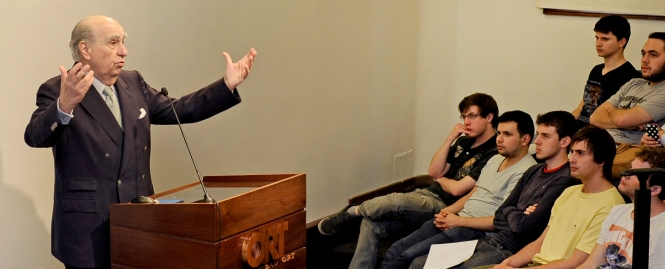
Dr. Julio María Sanguinetti, a two-time President of the Republic, delivered a lecture titled “The Formal Guarantees of Democracy,” in which he discussed the characteristics and challenges of today’s liberal democracies. The lecture took place on Tuesday, October 8, 2013, in the auditorium of the School of Management and Social Sciences, and was organized by the Department of International Studies.
Sanguinetti began by reviewing the historical circumstances that have shaped today’s democracies. Following the fall of the Berlin Wall, the market economy and liberal democracy “emerged triumphant,” Sanguinetti said. This milestone marked the “end of history,” an expression coined by American political scientist Francis Fukuyama to signify that the dialectic between communism and capitalism had come to an end, the former president explained. The United States remains the leading power, but China is now emerging as a major power, Sanguinetti added.
Since the fall of the Berlin Wall, “liberal democracy has struggled to take root and is grappling with the consequences of the knowledge and information revolution,” he observed. “Today, industry is no longer seen as the hallmark of development. It is other factors—such as patent ownership or the formulas for this or that medication—that define a developed country. The concept of wealth and property has changed,” he noted.
With the advent of television and the internet, the concepts of parliamentary mediation and political party representation have changed, the former president explained. Polls “undermine the representativeness” of democracy by seeking to replace elections, and the media can either propel or destroy candidates, he said. Added to this is the fact that families, the foundation of democracy, have become more unstable. The same has happened with employment. There are more opportunities for advancement, but it is more “precarious,” said Sanguinetti. The technological revolution, however, has a positive side, because it brings unprecedented opportunities, he explained.
According to the former president, democracy is liberal “because it is not just about voting, but is imbued with rights.” This, he noted, has been controversial for better or for worse. For Marxism, liberal democracy was an “empty shell” through which neither freedom nor prosperity could be attained, but history has shown that Marxism failed to achieve those goals. History, on the contrary, has shown that “liberal democracy puts food on the table,” said Sanguinetti. There are also positive critiques of democracy that argue it should be a concept enriched beyond the legal sphere and should incorporate values such as the fight against consumerism. On the other hand, when business and labor corporations encroach on democracy, the system moves closer to fascism, he said. Corporations shape public opinion but must not usurp public power.
“In Latin America, within popular democracies, there are governments led by a ‘messianic leader of the nation’ who stands above institutions but uses the state to bolster his image. These leaders mobilize the people in public squares and do not use parliament to engage with society,” said Sanguinetti. “And that is where the formal guarantees of democracy begin to take on greater significance,” Sanguinetti opined. “There is no democracy without elections, but democracy does not end there. There must be separation of powers and respect for rights. Those are the guarantees of democracy,” he concluded.
https://youtu.be/EOWkJ2N7xwI?si=jYZtUPJrDox-KGls