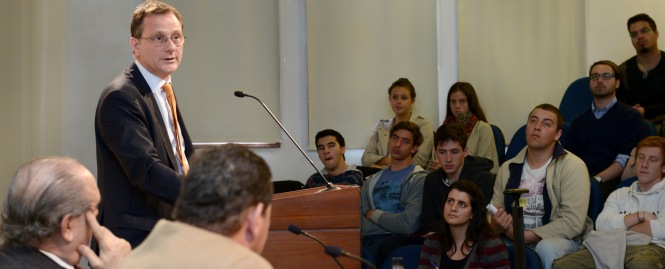
The lecture titled “Global Competitiveness Report: An Introduction to Its Methodology and Interpretation of Its Results” took place in the auditorium of the School of Business and Social Sciences. The event, organized by the Department of International Studies, was held on October 1, 2013. It was led by economist Isidoro Hodara and certified public accountant Bruno Gili. Both experts, who are professors at the faculty, compile the information regarding Uruguay for this World Economic Forum competitiveness report. Hodara, who has been performing this task for 12 years, noted that “at that time, Uruguay did not have a clear definition of its strengths and weaknesses, so it was worth the effort” to include the country in this report.
Gili, for his part, explained that the report aims to measure growth potential based on the factors that determine it. These institutional, political, and economic factors determine the country’s productivity. The report is based 75% on surveys of the business sector and the remainder on “hard” economic data. From there, an index ranging from 0 to 7 and a competitiveness ranking are developed, Gili explained. The report is based on three pillars. The first, which includes the “basic requirements,” consists of institutional quality, the macroeconomic environment, health, and primary education. The second pillar groups together the “drivers of efficiency,” such as the quality of higher education and training, the efficiency of the goods, labor, and financial markets, technological readiness, and market size. The third pillar consists of sophistication and innovation.
In light of the research findings, “Uruguay is in a transitional phase toward the development stage. But to reach that stage, it must focus on sophistication and innovation,” said Gili. In the latest edition of the report, Uruguay dropped in the rankings, but its score remained the same because other countries became more competitive and advanced faster than Uruguay, Gili explained. This, the accountant noted, should not be interpreted as one country being better than another, but rather as how and by how much that country improved from its previous position in the rankings.
Uruguay ranks first in Latin America in terms of GDP per capita, but lags behind in labor market efficiency. There is “little room for decision-making” due to a shortage of skilled labor, Gili said. From 2006 to 2013, Uruguay improved its macroeconomic stability, although it faces some challenges, such as a high fiscal deficit. At the same time, the financial market is underdeveloped. In terms of innovation, it ranks average. However, this factor is the one most critical for Uruguay to advance to the next stage of development. For Hodara, factors such as the shortage of skilled labor and the lack of innovation are “structural” in Uruguay’s competitiveness, because they have remained unchanged for years. “They become permanent attributes, so we cannot expect them to change from one year to the next.”
https://youtu.be/9wiiyWmsylk?si=svJB7K04NojfuIh8