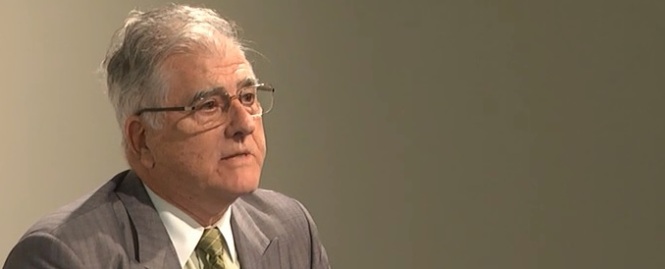
On November 11, 2013, the lecture “40 Years Since the Treaty of the Río de la Plata” was delivered by Dr. Edison González Lapeyre, professor of Diplomatic and International Law at the University of the Republic and former Uruguayan representative to the CARP (Administrative Commission of the Río de la Plata) and the CARU (Administrative Commission of the Uruguay River). During the talk, organized by the Department of International Studies, González Lapeyre reviewed and analyzed the historical circumstances that led to the signing of the binational treaty in 1973. The negotiations, in which the professor participated, lasted three years.
According to the expert, since the Preliminary Peace Convention of 1828, “the issue” of the borders with Argentina “has never been clear.” Without a clear definition of the borders, the early 20th century saw situations of “great tension,” even more serious than those currently surrounding the conflict over the UPM pulp mill. The level of tension was such that the Argentine navy conducted exercises off the coast of Montevideo, González Lapeyre reported. The Argentine Foreign Ministry, at that time, upheld the “dry border” doctrine, according to which Uruguayan jurisdiction began only “when one set foot on Pocitos Beach,” the professor explained.
The situation of uncertainty changed when Argentine President Roque Sáenz Peña attended a South American Congress on Private Law held in Montevideo in 1889. There, he befriended the event’s organizer, the Uruguayan diplomat Gonzalo Ramírez. Faced with this “contentious” situation, the “Ramírez-Sáenz Peña Protocol” was signed on January 5, 1910, at Ramírez’s home, establishing a status quo in the Río de la Plata, explained González Lapeyre.
From that point on, Argentina consistently maintained that the deepest channel of the river should remain under its jurisdiction, while Uruguay argued that the river should be divided along a “midline.” In 1969, sediment carried by the Uruguay and Paraná rivers formed a sandbar around Martín García Island, the sovereignty over which became a source of tension between the two countries. Uruguay always maintained that the island and the islet fell under its jurisdiction, but the Argentine foreign minister at the time, Nicanor Costa Méndez, ordered naval riflemen to be stationed there. Faced with this threat, the Uruguayan general stationed there, Timoteo Domínguez, was forced to withdraw, according to González Lapeyre.
The episode demonstrated that negotiations over the Río de la Plata were conducted by politicians who were unwilling to “make concessions” and operated in a “soccer-match” style, the expert noted. Beginning in 1970, there was a shift toward the formation of technical teams to negotiate the use of the Río de la Plata. The issue of Martín García Island remained a point of contention. In the treaty negotiations, Argentina never relinquished sovereignty over the island due to its historical significance: among other events, Domingo Sarmiento wrote his work Argirópolis there. Uruguay, for its part, claimed that all the islets formed by sediment fell under its jurisdiction.
This was set forth in the Treaty of the Río de la Plata, which was finally signed in 1973: Martín García was Argentine territory enclaved within Uruguayan waters, but all the islets formed by sedimentation belonged to Uruguay. The islet was named Timoteo Domínguez, in honor of the general who was forced to withdraw.
“On the maritime front, the agreement met Uruguay’s highest aspirations,” said González Lapeyre. A midline division was agreed upon, but a common fishing zone was also established that extends beyond the midline and reaches as far south as the province of Buenos Aires. This is of great economic importance due to the area’s fishery resources, explained González Lapeyre. These concessions sparked controversy in Argentina, where it was argued that the treaty was unconstitutional.
“Forty years have been sufficient proof that the treaty is an instrument that prevents conflict,” said the professor, adding that the treaty “came about due to a favorable political climate.” From his exile in Madrid, Juan Domingo Perón expressed his willingness to resolve border issues, and when he returned to Argentina, he gave the order to move forward with the agreement. On November 19, 1973, he traveled to Montevideo to sign the agreement at the Palacio Estévez. Perón was cheered in the streets by the Uruguayan people, the professor recalled. “What matters are not the rules, but the spirit of fraternal relations between peoples,” Perón said during the ceremony, González Lapeyre recounted. “If it weren’t for Perón, the treaty would not have been signed,” the expert opined.
https://www.youtube.com/watch?v=Qqa2XWqpjiE