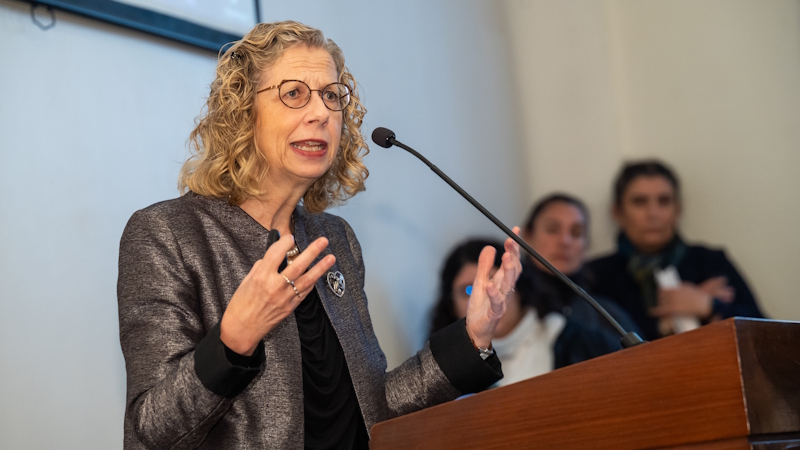
During the conference titled “Global Crisis: Challenges and the Role of Professionals,” Andersen not only shared compelling data on climate change, biodiversity loss, and pollution, but also encouraged students to think beyond their careers and degrees and embrace a sense of global responsibility.
The event took place on Monday, June 16, at the Pocitos Campus. The opening remarks were delivered by the Vice President for Academic Affairs, Dr. Pablo Landoni, and the Associate Dean for Academic Affairs of the School of Management and Social Sciences, Dr. Nicolás Gambetta.
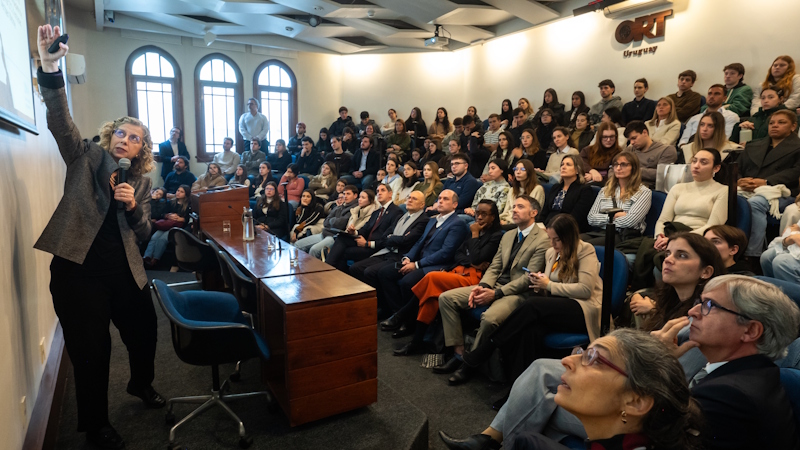
In a packed auditorium, the event was marked by the participation of students who were interested in and concerned about the issues raised. In fact, Andersen welcomed the presence of so many young people in the room and highlighted the importance of the questions they asked.
In this brief interview, the expert—who has worked for organizations such as the World Bank and the International Union for Conservation of Nature (IUCN)—outlined the scale of the current global crisis, discussed her greatest concerns, and shared a message for students and professionals who want to make a difference.
https://youtu.be/nDMLyKnuKxM?si=BXes8IzJy5UrjyqA
The triple global crisis
The conference addressed three key issues that Andersen referred to as “the triple planetary crisis”:
- Climate change, which threatens the stability of the system that made human development as we know it possible.
- The loss of biodiversity, which threatens the very foundation of our food supply, health, and ecosystem balance.
- Pollution—both visible and hidden—that affects everything from the air to the oceans.
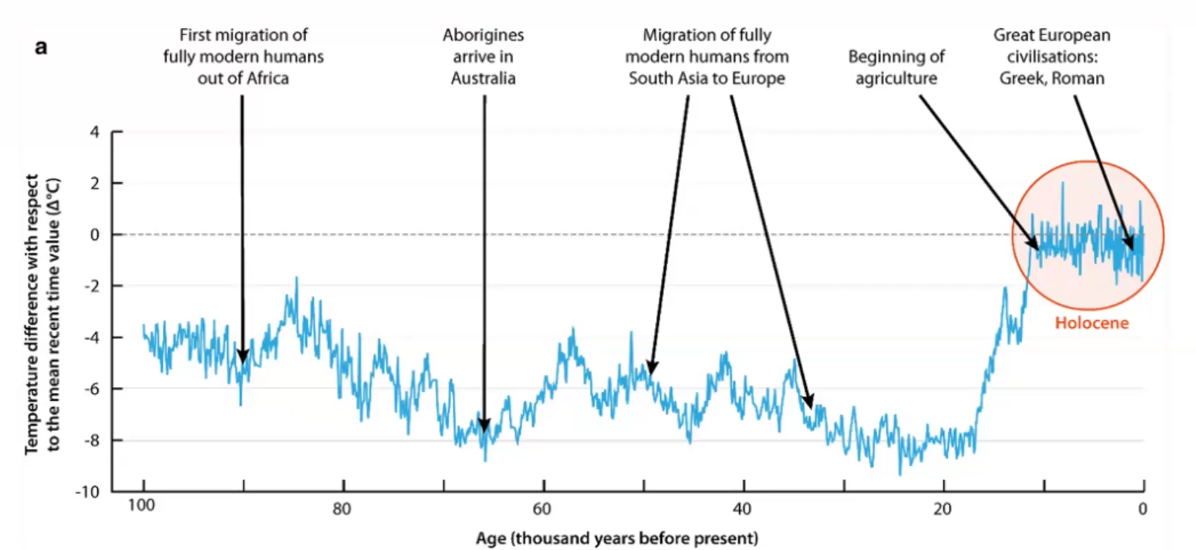
Using compelling images and data, Andersen traced a timeline from 100,000 years ago to the present day to show how the relatively stable climate of the past few millennia made agriculture, civilization, and, ultimately, our lives as we know them possible.
Andersen pointed out that “nature is generous,” but for centuries, humanity has believed it to be inexhaustible. “We have drawn on it to produce human capital, physical capital, technology… and now natural capital is paying the price.”
We did all of this ourselves. It’s not happening because of some external factor. That’s why it’s important to understand what our own role is in what’s happening.
Inger Andersen, M.S.
The Danish economist and environmentalist, with over 30 years of experience in sustainable development, added that humans are the only species that does not live in harmony with its environment. “Everything in nature is recycled: a tree sheds its leaves, they decompose, and become soil. An animal dies, and another eats it. But we leave behind toxic pollution. We are the only ones who do that.”
Understanding the world to lead effectively
What does it mean to be a professional in a world in crisis? The world we thought we lived in no longer exists. And his message was clear: no form of business, scientific, or social management is possible without a deep understanding of natural systems. Every decision matters. Every person counts.
How can we lead if we don't understand the air we breathe?
Inger Andersen, M.S.
In light of these challenges, the curriculum of the School of Management and Social Sciences has included topics related to sustainability and the triple bottom line (environmental, social, economic, and governance) for more than five years, according to Dr. Nicolás Gambetta, head of the Corporate Sustainability Chair and academic vice dean of the school.
Everything that was said at the conference is exactly what we cover in class; it reaffirms that we are on the same page and discussing the topics that need to be discussed in the classroom.
Dr. Nicolás Gambetta
Experts such as Catherine Richardson, PhD—a researcher in ecotoxicology and environmental health—and Johan Rockström, PhD—director of the Potsdam Institute for Climate Impact Research—warn that we have crossed several planetary boundaries, that is, the limits within which humanity can safely operate:
- We are overfertilizing the soil and polluting the water.
- We are losing species at an irreversible rate.
- We are causing critical changes to ecosystems, such as the Amazon.

In turn, the UN Environment Emissions Gap Report shows that current emission reductions are mathematically insufficient. The pledges are, at best, symbolic.
“Everything is connected to everything else.” With this statement, Andersen highlighted one of the key ideas of his lecture: the interdependence of natural and social systems in the face of the environmental crisis.
-
The Risks of Pesticides
The issue of pesticides was also on the table: “We need to eliminate the highly dangerous pesticides we use in our agriculture for the foods we actually eat. And, of course, that has a major impact. We’re not against pesticides altogether, but there are some that we know are very dangerous.”
The urgency is clear, and the deadlines have been set: 2030 to stop exporting banned substances and 2035 to phase out the most toxic pesticides entirely.
-
Climate justice
One of the central themes of his speech was inequality in the face of climate collapse. Andersen compared the situation of Pacific islands that are disappearing due to rising mar levels mar that of countries like the Netherlands: “It’s not like the case of the Netherlands, which faces the same problem but has invested millions because it has a stable economy and has undertaken megaprojects to mitigate the impact.” While some nations can hold out, others are forced to migrate.
Full recording of the “
” conference: “Global Crisis: Challenges and the Role of Professionals”
https://youtu.be/4_p4HFLPKto?si=1phhCyA7FVpQ_XBy
Sustainability in Action: ORT's Proposal
Universidad ORT Uruguay an active culture of sustainability: through its ORT Recicla program, it encourages recycling, energy efficiency, sustainable mobility, and responsible procurement, while also offering academic courses that cover these topics.
We work hard to raise students' awareness and minimize waste generation, as well as to ensure the proper handling of chemical and biological products.
Inés Tiscornia, M.A.
Deputy Coordinator of Environmental Management at ORT
ORT is the only Uruguayan university included in The Impact Rankings, the global ranking compiled by the British magazine Times Higher Education that recognizes universities with the strongest commitment to areas such as environmental stewardship, equity, and economic and social development.
The university performed particularly well in SDG 12: Responsible Consumption and Production, ranking among the top 201–300 universities worldwide with a score of 69.4 out of 100, and achieving a perfect score (100) for the publication of sustainability reports.
Through its School of Management and Social Sciences, ORT has been a member of the Principles for Responsible Management Education (PRME) initiative since 2017. In that context, in early June, the academic vice dean participated in RME Week 2025: A Global Call to Action for Responsible Management Education in New York, an event organized by Cornell University.
During PRME Week, the PRME Global Forum was held, an annual event where best practices for incorporating the triple bottom line into curricula are discussed. Also during this week, the AACSB Societal Impact Curriculum Workshop, organized by AACSB, took place. This highly practical and interactive workshop provided faculty with the time, tools, ideas, and partners they need to effectively incorporate social impact concepts into their programmes .
ORT's commitment to sustainability is nothing new. In 2022, the university received the National Environmental Award from the Ministry of the Environment.
The award, presented in the Tertiary and University Education category, was granted in recognition of the development of the Sustainable Development Monitor in collaboration with DERES. This tool helps companies measure their progress in generating a triple impact through seven indicators.
On June 9, a group of ORT graduates gathered on the terrace of the Hampton Inn hotel, right in the heart of Times Square, to share their career paths. The gathering, attended by Dr. Gambetta, was an opportunity to reflect on what it means to build a career from Uruguay out into the world. These graduates stand out for their careers in innovation, sustainability, and global impact, demonstrating that ORT trains professionals who generate a triple impact on a global scale.
All of this demonstrates that Universidad ORT Uruguay , without a doubt, a key player not only at the local level but also internationally, as it is part of the most significant global partnerships in sustainability and is training future professionals to address the triple planetary crisis, about which Inger Andersen has warned us and raised our awareness.
Dr. Nicolás Gambetta