https://www.youtube.com/watch?v=oOC-wRga6Cg
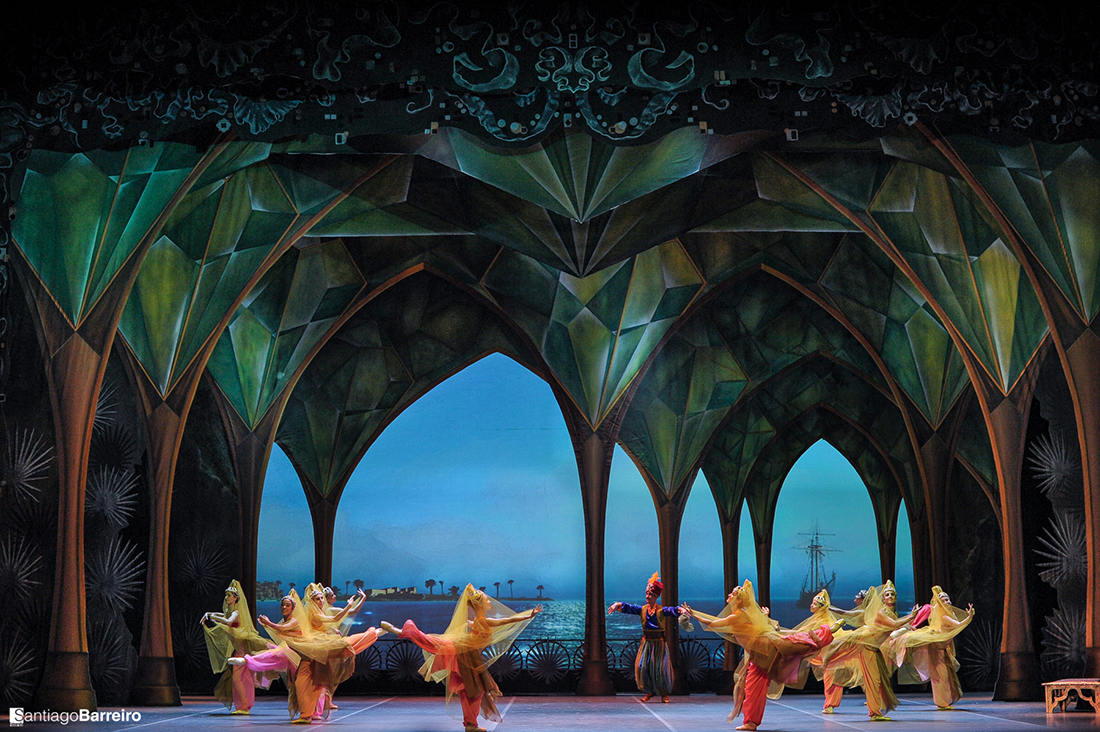
In September 2016, the Hong Kong Ballet decided to hire you to design the costumes for *Le Corsaire*. That meant you had to start from scratch, with almost no budget constraints, to create the costumes. The ballet premiered in October, and a week ago you were honored for your work. How would you sum up the past year?
It was a process that was full of adrenaline and tension due to the deadlines, but also because of the excitement and the novelty of it all.
It’s been a very intense year—I wouldn’t call it “successful”; many people have really enjoyed it, there are a lot of happy people, and there’s a huge team behind the scenes. Even though the design was the one nominated, what actually came together was a show that involved a lot of people.
An institution like the Hong Kong Ballet hired someone they didn't know, based on recommendations from Julio Bocca and choreographer Anna-Marie Holmes. They were very pleased with the outcome because the production received seven nominations, four of which were related to my work.
It has truly been a wonderful, heartwarming year, filled with affection and recognition from people.
Although you traveled there to oversee the project, most of the work was done remotely. How did you handle that?
Working remotely isn't easy, especially when there are details that aren't purely technical—they involve fitting, proportions, and adjustments; it's not like industrialized production, where you send a sample and then check it. That's not the case here: you rely heavily on the body, on the person who will be wearing it. That's why you have to start well in advance—about 15 to 18 days before the fitting—to do the fittings and make adjustments.
The set design, on the other hand, was actually created in Uruguay: the Hong Kong Ballet commissioned 16 hand-painted backdrops from Sodre. You were able to follow that process closely.
Yeah, step by step. That was great because I could make corrections. Day by day, you see how things are going and keep an eye on them; doing it remotely would have been really difficult.
What was it like to see the ballet live?
You’ve been working on it during rehearsals; you watch it, it gets cut, and you start over. You’re not seeing the film for the first time—you’ve seen it in bits and pieces, and you’ve been part of the revisions…
It's kind of a shock. The most exciting part is when it ends. I couldn't help but watch the dancers who had performed here. It was truly fantastic. Such nice people—everyone was so enthusiastic and grateful. It was really lovely and moving.
You said that throughout the process, things happened that you didn't expect. Maybe the nomination was something you didn't expect.
The thing is, I didn't even know there was an awards program. We received an email informing us that the Hong Kong Ballet had submitted its production, *Le Corsaire*, for the Hong Kong Dance Awards. They asked us for photos and an updated résumé. Then we heard the news about the nomination.
It was kind of strange. It was so far away, I didn't even know it existed… So that's when I decided to go. I said, “I want to be there because, as a company, they took a chance on this project and were satisfied with the results.” They were very happy to have us, and even happier after they won the award.
Did you know the other nominees?
Before I went, I looked into what kind of performances they were. There’s a thriving dance scene in Hong Kong; the East has a very strong dance tradition, and there’s a wide variety of shows—traditional, new, and combinations of modern and contemporary dance. I couldn’t help but want to know who they were and why… their names were unpronounceable.
I was looking at a few things. Some were more tech-oriented, heavily focused on filming and visuals—quite different; performances on a much smaller scale, with two or three dancers in a much more confined space, on a five-by-five-meter stage, things like that. A world of imagery, screens, projections, of that dance in a small space interacting with a projection, creating worlds; quite different.
And *El Corsario* is a show set within a 10 x 10 x 10-foot box; it’s a massive production with a large cast. The dynamics are much larger, more complex, and longer-lasting. There are many different combinations of elements, and as a result, the work is fascinating.
How was the awards ceremony?
The ceremony was the day after I arrived, so I only had time to socialize a bit and attend a few rehearsals—I was interested in seeing them—for some shows they’re developing. They work a lot with technology, lighting, and motion sensors.
The ceremony kind of happened out of the blue—it all went by so fast. I was in the second category, so they announced the award and that was it, and there I was, sitting there for another hour and a half, dying to go out and celebrate, but I couldn’t—I just had to sit there quietly. Plus there’s the language—I didn’t really understand much. Some people next to me told me, “It’s you.” In the moment, you’re kind of dazed; there’s a lot of confusion. But anyway, here I am—it’s over.
Is it over, or is it just beginning?
It's difficult. What happened is the result of the ripple effects of Julio Bocca's work and the arrival of choreographers from abroad. Anne Marie Holmes is a Canadian choreographer with a very extensive body of work who is in demand all over the world. She had a project in Hong Kong; she had just finished this one here and was satisfied with it.
Unless someone from the other side of the world comes here to work and sees the results, it’s unlikely that this experience will be repeated.
They were very happy; hopefully we can work together again. Sodre also emerged as a potential provider for other projects that don’t necessarily have to be done here, but could be designed by someone else in another part of the world; that would be great.
"Le Corsaire " is being revived on May 17 at the Sodre Auditorium. Is this because of everything that's happened?
No, it was part of the schedule. It just happened to coincide, which turned out to be great publicity. Even though the tickets had already sold out, there were still a lot of people eager to see it; the audience is always changing, and there’s a lot of enthusiasm.
I don't like watching it again because I start spotting things that need fixing… In Hong Kong, I'd see things and say, "We can tweak this," and we did. Color corrections, line corrections, shape corrections. When I got here, I said, "I want to change something about the costumes because that's how I did it over there"… and then I said, "No; it's going to be exactly like the original—we're not going to change a thing."