On November 1, 2005, the United Nations General Assembly decided to designate January 27 as the annual International Day of Commemoration in Memory of the Victims of the Holocaust.
This year, that commemoration was particularly moving, thanks to renewed displays of empathy and courage—which were highly creative in much of the world—despite the difficulties caused by the global spread of COVID-19 and the resulting restrictions. Below are two models used by Dr. David Serrano Blanquer this year in Barcelona.
Charlotte de Grünberg
General DirectorUniversidad ORT Uruguay
Universidad ORT Uruguay
In Commemoration of International Holocaust Remembrance Day
Text by David Serrano Blanquer, visiting professor at Universidad ORT Uruguay director of the documentary*Giza, the Girl in the Suitcase*
How can we commemorate a date like this in times like these? What is the best way to remember, denounce, and prevent the evils of totalitarianism?
The truth is that these are questions with no easy answers, but the one thing that’s clear is that we have to be proactive, get down to work, and pitch in—no matter what it takes, but we have to pitch in.
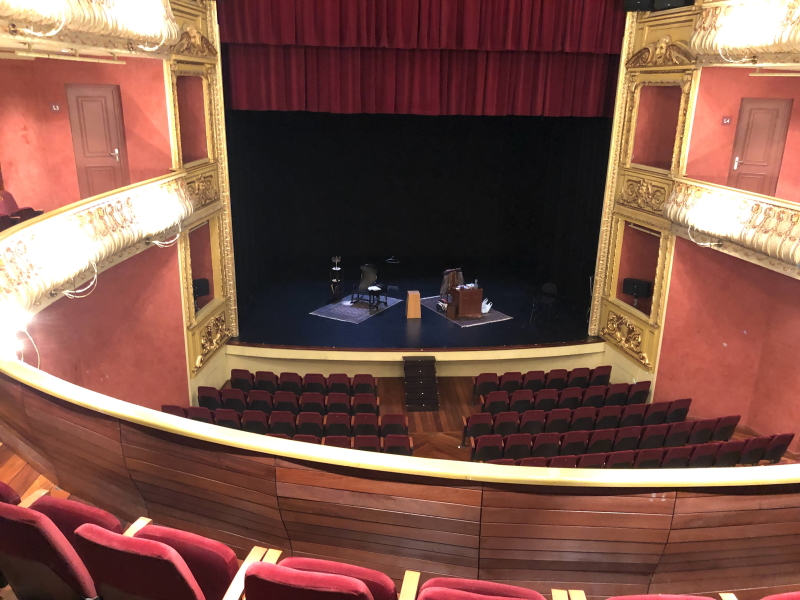
The first screening took place in the stunning Modernist theater known as the Ateneu de Igualada (a town near Barcelona, known for its exquisite leatherwork and dyeing techniques since the Middle Ages), where we screened the documentary made possible Universidad ORT Uruguay Ramón Llull University of Barcelona, *Giza, the Girl in the Suitcase* (Best Documentary Award at the Punta del Este Jewish Film Festival, 2014).
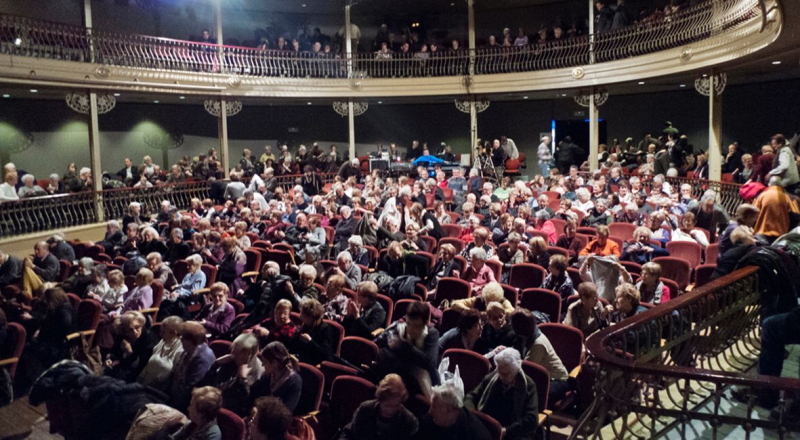
It is a stately building dating from 1878, with a ground floor and two floors of beautiful boxes, where Margarita Xirgu premiered García Lorca’s “Yerma” in 1935. With an enthusiastic audience of over 300 filled seats (the maximum allowed due to COVID-19 restrictions, despite the waiting list), an overwhelming silence filled the theater throughout the 49 minutes of the captivating story of Giza and Danusia, two beautiful women who demonstrate their courage in facing the most extreme situations anyone could imagine.
Two women who symbolize resistance and the struggle against barbarism, against oblivion, and against the repetition of horror. Afterward, the open discussion with an enthusiastic audience was very intense and profound, until Giza finally appeared on screen to speak with them. There was initial commotion and fervent applause, with people standing up. Emotion, more applause, tears—a flood of emotions that continued with up to three more rounds of applause.
And I am convinced that the legacy of these women is one we cannot afford to miss, because they clearly show us the path forward with their unwavering commitment to justice. I still remember Danusia’s last hug in Warsaw two months before she left us—her strength, her humility, and her piercing, mischievous gaze. I left in tears; I knew she would be gone soon, but I had had the honor of meeting one of the bravest women I have ever known. Giza continues to guide me, and she always will; the countdown is on until we can embrace again—something COVID-19 is currently preventing us from doing.
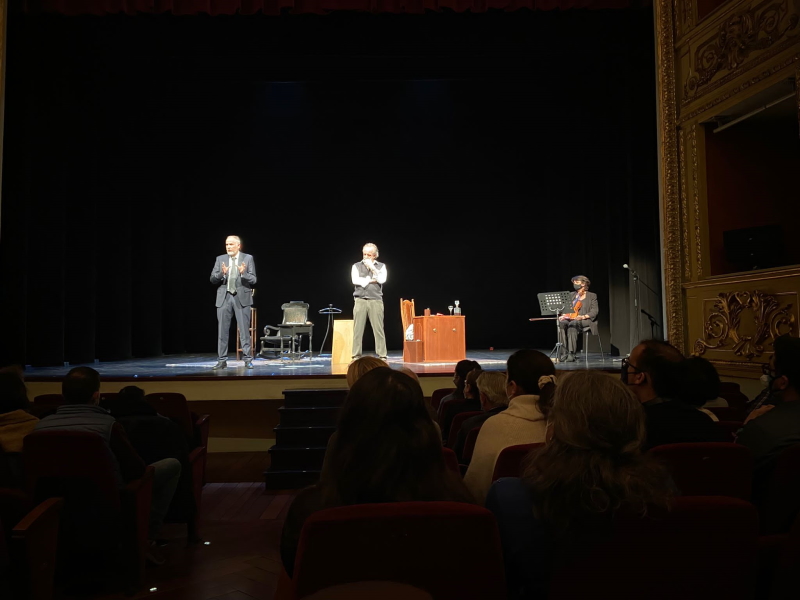
The second event took place on the same day, the 27th, at one of Catalonia’s oldest theaters, dating back to 1839, with a stalls section and three luxurious tiers of boxes: the Teatre Principal in Sabadell, where I organized a tribute to the victims and survivors through art and literature, featuring an adaptation of a prescient, courageous, and exemplary novel by another great woman, Katherine Kressmann Taylor, *Paradero desconocido*.
In 1938, Kressmann Taylor dared to show what would happen in Europe and around the world if what was beginning to take shape in Germany were to prevail. She had to do so under a male pseudonym in order to be heard. It was a warning—a warning that American society needed to heed. I had carried that text in my heart for many years, and it was precisely when my heart failed—exactly three years ago—that I decided I had to bring that text by that third great woman to the stage.
And not only that, but I had to do it myself, stepping into the suit and into the shoes of Max Eisenstein, a German who watches as his country and his people subtly but inexorably succumb to the destructive force of a brutal movement. He witnesses this from San Francisco, in the United States, where he has built up an art import business alongside his German childhood friend, Martin Schulz (Josep M. Roviralta), who in 1932 decides to return to Germany with his family.
From that point on, everything changes. What a talent Kressmann Taylor has for making us see that change in the world through the simple words captured in the letters exchanged over the course of barely a year by Max and Martin—Martin and Max! Friendship, love, solidarity, trust—everything, absolutely everything, is turned upside down even before a war that is not yet on the horizon has even begun.
A fast-paced story, full of mounting intrigue that draws the audience into a whirlwind of emotions—captivating them through the spoken words and the magical violin of Canòlich Prats, a violinist with the Orquestra Simfònica del Vallès, whose playing conveys the evolution of the two characters and the emotions the audience experiences. As a viewer, the silence is filled with moving words; as an actor, the spoken words spring from the depths of the heart.
We formed the Som-2 theater group to bring this play to the stage, and for that reason alone, the journey was worth it; we’ll keep taking it to theaters and schools as long as our voices and music allow us to.
Watch the documentary *Giza, the Girl in the Suitcase*